How do they differ?
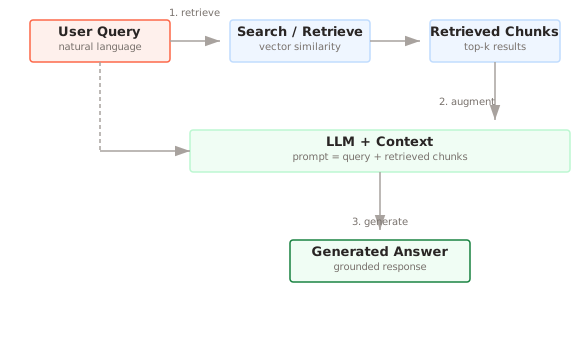
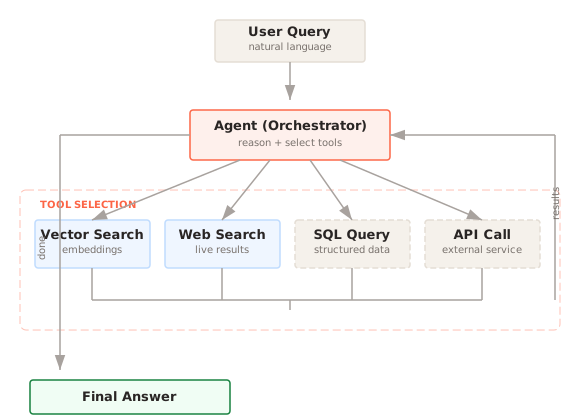
Basic RAG and Agentic RAG solve the same fundamental problem, giving a language model access to external knowledge, but they solve it in very different ways. Basic RAG is a pipeline. A query goes in, documents come out, the model generates an answer. The path is fixed and predictable. Agentic RAG puts an agent in control of the retrieval process. The agent decides what to search for, evaluates the results, and can search again, reformulate queries, or pull from entirely different sources based on what it finds.
The distinction is not just architectural. It changes the kinds of questions your system can answer. Basic RAG handles questions where a single retrieval step returns the relevant information. "What is our refund policy?" or "Summarize the Q3 earnings call." Agentic RAG handles questions that require the system to decompose, explore, and synthesize. "Compare our pricing strategy across the last three quarters and highlight where we deviated from competitors."
| Dimension | Basic RAG | Agentic RAG |
|---|---|---|
| Architecture | Fixed pipeline: embed, retrieve, generate | Agent loop: reason, retrieve, evaluate, repeat |
| Retrieval steps | Exactly one | One to many, determined at runtime |
| Query handling | Uses original query (possibly rewritten once) | Decomposes complex queries into sub-queries |
| Source flexibility | Single vector store or search index | Multiple sources: vector stores, SQL, APIs, web |
| Latency | Low and predictable (one retrieval round) | Higher and variable (multiple rounds possible) |
| Cost | Lower (fewer LLM calls) | Higher (agent reasoning + multiple retrievals) |
| Predictability | High. Same query produces similar results. | Lower. Agent may take different paths. |
| Implementation effort | Low. Well-understood pipeline. | Moderate to high. Requires agent framework. |
How Basic RAG works
The pipeline has three stages, and they always execute in the same order.
First, the user query is converted into an embedding vector using the same embedding model that was used to index the documents. Some implementations add a query rewriting step here, using the LLM to rephrase the user query for better retrieval, but the pipeline structure remains the same.
Second, the embedding is used to search a vector store (or a hybrid index combining vector and keyword search). The top-k most similar document chunks are returned. This is the only retrieval step.
Third, the retrieved chunks are concatenated into the LLM prompt along with the original query. The model generates an answer grounded in those chunks.
This works remarkably well for a wide range of use cases. Customer support knowledge bases, documentation search, internal wikis, policy lookups. The key requirement is that the answer to the question exists in a single retrievable chunk or a small cluster of related chunks.
Where it breaks down is when the answer requires information from multiple unrelated sources, when the initial query does not match the way the information is stored, or when the question is ambiguous and needs clarification before retrieval can be effective.
How Agentic RAG works
Agentic RAG wraps the retrieval process in an agent loop. The agent has access to one or more retrieval tools (vector search, SQL queries, API calls, web search) and decides at each step which tool to use and what query to send.
A typical flow for a complex question looks like this:
- The agent analyzes the user question and decides it needs information from two different sources.
- It formulates a query for the first source and retrieves results.
- It evaluates the results. Are they relevant? Do they fully answer the sub-question?
- If not, it reformulates the query or tries a different source.
- It repeats for the second sub-question.
- It synthesizes the information from both retrievals into a final answer.
The agent might also decide that a question is simple enough for a single retrieval and take the fast path. Good Agentic RAG implementations do not add unnecessary steps. They let the agent be efficient when the task is easy and thorough when it is hard.
When to use Basic RAG
Basic RAG is the right starting point for almost every retrieval-augmented application. Here is where it excels:
Single-source knowledge bases. You have a corpus of documents, users ask questions about those documents, and the answers live in one or two chunks. Product documentation, FAQ systems, internal policy lookup.
Latency-sensitive applications. When you need answers in under two seconds, the fixed pipeline of Basic RAG is easier to optimize. One embedding call, one vector search, one LLM call. Predictable and fast.
High-volume, low-complexity queries. Support chatbots handling thousands of queries per hour benefit from the simplicity and cost predictability of Basic RAG. Each query costs roughly the same amount.
When you need deterministic behavior. Basic RAG with a fixed retrieval pipeline produces consistent results for the same query. This matters for applications where reproducibility is important, like compliance or auditing.
Early-stage products. Get your RAG system working with Basic RAG first. Measure where it fails. Then upgrade to Agentic RAG for the specific query types that Basic RAG cannot handle.
Optimize Basic RAG before abandoning it. Better chunking strategies, hybrid search (combining vector and keyword retrieval), query rewriting, re-ranking retrieved results. These improvements can handle many cases that seem to require Agentic RAG.
When to use Agentic RAG
Graduate to Agentic RAG when you hit specific limitations that Basic RAG cannot solve, no matter how well you tune it.
Multi-source queries. The user asks a question that requires information from a vector store AND a SQL database AND an external API. Basic RAG cannot orchestrate across sources. An agent can.
Queries that need decomposition. "What changed in our security posture between Q2 and Q4?" This is really two queries (Q2 state and Q4 state) plus a comparison. An agent decomposes, retrieves, and synthesizes.
Ambiguous queries that need clarification. An agent can recognize when a query is too vague for effective retrieval and ask follow-up questions or make reasonable assumptions explicit.
Queries requiring iterative refinement. Sometimes the first retrieval reveals that you need to search for something different. "Find the contract with Acme Corp" retrieves nothing, so the agent tries "Acme Corporation" or searches by contract number instead.
Research and analysis tasks. When the user expects a thorough, multi-faceted answer that draws on diverse information, an agent can explore the knowledge base the way a human researcher would.
When retrieval quality varies. If your corpus has inconsistent chunking, mixed document types, or noisy data, an agent can evaluate retrieval quality and retry with different strategies.
Can they work together?
Absolutely. The most practical architecture is layered.
Use Basic RAG as the default fast path. Most queries in most applications are simple enough for a single retrieval step. Route these through the fixed pipeline for speed and cost efficiency.
Use Agentic RAG as the fallback for complex queries. A lightweight classifier (which can be as simple as checking the query length and the number of entities mentioned) routes complex queries to the agent. The agent then orchestrates multiple retrieval steps.
You can also use Agentic RAG as a wrapper around Basic RAG. The agent's tools include a "search knowledge base" tool that internally runs the Basic RAG pipeline. The agent calls this tool one or more times, evaluates the results, and decides whether to search again or generate the final answer.
This layered approach gives you the speed and predictability of Basic RAG for 80% of queries and the power of Agentic RAG for the 20% that need it. Your average latency stays low, your costs stay manageable, and your complex-query accuracy goes up.
Common mistakes
Jumping straight to Agentic RAG. Adding an agent layer to a system that has not exhausted the potential of Basic RAG optimizations wastes time and money. Better chunking, hybrid search, and re-ranking solve many problems that people attribute to needing an agent.
Not measuring where Basic RAG fails. Before building Agentic RAG, collect the queries that Basic RAG answers poorly. Categorize them. If 90% fail because of bad chunking, fix the chunking. If they fail because they need multi-source reasoning, then an agent is justified.
Making the agent too autonomous. Agentic RAG agents that can search indefinitely, call arbitrary APIs, or reformulate queries without limits become expensive and slow. Set maximum retrieval steps, constrain the available tools, and give the agent a clear stopping criterion.
Ignoring retrieval quality evaluation. The agent should not just retrieve and pass along. It should evaluate whether the retrieved chunks actually answer the question. Without this evaluation step, Agentic RAG degenerates into Basic RAG with extra steps and higher latency.
Not caching common queries. Both patterns benefit from caching, but it is especially important for Agentic RAG where the cost per query is higher. If 30% of your queries are variations of the same ten questions, cache the results.
Treating all queries the same. A query classifier that routes simple queries to Basic RAG and complex queries to Agentic RAG can cut costs by 60% or more compared to running every query through the agent. This is one of the highest-leverage optimizations you can make.
The migration path
A sensible progression looks like this:
-
Basic RAG with good defaults. Chunk your documents well. Use a quality embedding model. Implement hybrid search. Add a re-ranker. This handles most queries.
-
Basic RAG with query rewriting. Add an LLM step before retrieval that rewrites the user query for better search results. This is still a fixed pipeline, just with an extra step.
-
Basic RAG with a self-check. After generation, have the model evaluate whether the retrieved chunks actually supported the answer. If confidence is low, flag the answer for review or trigger a retry.
-
Agentic RAG for specific query types. Build the agent path for the query categories where steps 1 through 3 consistently fail. Route only those queries through the agent.
-
Full Agentic RAG with planning. For research-grade applications where users expect thorough, multi-source answers, give the agent a planning step and multiple retrieval tools.
Not every application needs to reach step 5. Many production systems thrive at step 2 or 3. Let your failure analysis guide the progression.
References
- Lewis, P. et al. (2020). "Retrieval-Augmented Generation for Knowledge-Intensive NLP Tasks." arXiv:2005.11401.
- Asai, A. et al. (2023). "Self-RAG: Learning to Retrieve, Generate, and Critique through Self-Reflection." arXiv:2310.11511.
- LangChain documentation on Agentic RAG architectures.
- LlamaIndex documentation on agent-based query engines.