Early Access — Draft Edition
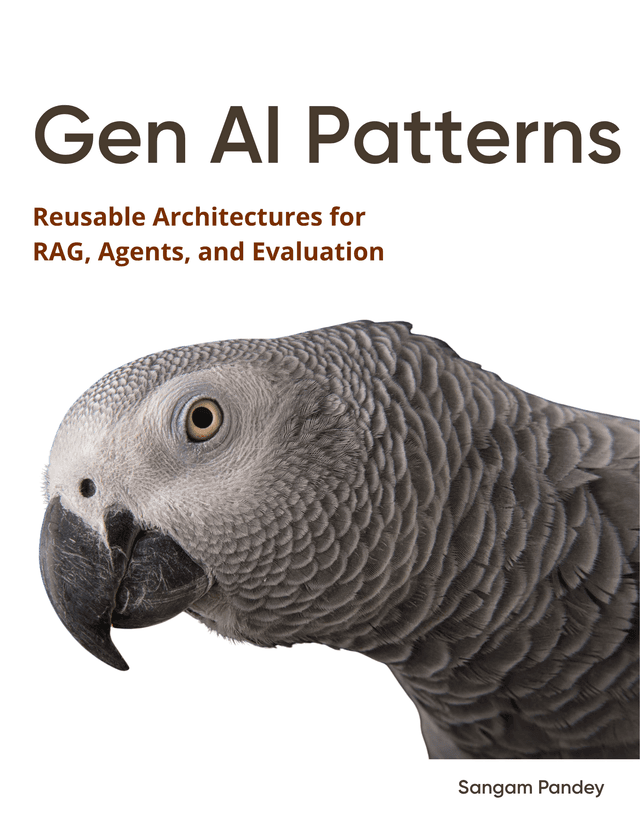
The GenAI Patterns Book
Every pattern, composition guide, and code example in one offline-ready package. Whether you are building your first RAG pipeline or designing multi-agent systems, this book gives you the reference you need.
31 patterns|8 categories|2 guides
Inside the Book
What You Will Learn
RAG Pipelines
Build retrieval-augmented generation systems that ground LLM output in your own data, from basic vector search to advanced re-ranking and hybrid retrieval.
Agent Architectures
Design tool-calling agents that plan, execute, and self-correct. Covers ReAct loops, multi-agent coordination, and human-in-the-loop patterns.
Prompt Engineering
Master chain-of-thought, few-shot prompting, and structured output techniques that produce reliable, consistent results from any model.
Production Safety
Ship with confidence using guardrails, content filtering, hallucination detection, and evaluation pipelines that catch problems before users do.
Table of Contents
Click any pattern to read it online
RAG
7Agents
7Prompting
5Routing & Orchestration
3Safety & Guardrails
2Evaluation
2Cost & Performance
3Memory & State
2Sample Chapter
Basic RAG
RAGBeginner
Large language models are trained on a fixed snapshot of text. Once training ends, the model knows nothing about events, documents, or data that appeared after the cutoff date. It also has zero visibility into your private databases, internal wikis, customer records, or proprietary codebases.
Read the full pattern“The fundamental tension is clear: you want the generative fluency of a language model combined with the factual grounding of a search engine. Basic RAG is the simplest pattern that resolves this tension.”

Sangam Pandey
Building at the intersection of AI-assisted development and practical software engineering. Writing about the patterns that actually work when you ship LLM-powered features to production.
Ready to build with patterns?
Available now as a free early access draft on Leanpub.
Content is free to read and share. Written by Sangam Pandey.
Weekly Newsletter
GenAI Patterns Dispatch
One pattern. One prompt. One build. Every Tuesday.