How do they differ?
Both patterns go beyond basic RAG by allowing the system to retrieve information iteratively rather than in a single shot. The difference is in who controls the retrieval strategy: a defined algorithm or an autonomous agent.
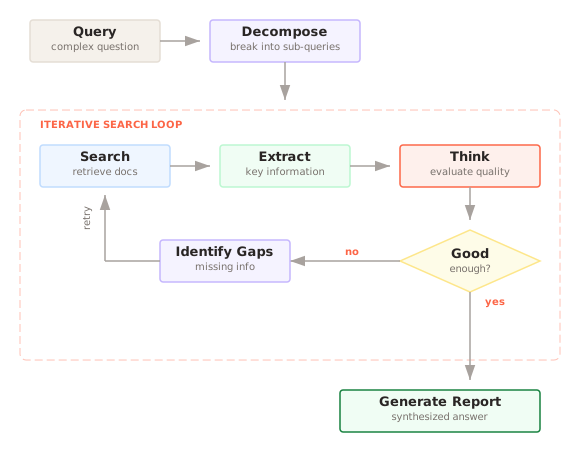
Deep Search follows a structured cycle. Decompose the question into sub-questions. Retrieve information for each sub-question. Reason over the results. Identify gaps. Retrieve again to fill those gaps. Synthesize a final answer. The process is multi-hop but predictable. You can trace exactly why each retrieval happened and how the pieces fit together.
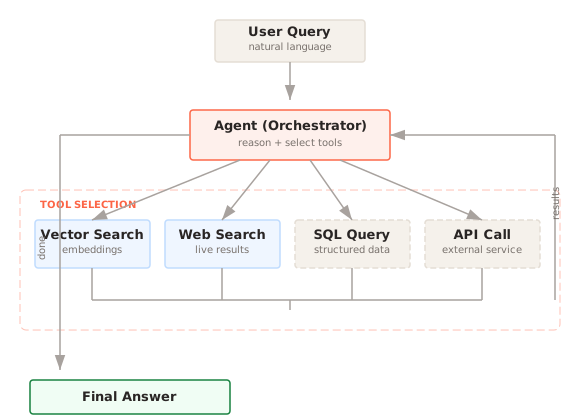
Agentic RAG gives the agent a set of retrieval tools and lets it decide when to search, what to search for, which sources to query, and when to stop. The agent might search a vector database, then decide it needs web results, then realize it should check a specific API, then go back to the vector database with a refined query. The retrieval strategy emerges from the agent's reasoning rather than following a predetermined plan.
| Dimension | Deep Search | Agentic RAG |
|---|---|---|
| Control | Algorithmic (defined cycle) | Agent-driven (emergent strategy) |
| Retrieval pattern | Decompose, retrieve, reason, re-retrieve | Agent decides dynamically per step |
| Predictability | High (same question, similar retrieval path) | Low (strategy varies across runs) |
| Auditability | Easy (each hop is traceable) | Harder (must inspect agent reasoning) |
| Source diversity | Typically single knowledge base | Multiple heterogeneous sources |
| Stopping condition | Defined (all sub-questions answered, or max hops) | Agent decides when it has enough |
| Error recovery | Limited (follows the plan) | Flexible (agent adapts strategy) |
| Latency | Predictable (fixed number of hops) | Variable (agent may do 2 or 20 retrievals) |
| Implementation | Pipeline with orchestration logic | Agent loop with retrieval tools |
Think of Deep Search as a research protocol and Agentic RAG as a research assistant. The protocol says "first search for X, then search for Y, then cross-reference." The assistant decides on its own what to search for based on what it finds along the way.
When to use Deep Search
Deep Search is the right choice when you need thorough, auditable answers to complex questions against a known knowledge base.
Research and analysis tasks. "What are all the factors that contributed to the 2023 revenue decline in our APAC region?" This question requires decomposition (market conditions, competitive landscape, operational issues, product changes), retrieval against multiple sub-topics, and synthesis. Deep Search provides a structured way to ensure all angles are covered.
Compliance and legal research. "Does our product comply with GDPR Article 17 and the California Consumer Privacy Act?" Compliance questions have clear sub-components that can be decomposed and checked individually. Each sub-answer needs to be traceable to a specific document or regulation section. The structured nature of Deep Search makes the audit trail clean.
Due diligence and fact verification. "Verify all claims in this report against our primary sources." The task is to check each claim independently, retrieve supporting or contradicting evidence, and produce a verification summary. Deep Search naturally handles this decompose-and-verify pattern.
Questions with known structure. When you know in advance what kind of sub-questions a query will decompose into, Deep Search lets you optimize the retrieval for each category. Medical diagnosis support might always decompose into symptoms, lab results, patient history, and differential diagnoses. You can tune retrieval parameters for each category.
When auditability is non-negotiable. Regulated industries, high-stakes decisions, and any context where you need to show exactly how the system arrived at its answer. Deep Search produces a clear chain: original question, sub-questions, retrieved evidence for each, reasoning steps, and final synthesis. This chain can be reviewed by humans, stored for compliance, and used to identify errors.
Controlled knowledge bases. When your retrieval sources are well-defined (a curated document collection, a specific database, a known set of APIs), Deep Search works well because the decomposition can target specific sources. You know what information exists and where to find it. The structured cycle ensures comprehensive coverage.
When to use Agentic RAG
Agentic RAG is the right choice when the retrieval strategy cannot be determined in advance, or when the system needs to adapt its approach based on what it finds.
Exploratory questions. "What should I know about deploying LLMs in healthcare?" The user does not have a specific question structure in mind. The agent might start with a broad search, discover that regulatory compliance is a major concern, pivot to searching for HIPAA-specific guidance, then find that data residency is also relevant, and follow that thread. The retrieval strategy evolves based on the information landscape.
Multi-source heterogeneous retrieval. When the answer might come from a vector database, a SQL database, a web search, an API, or a combination. The agent needs the flexibility to query different sources based on what it learns. "What is the current status of our enterprise deal with Acme Corp?" might require checking the CRM (structured data), searching email threads (unstructured text), reviewing the latest contract draft (document store), and checking the project management tool (API).
When the question's complexity is unknown upfront. Some questions are simple ("What is our refund policy?") and some are complex ("Why are customers in the Southeast churning at higher rates than other regions?"). Agentic RAG naturally adapts: simple questions get one retrieval and a direct answer, complex questions trigger extended investigation. Deep Search would apply the same multi-hop process regardless.
Error recovery and dead ends. If the first retrieval returns nothing useful, an agent can reformulate the query, try different search terms, switch to a different source, or ask the user for clarification. Deep Search follows its predetermined decomposition, which may not account for missing information in specific sub-categories.
Tasks requiring real-time information. When the agent needs to combine internal knowledge base results with live web searches, real-time API data, or freshly scraped content. The agent decides dynamically whether it needs real-time data or whether the internal corpus is sufficient. This judgment call is hard to encode in a fixed pipeline.
Personalized retrieval strategies. Different users might need different retrieval approaches for the same question. A senior engineer asking about a system architecture benefits from deep technical documentation. A product manager asking the same question benefits from architecture decision records and design docs. An agent can adapt its search strategy based on the user context.
Can they work together?
The two patterns combine well, and the integration point is straightforward: use Deep Search as a tool available to the Agentic RAG agent.
In this design, the agent has access to multiple retrieval tools, one of which is a Deep Search pipeline. When the agent encounters a sub-problem that is well-structured and research-intensive, it delegates to Deep Search. When the sub-problem is exploratory or requires adaptive retrieval, the agent handles it directly.
Example: "Prepare a competitive analysis of our product versus Competitor X, including recent market moves."
The agent might handle this in three phases:
-
Deep Search: "What are the technical capabilities and pricing of our product versus Competitor X?" This is a well-structured comparison that benefits from systematic decomposition (features, pricing, integrations, performance benchmarks, customer reviews).
-
Agentic retrieval: "What are Competitor X's recent market moves?" This requires checking news sources, social media, job postings, and patent filings. The agent decides dynamically which sources to query based on what it finds. Maybe the job postings reveal they are hiring heavily in AI, which leads the agent to search for AI product announcements.
-
Synthesis: Combine the structured comparison from Deep Search with the exploratory findings from the agentic retrieval into a comprehensive competitive analysis.
Another integration pattern is using Deep Search as the backbone and allowing agentic behavior at each hop. Instead of a rigid decompose-retrieve-reason cycle, each retrieval step is handled by a mini-agent that can adaptively search, retry with different queries, or pull from multiple sources. This gives you the structural predictability of Deep Search with the adaptability of Agentic RAG at the individual retrieval level.
You can also use Deep Search as a fallback. The agent starts with Agentic RAG for flexibility. If it cannot find sufficient information after N retrieval attempts, it falls back to Deep Search with a systematic decomposition to ensure comprehensive coverage. This hybrid catches cases where the agent's exploratory approach misses information that a structured approach would find.
Common mistakes
Using Deep Search for simple questions. If the question can be answered with a single retrieval, the decomposition step is overhead. Not every question needs multi-hop reasoning. Classify incoming questions by complexity and only route complex, multi-faceted questions to Deep Search. Simple factual questions should go through basic RAG.
Giving the Agentic RAG agent too many tools. An agent with access to 30 different retrieval tools will spend tokens reasoning about which tool to use and will sometimes pick the wrong one. Start with three to five well-chosen retrieval tools and add more only when you see the agent consistently needing capabilities it does not have. Quality of tool descriptions matters more than quantity of tools.
Not setting retrieval budgets. Agentic RAG can spiral into excessive retrieval, especially on open-ended questions. The agent finds something interesting, follows that thread, finds another lead, and continues until the context window is full. Set a retrieval budget: maximum number of retrieval calls, maximum total tokens retrieved, or a time limit. The agent should synthesize the best answer it can within the budget.
Poor sub-question decomposition in Deep Search. The quality of Deep Search depends entirely on how well the original question is decomposed. Shallow decomposition ("find information about topic A" and "find information about topic B") produces shallow results. Good decomposition produces specific, answerable sub-questions that target different aspects of the problem. Invest in prompt engineering for the decomposition step.
Ignoring retrieval quality in favor of retrieval quantity. Both patterns can retrieve a lot of information. But more context is not always better. Irrelevant context dilutes the signal and can confuse the synthesis step. Apply relevance filtering and reranking after each retrieval step. Trim low-relevance results before passing them to the reasoning or synthesis stage.
Not tracking the retrieval chain. With Agentic RAG, it is easy to lose track of what was retrieved, from where, and why. Without this trail, you cannot debug bad answers, you cannot identify failing retrieval sources, and you cannot explain the system's reasoning to users. Log every retrieval call with: query, source, number of results, top result scores, and the agent's stated reason for the search.
Assuming Deep Search is always more thorough. Deep Search is more systematic, but it is only as thorough as its decomposition. If the decomposition misses an important angle, Deep Search will miss it too, and it will miss it confidently because it completed all its planned hops. Agentic RAG, with its exploratory nature, sometimes stumbles onto relevant information that a predetermined decomposition would never have looked for. Neither pattern guarantees completeness.
Using the same embedding model and chunk size for all sources. When retrieving from multiple sources (especially in Agentic RAG with heterogeneous sources), one-size-fits-all retrieval settings produce inconsistent results. Technical documentation might work best with large chunks and a domain-specific embedding model. Customer support tickets might need small chunks with a general-purpose embedder. Tune retrieval parameters per source.
References
- Gao, Y., et al. "Retrieval-Augmented Generation for Large Language Models: A Survey." 2024.
- Jiang, Z., et al. "Active Retrieval Augmented Generation." EMNLP 2023.
- Asai, A., et al. "Self-RAG: Learning to Retrieve, Generate, and Critique through Self-Reflection." ICLR 2024.
- Yao, S., et al. "ReAct: Synergizing Reasoning and Acting in Language Models." ICLR 2023.
- Khattab, O., et al. "DSPy: Compiling Declarative Language Model Calls into Self-Improving Pipelines." ICLR 2024.
- Trivedi, H., et al. "Interleaving Retrieval with Chain-of-Thought Reasoning for Knowledge-Intensive Multi-Step Questions." ACL 2023.