How do they differ?
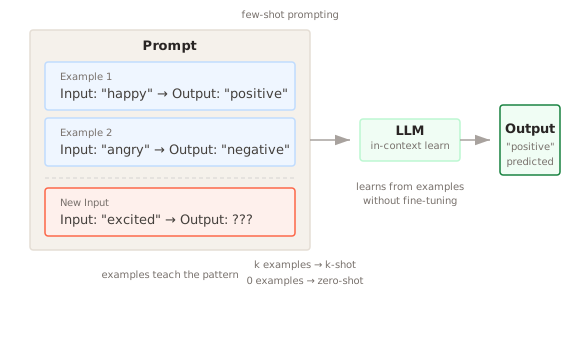
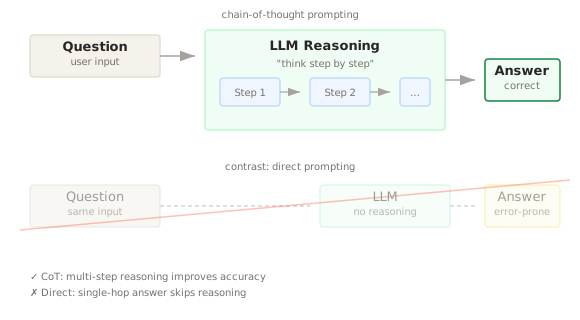
Few-Shot Prompting and Chain-of-Thought are both prompting strategies, but they target different capabilities of the model. Few-Shot teaches by demonstration. You show the model two or three examples of input-output pairs, and the model learns the pattern and applies it to the new input. Chain-of-Thought teaches by process. You instruct the model (or show it) how to break a problem into intermediate reasoning steps before arriving at the answer.
The core question is whether your task requires the model to learn a pattern or to reason through a problem. Formatting a customer email? Few-Shot. Calculating the tax implications of a multi-entity transaction? Chain-of-Thought. Classifying support tickets into categories? Few-Shot. Debugging why a distributed system is dropping messages? Chain-of-Thought.
Most developers reach for Few-Shot first because it is intuitive. Show examples, get similar outputs. But Few-Shot does not help when the model needs to think, not mimic. That is where Chain-of-Thought earns its place.
| Dimension | Few-Shot Prompting | Chain-of-Thought |
|---|---|---|
| Core mechanism | Learning from input-output examples | Explicit step-by-step reasoning |
| Best for | Format, style, and classification tasks | Math, logic, multi-step reasoning |
| Token cost | Moderate (examples consume context) | Higher (reasoning steps add tokens) |
| Output consistency | High for format, moderate for reasoning | Moderate for format, high for reasoning accuracy |
| Model size sensitivity | Works with smaller models | Benefits most from larger models |
| Prompt engineering effort | Selecting good examples takes work | Crafting reasoning templates takes work |
| Failure mode | Model copies example quirks literally | Model generates plausible but wrong reasoning |
| Interpretability | Low (output only, no reasoning visible) | High (intermediate steps are visible) |
How Few-Shot Prompting works
You provide the model with a small number of examples (typically two to five) that demonstrate the task. Each example consists of an input and the corresponding desired output. The model uses in-context learning to infer the pattern and apply it to the new query.
The power of Few-Shot is in its simplicity. You do not need to explain the rules or the logic. You just show the model what good output looks like, and it figures out the rest. This works because large language models are remarkably good at pattern matching across examples.
Where Few-Shot gets tricky is in example selection. The examples you choose have an outsized influence on the output. Poorly chosen examples can bias the model toward irrelevant patterns. For instance, if all your examples happen to start with "Dear Customer," the model might start every output with that phrase even when it does not fit. The order of examples matters too. Models tend to weight recent examples more heavily.
Good Few-Shot practice involves:
- Choosing diverse examples that cover edge cases
- Ordering examples from simple to complex
- Making sure examples do not share incidental patterns that the model might latch onto
- Including negative examples when the distinction between correct and incorrect outputs is subtle
How Chain-of-Thought works
Chain-of-Thought (CoT) prompting instructs the model to show its work. Instead of jumping directly from question to answer, the model generates intermediate reasoning steps. This can be triggered with a simple instruction like "Think step by step" (zero-shot CoT) or by providing examples that include the reasoning process (few-shot CoT).
The mechanism behind CoT is that it forces the model to decompose a complex problem into smaller, manageable pieces. Each reasoning step grounds the next step, reducing the chance of the model skipping ahead and landing on a wrong answer. It is particularly effective for tasks where the answer depends on multiple intermediate computations or logical inferences.
Wei et al. (2022) showed that CoT dramatically improves performance on math word problems, logical reasoning, and multi-step tasks. The improvement scales with model size. Smaller models sometimes generate plausible-looking but incorrect reasoning chains. Larger models produce more reliable chains.
The practical advantage of CoT goes beyond accuracy. The reasoning chain is visible. You can inspect it, debug it, and identify exactly where the model went wrong. With standard prompting, you get a wrong answer and no insight into why.
When to use Few-Shot Prompting
Few-Shot is your tool when the challenge is output format, style, or classification rather than reasoning.
Text classification. Categorizing emails, tickets, reviews, or documents into predefined buckets. Show two examples per category and the model generalizes well.
Format standardization. Converting unstructured data into structured formats. Show the model a few examples of raw text converted to JSON, CSV, or a specific template, and it will apply the same transformation.
Style transfer. Writing in a specific voice or tone. Show examples of the target style and the model adapts. This is how you get consistent brand voice, technical writing style, or documentation format.
Entity extraction. Pulling specific pieces of information from text. Show the model examples of input text with the extracted entities, and it learns what to look for.
Code generation with specific conventions. If your team uses particular naming conventions, error handling patterns, or API styles, a few examples teach the model faster than a paragraph of instructions.
Translation between formats. SQL to natural language, API specs to code, requirements to test cases. The mapping is pattern-based, and examples communicate the pattern efficiently.
When to use Chain-of-Thought
Chain-of-Thought is your tool when the task requires the model to reason, not just pattern-match.
Mathematical and numerical reasoning. Any task involving calculations, comparisons, or quantitative analysis. CoT reduces errors on arithmetic, word problems, and financial calculations significantly.
Logical inference. Tasks that require deduction, such as determining whether a set of conditions leads to a specific conclusion. Without CoT, models tend to guess. With CoT, they work through the logic.
Multi-step analysis. Questions where the answer depends on synthesizing information from multiple pieces of evidence. "Given these three data points, what conclusion can we draw?" CoT ensures the model considers each piece of evidence.
Debugging and troubleshooting. Asking the model to diagnose an issue benefits from step-by-step reasoning. "The API returns a 403. Let me check the authentication flow, then the authorization rules, then the resource permissions."
Planning and strategy. When you need the model to evaluate options, consider tradeoffs, and recommend a course of action. CoT surfaces the reasoning process and makes the recommendation more trustworthy.
Ambiguous or nuanced tasks. When there is no single right answer and the quality of the response depends on careful consideration of multiple factors, CoT produces more thoughtful outputs.
Can they work together?
This is where things get interesting. Few-Shot and Chain-of-Thought are not mutually exclusive. Combining them, known as few-shot CoT, is often more effective than either technique alone.
In few-shot CoT, your examples include not just the input and output but also the reasoning process. Instead of:
Input: If a train travels 60 mph for 2.5 hours, how far does it go?
Output: 150 miles
You provide:
Input: If a train travels 60 mph for 2.5 hours, how far does it go?
Reasoning: The train travels at 60 miles per hour. In 2.5 hours, it covers
60 * 2.5 = 150 miles.
Output: 150 miles
The model learns both the output format and the reasoning style from your examples. This is especially powerful for domain-specific reasoning where you want the model to follow a particular analytical framework.
Another combination pattern is using Few-Shot for format and CoT for content. You provide few-shot examples that establish the output structure (JSON schema, report template, etc.) and also instruct the model to think step by step when generating the content that fills that structure. This gives you consistent formatting with rigorous reasoning.
For classification tasks with edge cases, you can use few-shot examples for the clear-cut cases and add a CoT instruction for ambiguous ones: "If the classification is not obvious from the examples, reason through the criteria step by step before deciding."
Common mistakes
Using Few-Shot for reasoning tasks. Showing the model three examples of correctly solved math problems does not teach it math. It teaches it to produce text that looks like solved math problems. The model might get the easy cases right by pattern matching and fail on anything that deviates from the examples.
Using CoT for simple format tasks. Asking the model to "think step by step" about how to format a JSON object is wasted tokens. The model already knows how to format JSON. Just show it an example.
Too many few-shot examples. More is not always better. Beyond five or six examples, you start consuming context window that could be used for the actual task. Diminishing returns set in quickly. Two to three high-quality examples usually outperform eight mediocre ones.
Ignoring example diversity. If all your few-shot examples are similar, the model overfits to their shared characteristics. Include examples that cover different edge cases and variations.
Not verifying CoT reasoning. The fact that the model shows its work does not mean the work is correct. Models can produce confident, well-structured reasoning chains that arrive at the wrong answer. Always validate the intermediate steps, not just the final output.
Zero-shot CoT as a universal fix. Adding "think step by step" to every prompt is lazy prompting. It helps on reasoning tasks but adds unnecessary verbosity to simple tasks. Be intentional about when you invoke CoT.
Mixing conflicting examples. If your few-shot examples are inconsistent (different formats, different levels of detail, different reasoning approaches), the model will be confused. Consistency across examples matters more than the number of examples.
A decision framework
Ask these three questions about your task:
-
Is the challenge about format or reasoning? Format challenges call for Few-Shot. Reasoning challenges call for CoT.
-
Can you demonstrate the task with examples? If the task is well captured by three input-output pairs, use Few-Shot. If the examples would need to include complex reasoning to be useful, use few-shot CoT.
-
Does the task have a verifiable intermediate process? If there are clear intermediate steps that you can check (calculations, logical deductions, evidence evaluation), CoT makes both the output and the process auditable.
For most production systems, you will end up using both techniques across different parts of your prompt pipeline. The structured output stage uses Few-Shot. The analysis stage uses CoT. The combination delivers both consistent formatting and reliable reasoning.
References
- Brown, T. et al. (2020). "Language Models are Few-Shot Learners." arXiv:2005.14165.
- Wei, J. et al. (2022). "Chain-of-Thought Prompting Elicits Reasoning in Large Language Models." arXiv:2201.11903.
- Kojima, T. et al. (2022). "Large Language Models are Zero-Shot Reasoners." arXiv:2205.11916.
- Zhang, Z. et al. (2022). "Automatic Chain of Thought Prompting in Large Language Models." arXiv:2210.03493.