How do they differ?
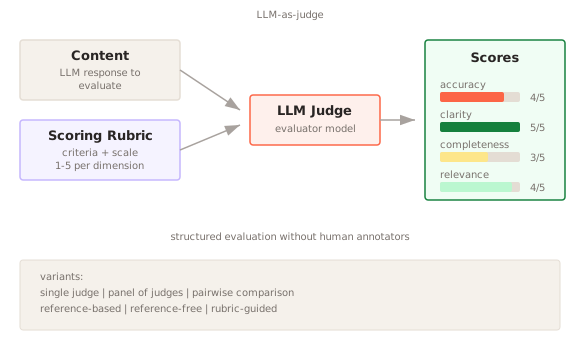
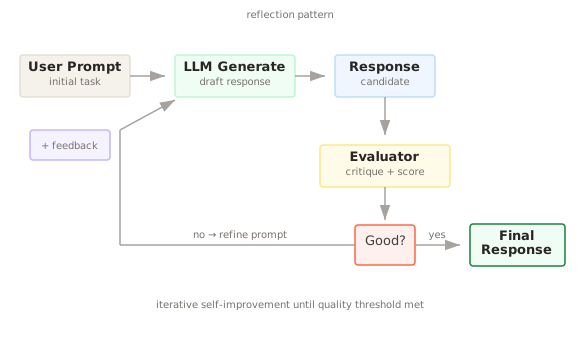
These two patterns both care about output quality, but they attack the problem from opposite directions. LLM-as-Judge is an external evaluator. It looks at a finished output and assigns a score, a label, or a ranking. Reflection is an internal loop. It takes a draft output, critiques it, and rewrites it before the user ever sees it.
Think of it this way. LLM-as-Judge is the food critic who reviews the dish after it leaves the kitchen. Reflection is the chef who tastes the sauce three times while cooking and adjusts the seasoning each time. One tells you how good the result is. The other makes the result better.
The distinction matters because they serve different roles in a system. A judge does not change the output. It produces metadata about the output, a score, a pass/fail decision, a ranked ordering. A reflection loop changes the output itself. It produces a better version of whatever the model generated on the first pass.
| Dimension | LLM-as-Judge | Reflection |
|---|---|---|
| Role | Evaluator (quality gate) | Improver (quality amplifier) |
| When it runs | After generation is complete | During generation, before final output |
| Output | Score, label, or ranking | Revised and improved text |
| Modifies the original? | No | Yes |
| Latency impact | Adds one LLM call per evaluation | Adds N LLM calls per reflection iteration |
| Typical use | Batch evaluation, A/B testing, monitoring | Real-time output improvement |
| Requires rubric? | Almost always | Optional, but helps focus the critique |
| Failure mode | Score drift, rubric gaming | Infinite loops, over-editing, regression |
There is a subtlety in how each pattern handles context. LLM-as-Judge typically receives the output (and sometimes the input and a reference answer) in a single prompt. It does not need to track state across turns. Reflection requires maintaining a conversation-like state: the original output, the critique, the revision, potentially another critique, and so on. This makes reflection more expensive in terms of tokens and more sensitive to context window limits.
When to use LLM-as-Judge
LLM-as-Judge is the right choice when you need to measure quality at scale without modifying the outputs themselves.
Offline evaluation pipelines. You have a dataset of model outputs and you want to score them for correctness, helpfulness, or safety. Running human evaluation on thousands of examples is expensive and slow. An LLM judge can process them in hours instead of weeks. This is the most common use case.
A/B testing and model comparison. You are considering switching from one model to another, or from one prompt template to another. You generate outputs from both variants and have the judge score them side by side. Pairwise comparison (asking the judge "which output is better?") tends to be more reliable than absolute scoring.
Production monitoring. You log model outputs in production and run a judge asynchronously to flag low-quality responses. This feeds into dashboards, alerts, and regression detection. The judge does not slow down the user-facing request because it runs after the fact.
Reward modeling and RLHF data. If you are fine-tuning a model with reinforcement learning from human feedback, an LLM judge can generate preference labels to supplement or replace human annotators. The judge becomes a proxy reward model.
Content moderation at scale. You need to classify outputs as safe or unsafe, on-topic or off-topic, compliant or non-compliant. A judge with a clear rubric can handle this consistently across millions of outputs.
The key signal is: you want a measurement, not a modification. If the goal is to produce a number, a label, or a ranking, use LLM-as-Judge.
When to use Reflection
Reflection is the right choice when you want to improve the quality of a single output before delivering it to the user.
Complex generation tasks. Writing long-form content, generating detailed code, producing structured analysis. These tasks benefit from a second pass. The model catches logical errors, fills gaps, improves clarity, and tightens the structure. First drafts are almost always worse than revised drafts, and this holds for LLMs just as it holds for human writers.
Tasks where correctness is critical. If you are generating code that will be executed, or producing medical or legal information, a reflection step that specifically checks for errors can catch mistakes that the initial generation missed. The critique step can be focused: "Check this code for off-by-one errors and null pointer dereferences."
Constrained output formats. If the output must conform to a specific schema, style guide, or set of constraints, a reflection loop can verify compliance and fix violations. This is especially useful when the constraints are complex enough that the model sometimes misses one or two on the first attempt.
When you cannot afford post-hoc filtering. If every output must be high quality (not just most of them), reflection gives you a way to improve quality at generation time rather than filtering bad outputs after the fact. This matters when you do not have a fallback or when regeneration is expensive.
Agentic workflows. An agent that plans, executes, and then reflects on the result before proceeding to the next step. Reflection becomes part of the agent loop, not a separate system.
The key signal is: you want a better output, not a score. If the goal is to deliver the best possible response to the end user, use Reflection.
Can they work together?
Yes, and this is one of the most effective combinations in production AI systems. The canonical integration looks like this:
- The model generates an initial output.
- An LLM-as-Judge evaluates the output against a rubric and produces a structured critique (not just a score, but specific feedback).
- The model receives the critique and generates a revised output.
- The judge evaluates again.
- The loop continues until the score passes a threshold or a maximum iteration count is reached.
In this design, LLM-as-Judge provides the evaluation function inside the reflection loop. The judge answers "how good is this?" and the reflector answers "how can I make it better?" They are complementary, not competing.
This combined approach solves a real problem with naive reflection. When you ask a model to critique its own output without structure, it sometimes fixates on superficial issues, ignores real problems, or confidently declares the output is fine when it is not. A judge with an explicit rubric provides more consistent and targeted feedback.
You can also use them in sequence rather than nested. Generate outputs, reflect and improve them, then run a judge as a final quality gate. Outputs that pass the judge go to the user. Outputs that fail get flagged for human review or regenerated entirely.
A third integration point is using the judge to decide whether reflection is even necessary. Run a quick evaluation. If the score is above the threshold, return the output immediately without paying the latency cost of reflection. If the score is below the threshold, trigger a reflection loop. This gives you the quality benefits of reflection without the latency penalty on already-good outputs.
Common mistakes
Using a judge when you actually want improvement. If you score every output and then just log the scores without acting on them, you have a monitoring system but not a quality system. Scores are only useful if they drive action, whether that is reflection, regeneration, or human review.
Using reflection without a stopping condition. A reflection loop without a clear exit criterion can run indefinitely, burning tokens and sometimes making the output worse. Always set a maximum iteration count (two or three passes is usually enough). And always check whether the revised output is actually better. It is possible for reflection to introduce new errors while fixing old ones.
Expecting the judge to be perfectly calibrated. LLM judges have biases. They tend to prefer longer outputs, more formal language, and outputs that match their own generation patterns. They also drift over time as the underlying model changes. Calibrate your judge against human evaluations regularly. Use pairwise comparison instead of absolute scoring when possible, as it is more robust to these biases.
Reflecting without focused critique. A generic "improve this" instruction produces vague revisions. A focused critique like "check for factual accuracy in the statistics section" or "verify that every claim has a cited source" produces targeted improvements. The more specific the reflection prompt, the more useful the revision.
Ignoring the cost multiplication. Each reflection iteration doubles (roughly) the token cost and latency of the request. Each judge evaluation adds another LLM call. If you nest a judge inside a reflection loop with three iterations, you are making at least seven LLM calls for a single user request. That is fine for high-value tasks. It is wasteful for simple questions that the model gets right on the first try. Use the combined approach selectively.
Treating judge scores as ground truth. An LLM judge is a proxy for human judgment, not a replacement. It is useful for identifying patterns and catching regressions at scale, but individual scores can be wrong. Never use judge scores as the sole basis for critical decisions without periodic human validation.
References
- Zheng, L., et al. "Judging LLM-as-a-Judge with MT-Bench and Chatbot Arena." NeurIPS 2023.
- Madaan, A., et al. "Self-Refine: Iterative Refinement with Self-Feedback." NeurIPS 2023.
- Shinn, N., et al. "Reflexion: Language Agents with Verbal Reinforcement Learning." NeurIPS 2023.
- Kim, S., et al. "Prometheus: Inducing Fine-Grained Evaluation Capability in Language Models." ICLR 2024.
- OpenAI. "GPT-4 Technical Report." 2023. (Section on using GPT-4 as an evaluator.)