How do they differ?
Multi-Agent Collaboration and Plan-and-Execute are both patterns for handling complex tasks that require multiple steps, tool use, and coordination. They represent different points on a spectrum of architectural complexity, and choosing the wrong one for your situation means either over-engineering a simple problem or under-engineering a complex one.
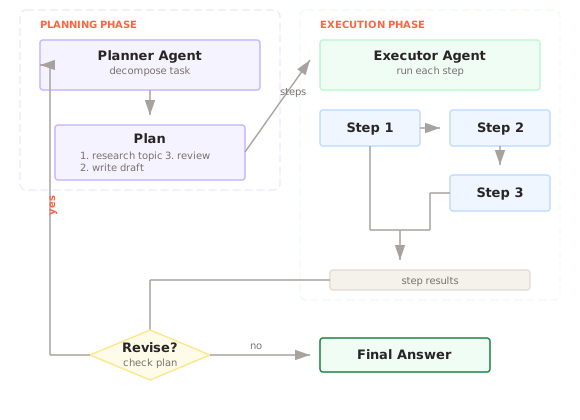
Plan-and-Execute separates thinking from doing. A planner agent receives the user request and produces a structured plan, a sequence of steps that, when completed in order, should accomplish the goal. An executor agent then works through the plan step by step, using tools and generating responses as needed. The planner may revise the plan between steps based on intermediate results, but there is a clear division: one component decides what to do, another component does it.
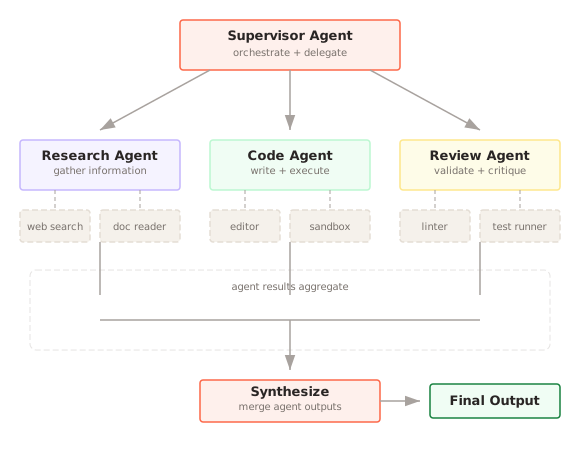
Multi-Agent Collaboration distributes work across multiple specialized agents. Instead of a single executor, you have agents with different capabilities: a researcher that searches the web, a coder that writes and tests code, a reviewer that evaluates outputs, a writer that produces documentation. An orchestrator (which might itself use a Plan-and-Execute pattern internally) coordinates these agents, routing sub-tasks to the right specialist and synthesizing their outputs into a final result.
The key architectural difference is the number and specialization of executor roles. Plan-and-Execute has one generalist executor. Multi-Agent has multiple specialist executors. Everything else, the planning, the coordination, the tool use, can exist in both patterns.
| Dimension | Plan-and-Execute | Multi-Agent Collaboration |
|---|---|---|
| Architecture | One planner + one executor | Orchestrator + multiple specialized agents |
| Executor specialization | Generalist (one agent does everything) | Specialists (different agents for different tasks) |
| Coordination complexity | Low (linear step execution) | High (routing, delegation, result synthesis) |
| Communication overhead | Minimal (planner talks to executor) | Significant (agents may need to share context) |
| Failure modes | Plan is wrong, or executor fails a step | Routing errors, agent miscommunication, context loss |
| Debugging | Straightforward (follow the plan) | Harder (trace across multiple agents) |
| Cost per task | Lower (fewer LLM calls) | Higher (multiple agents, each making calls) |
| Parallelism potential | Limited (steps are usually sequential) | High (independent sub-tasks can run concurrently) |
| Best for | Structured tasks with clear sequential steps | Tasks requiring genuinely different expertise |
When to use Plan-and-Execute
Plan-and-Execute is the right pattern for the majority of agent tasks that people build today. Its simplicity is a feature, not a limitation.
Tasks with a clear sequential structure. "Research this topic, then write a report, then format it as a PDF." "Look up the customer's order, check the return policy, draft a response." When the task decomposes into an ordered sequence of steps where each step depends on the previous one, Plan-and-Execute handles it cleanly. The planner produces the sequence, the executor works through it.
When a single model can handle all sub-tasks. Modern frontier models are generalists. They can write code, analyze data, search the web, compose emails, and reason about complex problems all within a single conversation. If your task requires capabilities that fit within one model's competence, there is no benefit to splitting the work across multiple specialized agents. The overhead of coordination, context passing, and result synthesis adds complexity without adding capability.
When you want predictable execution and easy debugging. A Plan-and-Execute trace is easy to follow. You can see the plan, you can see each step's input and output, and you can identify exactly where things went wrong. With multi-agent systems, a bug might be in the routing logic, in how context was passed between agents, in a specialist agent's interpretation of its sub-task, or in the synthesis of results. Plan-and-Execute is dramatically easier to debug in production.
When cost matters. Each agent in a multi-agent system makes its own LLM calls, maintains its own context, and adds its own token consumption. A Plan-and-Execute system with one planner and one executor makes fewer total LLM calls for the same task. If you are watching your API spend, this difference adds up quickly.
Prototyping and initial development. Even if you think you will eventually need multi-agent, start with Plan-and-Execute. Build the planner, build the executor, get the core workflow working. You can always decompose the executor into multiple agents later if you discover that specific sub-tasks need dedicated handling. Starting with the simpler pattern gives you a working baseline faster.
Iterative plan refinement. One underappreciated strength of Plan-and-Execute is adaptive re-planning. After each step, the planner can observe the result and revise the remaining plan. This creates a tight feedback loop that is harder to achieve in a multi-agent system where sub-tasks have been delegated to agents that do not have full visibility into the overall progress.
When to use Multi-Agent Collaboration
Multi-Agent Collaboration earns its complexity when the task genuinely requires different types of expertise that benefit from isolation and specialization.
Tasks requiring genuinely different skills. Consider building a full-stack feature: you need to research the API design, write backend code, write frontend code, write tests, and review the implementation. Each of these sub-tasks benefits from a different system prompt, different tools, and different evaluation criteria. A code-writing agent should be tuned for code generation with access to a code execution sandbox. A review agent should be tuned for critical analysis without the temptation to just fix things itself. Specialization produces better results when the sub-tasks are meaningfully different.
When sub-tasks can run in parallel. If your task has independent branches, multi-agent systems can execute them concurrently. While one agent researches competitor pricing, another agent analyzes your sales data, and a third agent reviews customer feedback. The orchestrator waits for all three and then synthesizes the results. Plan-and-Execute, being inherently sequential, would handle these one at a time.
When context isolation improves quality. Each agent in a multi-agent system has its own context window. A code-writing agent does not need to see the full research report that informed the architecture decision. It just needs the specification. This isolation reduces context window pollution, where irrelevant information degrades the model's performance on the current sub-task. For long, complex workflows, this can make a meaningful difference in output quality.
Adversarial or review-oriented workflows. Some tasks benefit from having one agent generate content and a separate agent critique it. The reviewer agent should have a different perspective, different instructions, and ideally no "loyalty" to the generated content. This separation of concerns is a natural fit for multi-agent architecture. A single executor reviewing its own work is less effective than a dedicated reviewer.
When you need domain-specific routing. Customer support systems that handle billing questions, technical issues, account management, and sales inquiries. Each category benefits from a specialist agent with its own knowledge base, tools, and response style. A semantic router in front of these agents directs queries to the right specialist. This is a classic multi-agent pattern that would be awkward to implement as a single Plan-and-Execute system.
Workflows that span multiple sessions or long time horizons. Project management, ongoing research, or multi-day code generation workflows. When the task is large enough that it needs to be broken into independently manageable pieces with their own state and progress tracking, multi-agent architectures provide the natural modularity for this decomposition.
Can they work together?
They almost always do in practice. The relationship between these patterns is hierarchical, not exclusive.
The most common architecture is to use Multi-Agent Collaboration at the top level, with Plan-and-Execute inside each agent. The orchestrator receives a complex task. It decomposes it into sub-tasks and routes each to a specialist agent. Each specialist agent uses Plan-and-Execute internally to work through its sub-task. The researcher plans its search strategy and executes searches step by step. The coder plans its implementation and codes file by file. The reviewer plans its review criteria and evaluates systematically.
You can also go the other direction. A Plan-and-Execute system where certain steps are delegated to specialist agents. The planner produces a five-step plan. Steps one, three, and five are handled by the general executor. Step two is routed to a specialized data analysis agent. Step four goes to a code generation agent. This is multi-agent collaboration embedded within a Plan-and-Execute framework.
LangGraph, CrewAI, AutoGen, and similar frameworks all support both patterns and their composition. LangGraph lets you define agent graphs where some nodes are simple executors and others are complete multi-agent sub-systems. CrewAI lets you define crews with different process types (sequential for Plan-and-Execute, hierarchical for orchestrated multi-agent). The tooling encourages composition rather than choosing one pattern exclusively.
A particularly effective combination for software engineering tasks is the planner-coder-reviewer trio. The planner (Plan-and-Execute) decomposes the feature request into implementation steps. The coder (specialist agent) implements each step. The reviewer (specialist agent) evaluates each implementation. If the reviewer finds issues, the planner adjusts the remaining steps. This three-agent loop combines the structured progression of Plan-and-Execute with the quality benefits of specialized review.
Common mistakes
Defaulting to multi-agent when Plan-and-Execute would suffice. This is the most common mistake. Multi-agent systems are exciting to build but expensive to maintain. If your task is "search for information, then write a summary, then send an email," you do not need three agents. You need one executor with access to search, writing, and email tools. The overhead of agent coordination, context passing, and result synthesis adds latency, cost, and bugs without adding value.
Too many agents doing too little. Some teams create a separate agent for every minor function: a "formatter agent," a "validation agent," a "logging agent." These should be tools or utility functions, not agents. An agent should represent a meaningful domain of expertise that benefits from its own context, system prompt, and decision-making. If the "agent" is just calling one function, it is a tool pretending to be an agent.
Not sharing enough context between agents. Context isolation is a feature of multi-agent systems, but too much isolation causes problems. If the code-writing agent does not know about constraints discussed with the architecture agent, it will make wrong decisions. Design explicit context-passing mechanisms. Define what information each agent receives from the orchestrator and from other agents.
Sharing too much context between agents. The opposite problem. Dumping the entire conversation history from all agents into every agent's context window defeats the purpose of specialization and quickly fills context windows. Be selective about what context gets passed between agents.
No clear orchestration strategy. Multi-agent systems need a decision-maker. Who decides which agent handles which sub-task? Who decides when to re-plan? Who synthesizes the final result? If the orchestration logic is ad-hoc, the system will behave unpredictably. Design the orchestrator as carefully as you design the specialist agents.
Not measuring the quality improvement. Before committing to multi-agent complexity, run an A/B test. Does the multi-agent system actually produce better results than a well-prompted Plan-and-Execute system on your specific tasks? Sometimes the answer is no, and you have added architectural complexity for no measurable benefit. Let the data decide.
Ignoring failure recovery. In Plan-and-Execute, if a step fails, the planner can re-plan. In multi-agent systems, failure recovery is harder. If the code agent produces broken code, does the orchestrator re-route to the code agent? Does it ask the reviewer for guidance? Does it re-plan the entire task? Define failure modes and recovery strategies explicitly for each agent handoff.
References
- Yao, S., Zhao, J., et al. "ReAct: Synergizing Reasoning and Acting in Language Models." ICLR 2023.
- Wang, L., Ma, C., et al. "A Survey on Large Language Model based Autonomous Agents." arXiv, 2023.
- Wu, Q., Bansal, G., et al. "AutoGen: Enabling Next-Gen LLM Applications via Multi-Agent Conversation." arXiv, 2023.
- Hong, S., Zhuge, M., et al. "MetaGPT: Meta Programming for A Multi-Agent Collaborative Framework." ICLR 2024.
- LangChain. "Plan-and-Execute Agents." LangChain Documentation, 2024.
- CrewAI. "Building Multi-Agent Systems." CrewAI Documentation, 2024.