How do they differ?
Prompt Caching and Small Language Models both reduce the cost of running LLM-powered applications, but they attack the problem from completely different angles. Understanding the mechanism behind each one is what helps you decide which to apply, and when to combine them.
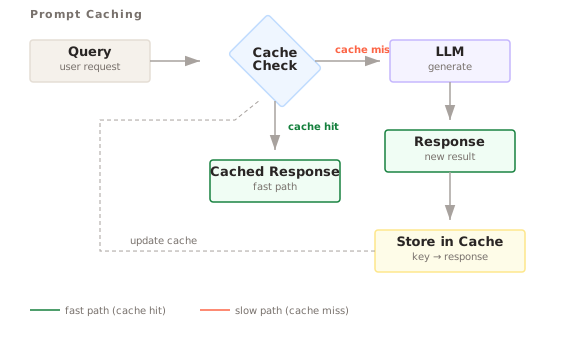
Prompt Caching is a runtime optimization. It stores and reuses the results of previous computations so you do not pay for the same work twice. There are several flavors. Semantic caching stores the full response for a query and returns it when a sufficiently similar query arrives later. Prefix caching (offered by Anthropic, OpenAI, and others) caches the KV (key-value) computations for the static portion of your prompt, like a long system message or a large document, so only the new user-specific tokens incur full computation cost. The core idea is the same across all flavors: if you have already done the work, do not do it again.
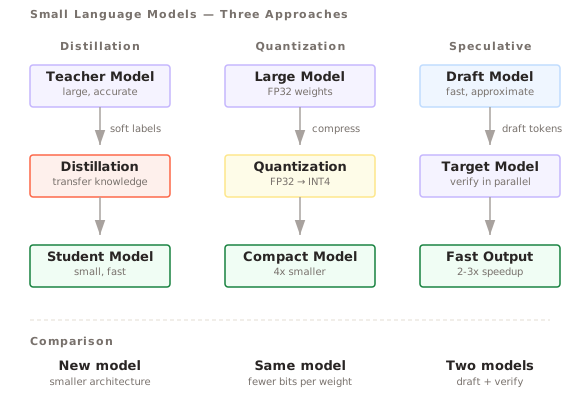
Small Language Models (SLMs) are a model selection and architecture decision. Instead of routing every request to a 400 billion parameter frontier model, you use a smaller model, often in the 1 to 8 billion parameter range, that can handle the task adequately. These smaller models can come from distillation (training a small model to mimic a larger one), quantization (reducing the precision of model weights), or simply choosing a smaller model from a provider's lineup. Each request is cheaper because the model itself requires less computation.
The fundamental distinction is this. Caching reduces the number of times you compute. SLMs reduce the cost of each computation. These are orthogonal levers.
| Dimension | Prompt Caching | Small Language Models |
|---|---|---|
| Cost reduction mechanism | Avoid redundant computation | Cheaper per-request computation |
| Type of optimization | Runtime / infrastructure | Model selection / architecture |
| When it helps most | Repetitive query patterns | Tasks that do not need frontier capability |
| Capability trade-off | None (same model, same quality) | Lower capability ceiling |
| Latency impact | Cache hits are faster | Faster inference per token |
| Implementation | Cache layer in front of LLM | Model swap, distillation, or quantization |
| Works with any model | Yes | N/A (you are choosing the model) |
| Requires training | No | Sometimes (distillation, fine-tuning) |
| Upfront investment | Low (cache infrastructure) | Medium to high (evaluation, possible training) |
When to use Prompt Caching
Prompt Caching delivers the best returns when your query patterns have natural redundancy.
Repetitive customer queries. Support chatbots, FAQ systems, and internal helpdesks receive the same questions repeatedly with minor phrasing variations. "How do I reset my password" and "I forgot my password, how do I reset it" will produce identical answers. A semantic cache with reasonable similarity thresholds can serve a large percentage of queries from cache, cutting cost and latency dramatically.
Long system prompts or shared context. If every request to your model includes a 5,000 token system prompt, a set of few-shot examples, or a large document, prefix caching lets you compute those tokens once and reuse the KV cache across requests. Anthropic's prompt caching, for example, can reduce input token costs by up to 90% for the cached portion. This is particularly valuable for RAG systems where the same set of retrieved documents appears in multiple follow-up questions within a conversation.
When you need frontier model quality. Caching does not degrade output quality. You are serving the exact same response (semantic cache) or computing with the exact same model (prefix cache). If your application requires GPT-4 or Claude Opus level reasoning and you cannot afford to downgrade, caching is how you reduce costs without sacrificing capability.
Conversational applications with long contexts. Multi-turn conversations accumulate context. Each turn, you resend the entire conversation history. Prefix caching means you only pay full compute cost for the new message, not for the entire history that the model already processed in previous turns.
Predictable, narrow query distributions. If you can anticipate what users will ask, like during a product launch or a seasonal event, you can pre-warm your cache with expected queries. The cache hit rate will be high, and cost savings will be substantial.
When to use Small Language Models
SLMs make sense when you can trade capability for efficiency without hurting the user experience.
Well-defined, narrow tasks. Classification, entity extraction, sentiment analysis, intent detection, simple summarization. These tasks have clear input-output mappings that a 3 billion parameter model can learn to handle as well as a frontier model, especially with fine-tuning. There is no reason to pay for 400 billion parameters when 3 billion will do.
High-volume, low-complexity workloads. If you are processing millions of log entries, tagging images with descriptions, or extracting structured data from invoices, the per-request cost is the dominant factor. A distilled SLM that costs 1/50th per token and handles the task with 95% of the accuracy is almost always the right choice at this scale.
Edge deployment and offline scenarios. SLMs can run on devices, in browsers, or in environments without internet access. If your application needs to work on a phone, a laptop without connectivity, or an embedded system, a quantized 1 to 3 billion parameter model is your only option. Frontier models require cloud infrastructure.
Latency-critical paths. Smaller models generate tokens faster. If your application has a strict latency budget, like real-time autocomplete, inline code suggestions, or interactive tutoring, an SLM running locally or on a lightweight server can meet timing requirements that a frontier model API cannot.
When you have good training data. The gap between SLMs and frontier models shrinks significantly with task-specific fine-tuning. If you have thousands of labeled examples for your specific task, a fine-tuned 7 billion parameter model can match or exceed the frontier model's performance on that task. The investment in training data pays off through permanently lower inference costs.
Can they work together?
Absolutely, and combining them is where the most aggressive cost reduction happens.
The simplest combination is to use an SLM for common, simple queries and a frontier model for complex ones, with caching in front of both. A routing layer examines each incoming query and decides whether it needs the full power of a large model or whether the SLM can handle it. The cache sits in front of this router, catching repeated queries before they even reach the routing decision.
A more sophisticated pattern uses the SLM as a "first responder." The small model generates an initial answer. A lightweight quality check (rule-based or classifier-based) evaluates whether the answer is good enough. If it passes, you serve it. If not, you escalate to the frontier model. The frontier model's response gets cached so that future similar queries are served cheaply. Over time, the cache fills up with high-quality frontier model answers, and the SLM handles the remaining novel simple queries. The combination drives down both the average cost per query and the average latency.
You can also use caching specifically to reduce the cost of training or evaluating SLMs. When you are distilling a large model into a small one, you generate training data by running the large model on many examples. Caching the large model's outputs during this data generation phase can cut the distillation cost significantly.
Prefix caching and SLMs combine naturally in RAG pipelines. Use prefix caching for the large retrieved context (which stays the same across related follow-up queries). Use an SLM for the generation step if the answer synthesis does not require frontier reasoning. The expensive retrieval context is cached, and the cheap model handles generation.
Common mistakes
Caching without measuring hit rates. A cache that never gets hit is just wasted infrastructure. Before building a semantic caching layer, analyze your query logs. What percentage of queries are near-duplicates? If your queries are highly diverse (each one unique), caching will not help much. Calculate expected hit rates before investing.
Setting similarity thresholds too loosely. Semantic caches match queries by embedding similarity. If the threshold is too loose, you serve cached answers for queries that are similar but not equivalent. "How do I delete my account" and "How do I delete a file" might be close in embedding space but require completely different answers. Start with strict thresholds and loosen them carefully with monitoring.
Assuming SLMs are always worse. For well-defined tasks with good training data, a fine-tuned SLM can outperform a general-purpose frontier model. The frontier model is better at everything in general but not necessarily better at your specific task. Always benchmark on your actual workload.
Choosing an SLM without evaluation. Picking a smaller model because it is cheaper and hoping it works is a recipe for degraded quality. Build an evaluation set that represents your real queries and acceptable quality thresholds. Test multiple SLM candidates against this set before committing. The cheapest model that passes your quality bar is the right choice, not the cheapest model available.
Ignoring cache invalidation. If your knowledge base changes, cached answers become stale. A customer asks about pricing, gets a cached answer from last month, and sees outdated numbers. Implement cache invalidation strategies tied to your data update cycles. Time-based expiry is the simplest approach. Event-based invalidation (clear cache when pricing changes) is more precise.
Treating these as permanent decisions. Both caching and model selection should be revisited as your application evolves. Query patterns change. Model capabilities improve. A task that required a frontier model six months ago might be handled well by today's SLMs. Build your architecture to make these choices configurable rather than hardcoded.
References
- Anthropic. "Prompt Caching." Anthropic API Documentation, 2024.
- OpenAI. "Prompt Caching." OpenAI API Documentation, 2024.
- Zhu, B., Sharma, P., et al. "Scalable Semantic Caching for LLM Applications." arXiv, 2024.
- Hinton, G., Vinyals, O., Dean, J. "Distilling the Knowledge in a Neural Network." NeurIPS Workshop, 2015.
- Dettmers, T., Pagnoni, A., Holtzman, A., Zettlemoyer, L. "QLoRA: Efficient Finetuning of Quantized Language Models." NeurIPS 2023.
- Gunter, T., Wang, Z., et al. "Apple Intelligence Foundation Language Models." Apple Machine Learning Research, 2024.