How do they differ?
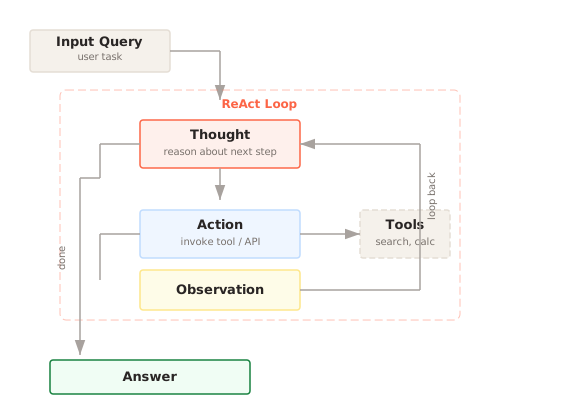
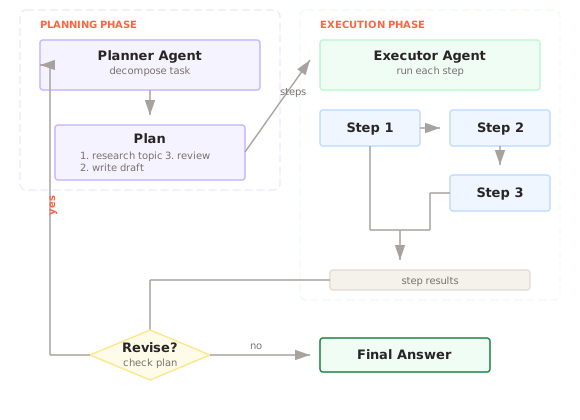
ReAct Loop and Plan-and-Execute represent two fundamentally different philosophies about how an AI agent should approach a task. ReAct treats every step as a fresh decision point. The agent observes the current state, reasons about what to do next, takes an action, and then re-evaluates. Plan-and-Execute front-loads the thinking. The agent analyzes the full task, produces a structured plan, and then works through that plan step by step.
The difference matters more than it might seem at first glance. ReAct is inherently adaptive. If step three produces an unexpected result, step four can pivot immediately. Plan-and-Execute is inherently efficient. Because the agent has already mapped out the path, it avoids the overhead of re-reasoning at every single step.
Think of it this way. ReAct is like navigating a new city on foot, making turn-by-turn decisions based on what you see. Plan-and-Execute is like studying the map before you leave, plotting your route, and following it. Both get you to the destination. The question is which approach fits the terrain.
| Dimension | ReAct Loop | Plan-and-Execute |
|---|---|---|
| Decision timing | Per-step (reactive) | Upfront (proactive) |
| Adaptability | High. Adjusts after every observation. | Lower. Requires re-planning if the plan breaks. |
| Token efficiency | Lower. Repeated reasoning at each step. | Higher. Single planning phase, leaner execution. |
| Failure mode | Can wander or loop without converging. | Brittle when assumptions in the plan are wrong. |
| Latency profile | Consistent per-step latency. | Front-loaded latency during planning, faster execution. |
| Transparency | Each thought-action-observation triple is visible. | The plan itself is inspectable before execution begins. |
| Best model fit | Works well even with smaller models. | Benefits from stronger models that can plan coherently. |
The reasoning model underneath
ReAct interleaves reasoning and action in a tight loop. The canonical sequence is Thought, Action, Observation, repeated until the agent reaches a final answer. This structure was introduced by Yao et al. (2022) and has become the default pattern in most agent frameworks. The key insight is that reasoning traces ground the model and reduce hallucination, because the model has to justify each action before taking it.
Plan-and-Execute separates the two phases. First, a planner agent generates a list of steps. Then an executor agent (which itself might use ReAct internally) works through each step. If a step fails, control returns to the planner, which can revise the remaining steps. Wang et al. (2023) formalized this in the Plan-and-Solve prompting paper, showing that explicit planning improves accuracy on complex multi-step tasks.
The practical difference shows up in token usage. A ReAct agent solving a ten-step problem will include the full reasoning context at every step, which means the context window fills up quickly. A Plan-and-Execute agent spends tokens once on the plan and then executes with a narrower context per step.
When to use ReAct Loop
ReAct is the right choice when you cannot predict the shape of the task in advance. Some concrete scenarios:
Exploratory research. The agent needs to search for information, follow leads, and adjust its strategy based on what it finds. You cannot write a plan for this because you do not know what the search results will contain.
Tool-heavy workflows with unpredictable outputs. If the agent calls APIs, runs code, or queries databases where the output at each step determines the next step, ReAct handles this naturally. A plan would be speculative at best.
Simple tasks with few steps. If the task only requires two or three actions, the overhead of a planning phase is wasted. ReAct gets to work immediately.
Error recovery. When individual steps might fail and the agent needs to try alternative approaches, ReAct can pivot without needing to formally revise a plan document.
Interactive or conversational agents. Chatbots and assistants that respond to user input in real time benefit from the reactive nature of ReAct. Each user message is a new observation.
Watch out for the failure modes, though. ReAct agents can loop, repeating the same action and expecting different results. They can also wander, taking tangential actions that do not converge toward the goal. Good implementations include loop detection and a maximum step count.
When to use Plan-and-Execute
Plan-and-Execute shines when the task has a clear structure and the steps are somewhat predictable. Here are the scenarios where it earns its keep:
Multi-step workflows with known structure. Writing a report, building a data pipeline, or completing a form with multiple sections. You know the steps. Planning them upfront avoids redundant reasoning.
Tasks requiring coordination. When steps depend on each other in non-trivial ways (step 5 needs the output of steps 2 and 3), an explicit plan makes those dependencies visible and manageable.
Cost-sensitive applications. The upfront planning cost is fixed. Execution costs are lower per step because the executor does not need to reason about the big picture. For long tasks, this adds up.
Auditable processes. Regulated environments or high-stakes decisions benefit from having a reviewable plan before execution begins. A human can approve the plan, and then the agent executes it.
Parallel execution. If the plan reveals that steps 3 and 4 are independent, you can run them in parallel. ReAct, being sequential by nature, does not surface these opportunities.
The failure mode here is rigidity. If step 4 produces an unexpected result that invalidates steps 5 through 8, the agent needs to re-plan. Naive implementations will just barrel through the remaining steps and produce garbage. Good implementations check execution results against expectations and trigger re-planning when things diverge.
Can they work together?
Yes, and the combination is arguably the most effective pattern for complex agents. The architecture looks like this:
- A planner agent generates a high-level plan with discrete steps.
- Each step is executed by a ReAct sub-agent that can reason, act, and adapt within the scope of that step.
- After each step completes, the planner reviews the result and decides whether to continue with the existing plan or revise it.
This layered approach gives you the best of both worlds. The planner provides structure, efficiency, and auditability. The ReAct executors provide adaptability within each step. The re-planning mechanism handles surprises at the strategic level.
LangGraph and similar frameworks support this pattern natively. You define a planning node, execution nodes (which are themselves ReAct loops), and conditional edges that route control back to the planner when needed.
A practical example: an agent that writes a technical blog post. The planner produces steps like "research the topic," "create an outline," "write each section," "add code examples," "edit for clarity." Each step runs as a ReAct loop. The research step might involve multiple search queries and follow-up reads. The writing step might involve generating text, checking it against the outline, and revising. The planner ties it all together.
Common mistakes
Using Plan-and-Execute for exploratory tasks. If you do not know what the steps should be, forcing the model to generate a plan leads to vague or wrong plans. The agent then executes a bad plan confidently, which is worse than wandering.
Using ReAct for long, structured tasks. A 20-step workflow executed purely with ReAct will consume enormous amounts of tokens and risk losing track of the big picture. The agent forgets what it already did or repeats work.
Not implementing re-planning. Plan-and-Execute without a re-planning mechanism is just a script. Real tasks have surprises. If the agent cannot revise its plan, it will fail on any deviation from the expected path.
Ignoring loop detection in ReAct. Without explicit checks, ReAct agents can enter infinite loops. Always set a maximum step count and implement detection for repeated actions.
Over-planning. Generating a 30-step plan for a task that needs 5 steps wastes tokens and introduces unnecessary complexity. The plan granularity should match the task complexity.
Under-specifying the executor. In Plan-and-Execute, the executor needs enough context to complete each step. Passing only the step description without relevant context from previous steps leads to failures. Make sure the executor receives the plan, the current step, and the results of prior steps.
Choosing based on your constraints
If latency is your primary concern, Plan-and-Execute usually wins for tasks longer than three or four steps. The planning phase adds initial latency, but execution is faster per step.
If reliability is your primary concern, the hybrid approach (Plan-and-Execute with ReAct executors and re-planning) is the safest choice. It handles both predictable and unpredictable tasks.
If cost is your primary concern, Plan-and-Execute is more token-efficient for long tasks. ReAct is more efficient for short tasks where the planning overhead is not justified.
If you are building a general-purpose agent that handles diverse tasks, start with ReAct. It is simpler to implement, more forgiving of edge cases, and works reasonably well across a wide range of tasks. Add Plan-and-Execute when you identify specific workflows that would benefit from upfront planning.
References
- Yao, S. et al. (2022). "ReAct: Synergizing Reasoning and Acting in Language Models." arXiv:2210.03629.
- Wang, L. et al. (2023). "Plan-and-Solve Prompting: Improving Zero-Shot Chain-of-Thought Reasoning by Large Language Models." arXiv:2305.04091.
- LangChain documentation on Plan-and-Execute agents.
- LangGraph documentation on cyclic agent architectures.