Inference Optimization is a pattern that reduces LLM serving costs and latency through techniques like quantization, batching, speculative decoding, and KV-cache management. These optimizations work at the infrastructure level without changing prompts or model weights.
What problem does Inference Optimization solve?
You have deployed a language model and it works. But it serves one request at a time, each response takes two to four seconds, and your GPU utilization hovers around 30%. You are paying for expensive hardware that spends most of its time waiting. Meanwhile, your request queue is growing and users are complaining about latency.
The issue is that naive LLM inference is remarkably inefficient. During the autoregressive decoding phase, the model generates one token at a time. Each token requires a full forward pass through billions of parameters, but only produces a single output. The GPU's massive parallel processing capability is barely utilized because the computation is bottlenecked by memory bandwidth, not compute. You have a machine designed to process thousands of operations simultaneously, and you are feeding it one small task at a time.
Scaling by adding more GPUs in a brute-force way solves the throughput problem but destroys your economics. If each request already costs more than your revenue per query, doubling your hardware just doubles your losses. You need to extract more value from the hardware you have before you consider scaling it.
How does Inference Optimization work?
Inference optimization is a collection of techniques that make the mechanics of running a language model faster and more efficient. They operate below the application layer, at the level of how tokens are processed, how memory is managed, and how hardware is utilized.
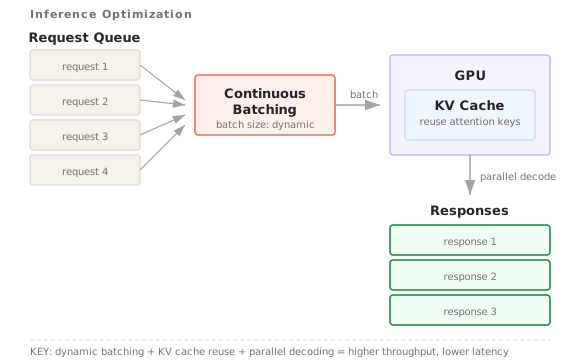
Continuous batching is the single most impactful optimization for throughput. Traditional batching waits until it has collected N requests, processes them together, and returns all results. The problem is that LLM requests vary wildly in length. A short request finishes quickly but has to wait for the longest request in the batch before its slot is freed. Continuous batching (also called iteration-level batching) solves this by managing the batch at the token level rather than the request level. When a short request finishes, its slot is immediately filled by the next waiting request. The GPU stays saturated. No slot sits idle waiting for a long generation to complete. This alone can improve throughput by 5-10x compared to naive sequential processing.
KV cache optimization addresses the memory bottleneck. During generation, the model stores key-value states for every token it has processed. These states are reused when generating subsequent tokens so the model does not have to recompute attention over the entire sequence for each new token. The problem is that these caches grow linearly with sequence length and batch size, and they consume GPU memory that could otherwise be used for larger batches. PagedAttention, the technique behind vLLM, manages KV cache memory like an operating system manages virtual memory. It allocates cache in non-contiguous pages, eliminating the memory fragmentation that wastes 60-80% of KV cache memory in naive implementations. This allows you to fit more concurrent requests in the same GPU memory.
Model parallelism distributes the model across multiple GPUs when it does not fit in one. Tensor parallelism splits individual layers across GPUs, allowing each forward pass to use all available devices. Pipeline parallelism assigns different layers to different GPUs, creating a pipeline where multiple requests are processed at different stages simultaneously. The choice between them depends on your hardware topology and latency requirements. Tensor parallelism reduces per-request latency. Pipeline parallelism maximizes aggregate throughput.
Flash Attention reimplements the attention computation to be aware of the GPU memory hierarchy. Standard attention computation creates large intermediate matrices that spill out of fast on-chip SRAM into slower GPU HBM. Flash Attention tiles the computation so that intermediate results stay in SRAM, reducing memory reads and writes. The result is faster attention computation and lower memory usage, which translates directly into faster generation and the ability to handle longer sequences.
When should you use Inference Optimization?
These optimizations matter when you are running models at scale and either cost or latency is a pressing concern. If you are making a handful of API calls per day to a hosted provider, none of this applies. The provider is already doing this work on their end.
Inference optimization becomes relevant when you are self-hosting models. The moment you are paying for GPU time directly, every percentage point of utilization improvement translates to real savings. It also matters when you are hitting latency targets. If your application needs sub-second responses and the model takes two seconds, no amount of prompt engineering will fix that. You need the inference itself to be faster.
Continuous batching should be your first optimization. It provides the largest improvement with the least effort because mature frameworks like vLLM, TGI (Text Generation Inference), and TensorRT-LLM implement it out of the box. Deploying your model through one of these frameworks instead of a naive serving script is often the only optimization you need.
What are the common pitfalls?
Optimizing inference is systems engineering, and systems engineering has sharp edges. Aggressive batching increases memory pressure. If your batch size exceeds available GPU memory, requests start failing. You need monitoring and backpressure mechanisms to prevent over-subscription.
KV cache memory management introduces complexity. PagedAttention is well-tested in frameworks like vLLM, but custom implementations or edge cases (very long sequences, unusual model architectures) can trigger bugs that produce incorrect outputs silently. Always validate outputs after changing your inference stack.
Model parallelism adds communication overhead between GPUs. The speed of the interconnect (NVLink, PCIe, InfiniBand) becomes a critical factor. On hardware with slow inter-GPU communication, the overhead of parallelism can exceed its benefits, making a single larger GPU a better choice than multiple smaller ones.
The optimization frameworks themselves move fast. Breaking changes, version incompatibilities with specific model architectures, and subtle differences in numerical behavior between frameworks are common. Treat your inference stack as production infrastructure that needs testing, monitoring, and version management.
What are the trade-offs?
Complexity increases with each optimization layer. A model served through a basic Python script is easy to debug. A model served through vLLM with tensor parallelism, PagedAttention, and CUDA graph optimization has many more potential failure points. You are trading simplicity for performance.
These optimizations are hardware-specific. A configuration that works well on A100 GPUs may perform differently on H100s or on AMD hardware. Benchmarking on your actual deployment hardware is essential. Published benchmark numbers from other setups are directional at best.
Some optimizations trade latency for throughput or vice versa. Larger batch sizes improve throughput but increase the time any individual request waits. Model parallelism strategies have different latency and throughput profiles. Your choice should be guided by which metric matters more for your application.
The effort to maintain an optimized inference stack is ongoing. New model architectures may not work with existing optimizations. Framework updates require testing. Hardware upgrades require re-tuning. This is not a one-time setup.
Goes Well With
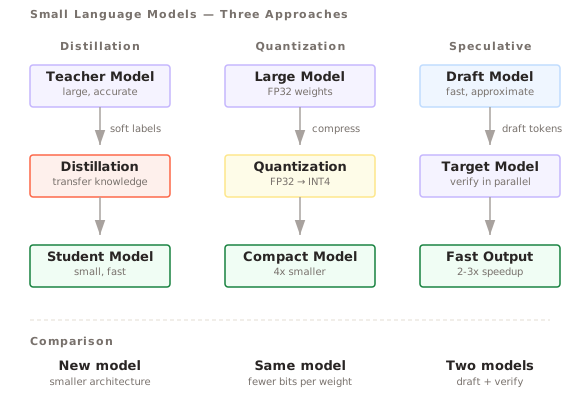
Small Language Models reduce the baseline resource requirements, making all inference optimizations more effective. Optimizing a 7B model's inference is easier and cheaper than optimizing a 70B model. The smaller memory footprint leaves more room for larger batches and longer sequences.
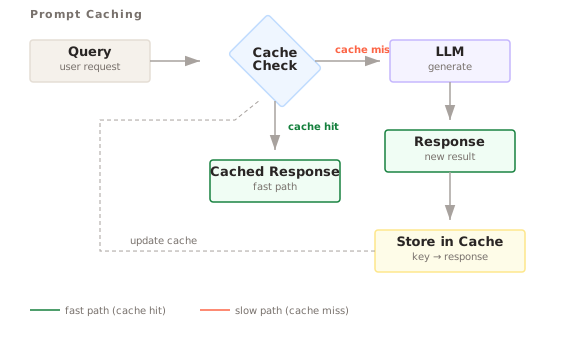
Prompt Caching at the server level (prefix caching) is itself an inference optimization, and it compounds with the techniques described here. Reusing KV cache states across requests that share a prefix means less computation and less memory pressure per request.
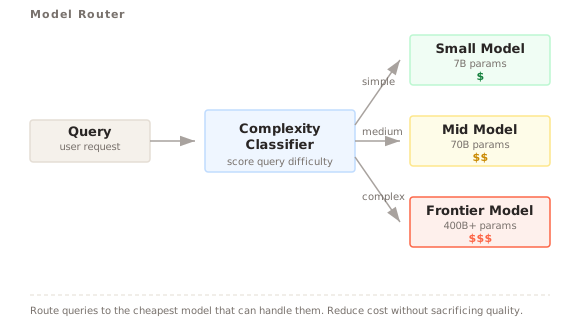
Model Router determines which requests need a powerful model and which can be handled by a lightweight one. Inference optimization ensures that whichever model handles a request does so efficiently. The router reduces how many requests hit the expensive model. Inference optimization reduces the cost of each request that does.
References
- Kwon, W., et al. (2023). Efficient Memory Management for Large Language Model Serving with PagedAttention. SOSP 2023.