How do they differ?
Chain-of-Thought (CoT) and Self-Consistency are closely related prompting techniques, but they solve different problems and operate at different points on the cost-accuracy spectrum. Understanding the relationship between them is the key to choosing correctly.
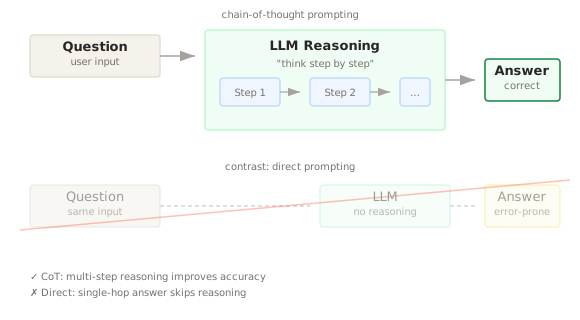
Chain-of-Thought prompting asks the model to show its reasoning step by step before arriving at a final answer. You get one completion, one reasoning trace, one answer. The technique works because it forces the model to allocate more computation to the problem, keeping intermediate results visible in the output where they can inform subsequent steps. Without CoT, a model tends to skip straight to a final answer. With CoT, it walks through the logic, which dramatically reduces errors on math, logic, and multi-step reasoning tasks.
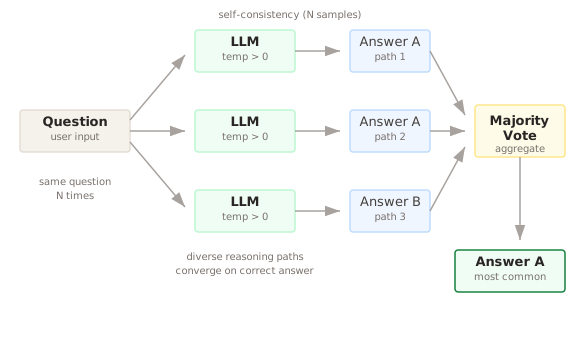
Self-Consistency takes a different approach to the same underlying problem. Instead of trusting a single reasoning path, it generates multiple independent CoT traces by calling the model several times with temperature above zero. Each call produces its own step-by-step reasoning and its own final answer. Then you extract the final answers from all samples and pick the one that appears most frequently. The majority vote wins.
The critical thing to understand is that Self-Consistency is not an alternative to Chain-of-Thought. It is Chain-of-Thought run multiple times with a voting layer on top. CoT is a prerequisite. Self-Consistency without step-by-step reasoning is just sampling multiple short answers, which provides far less benefit because the diversity of reasoning paths is what makes the voting meaningful.
| Dimension | Chain-of-Thought | Self-Consistency |
|---|---|---|
| API calls per query | 1 | N (typically 5-20) |
| Cost multiplier | 1x | Nx (linear with sample count) |
| Latency | Single call latency | Parallel calls possible, but still Nx tokens generated |
| Accuracy on reasoning tasks | Strong improvement over direct prompting | Further improvement over single CoT |
| Best for | Most reasoning tasks where cost matters | High-stakes tasks with a definitive correct answer |
| Implementation complexity | Minimal (prompt modification) | Moderate (sampling, answer extraction, voting) |
| Works with | Any LLM that follows instructions | Any LLM, but requires temperature > 0 |
| Output format | Single reasoning trace + answer | Multiple traces + consensus answer |
When to use Chain-of-Thought
Chain-of-Thought is the right default for most reasoning tasks. It is simple, cheap, and effective. Here are the scenarios where single-path CoT is sufficient.
Cost-sensitive applications. If you are processing thousands of queries per day and each query only justifies a single API call, CoT gives you the best accuracy improvement for your budget. The difference between zero reasoning and one reasoning trace is much larger than the difference between one trace and five traces.
Open-ended tasks. Self-Consistency works by taking a majority vote, which assumes there is one correct answer to converge on. For tasks like writing, summarization, or creative brainstorming, there is no single correct answer. CoT helps the model think more carefully, but voting across multiple open-ended outputs does not produce a meaningful "consensus." Stick with a single CoT trace.
Latency-critical paths. If your application needs to respond within a few hundred milliseconds, you cannot afford to wait for five or ten parallel completions. One CoT call is your speed ceiling.
Prototyping and development. When you are still iterating on your prompt design, start with CoT. Get the single-path accuracy as high as possible before investing in multi-path sampling. A well-crafted CoT prompt often eliminates the need for Self-Consistency entirely.
Tasks the model already handles well. If your single CoT prompt is already achieving 95%+ accuracy on your evaluation set, adding Self-Consistency will produce diminishing returns. The marginal accuracy gain from voting may not justify the cost.
When to use Self-Consistency
Self-Consistency shines in specific situations where the extra cost is justified by the accuracy requirements.
High-stakes decisions with a correct answer. Medical triage, financial calculations, legal clause interpretation. When a wrong answer has real consequences and the task has a definitive right answer, spending 5-10x more per query is often worthwhile. Self-Consistency can push accuracy from 85% to 95% on these tasks.
Math and formal reasoning. Self-Consistency was originally evaluated on arithmetic, commonsense, and symbolic reasoning benchmarks, and this is still where it performs best. The model can reach the same correct answer through multiple valid reasoning paths, while incorrect answers tend to be scattered across different wrong values. This makes majority voting highly effective.
Batch processing where latency does not matter. If you are grading exams, processing insurance claims overnight, or running weekly compliance checks, the extra time and cost per query is negligible compared to the value of higher accuracy.
When you need confidence estimation. Self-Consistency gives you a natural confidence signal. If 9 out of 10 samples agree, you can be fairly confident in the answer. If the vote is split 4-3-3, the model is uncertain. You can use this signal to route low-confidence queries to a human reviewer, which is something single-path CoT cannot provide.
Reducing variance in production. Even if your average accuracy is acceptable with single CoT, the variance might not be. Self-Consistency smooths out the randomness. If the same query sometimes gets the right answer and sometimes does not, voting across samples makes the system more predictable.
Can they work together?
They are designed to work together. Self-Consistency is literally CoT plus sampling plus voting. You cannot run Self-Consistency without first having a Chain-of-Thought prompt.
The practical architecture looks like this. You write a strong CoT prompt, either zero-shot ("Let us think step by step") or few-shot (with worked examples). Then you decide at the routing level whether a given query gets single-path or multi-path treatment.
A common production pattern is to use single CoT by default and escalate to Self-Consistency when the task is flagged as high-stakes or when a first-pass answer has low confidence. Some teams run two CoT samples as a quick check. If both agree, they return the answer immediately. If they disagree, they sample three more and take the majority vote. This adaptive approach keeps average cost low while providing high reliability where it matters.
You can also combine Self-Consistency with other techniques. For instance, you might use few-shot CoT for the prompt format, Self-Consistency for sampling, and then pass the majority answer through a verification step (like LLM-as-Judge or a domain-specific validator). Each layer adds reliability, and they compose cleanly because they operate at different stages of the pipeline.
Common mistakes
Running Self-Consistency with temperature zero. If the temperature is zero, every sample produces the same output. There is no diversity in reasoning paths and no benefit from voting. Self-Consistency requires temperature above zero, typically between 0.5 and 0.7 for a good balance of diversity and quality.
Using Self-Consistency for open-ended generation. Asking five samples to write a marketing email and then picking the "majority" does not make sense. There is no correct answer to vote on. Use Self-Consistency only for tasks with a convergent correct answer.
Too few samples. Three samples is better than one, but it is a small voting pool. With three samples, a single outlier can swing the result. Five to ten samples is the typical sweet spot for reliability without excessive cost. Beyond fifteen, you usually see diminishing returns.
Ignoring the CoT prompt quality. Self-Consistency amplifies whatever your base prompt produces. If your CoT prompt is poorly written and the model only gets the right answer 40% of the time, majority voting across ten samples will still get it wrong frequently. Fix the prompt first. Self-Consistency is not a substitute for good prompt engineering.
Not extracting answers correctly. The voting step requires you to extract the final answer from each reasoning trace. If your extraction logic is brittle, it will misparse some answers and corrupt the vote. Use structured output formats (like asking the model to put its final answer in a specific tag) to make extraction reliable.
Assuming Self-Consistency always helps. On tasks where the model is already highly accurate, Self-Consistency adds cost without meaningful accuracy gains. On tasks where the model is fundamentally incapable (like questions requiring knowledge it does not have), more samples of wrong answers do not produce a right one. Self-Consistency helps most in the middle range, where the model gets it right more often than not but not reliably enough for your requirements.
References
- Wei, J., Wang, X., Schuurmans, D., et al. "Chain-of-Thought Prompting Elicits Reasoning in Large Language Models." NeurIPS 2022.
- Wang, X., Wei, J., Schuurmans, D., et al. "Self-Consistency Improves Chain of Thought Reasoning in Language Models." ICLR 2023.
- Kojima, T., Gu, S.S., Reid, M., et al. "Large Language Models are Zero-Shot Reasoners." NeurIPS 2022.
- Fu, Y., Peng, H., Sabharwal, A., et al. "Complexity-Based Prompting for Multi-Step Reasoning." ICLR 2023.