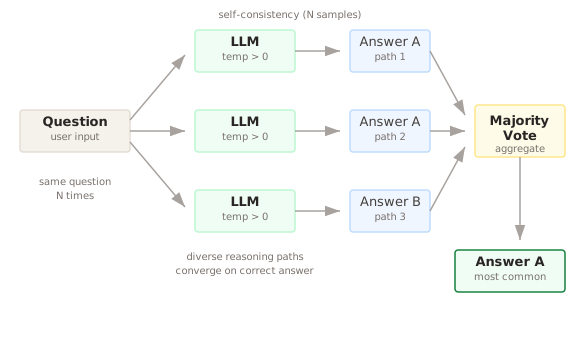
Self-Consistency is a decoding strategy that samples multiple chain-of-thought reasoning paths from the LLM and selects the final answer by majority vote. By generating diverse reasoning traces and aggregating results, it reduces errors from any single reasoning path.
What problem does Self-Consistency solve?
Language models are stochastic. Ask the same question twice with any temperature above zero and you might get two different answers. One might be correct. The other might be plausible but wrong. You have no reliable way to tell which is which from a single response.
This randomness is a feature for creative tasks. You want variation when brainstorming or writing fiction. But for tasks with a definitive correct answer, like math problems, factual questions, or logical deductions, randomness is a liability. You are rolling a die every time you call the API, and sometimes the die lands on the wrong face.
The problem is amplified when tasks involve multiple reasoning steps. Each step introduces its own chance of error. A five-step reasoning chain where each step has 90% accuracy only produces the correct final answer about 59% of the time. One bad step anywhere in the chain can derail the entire result. Calling the model once and hoping for the best is a fragile strategy.
How does Self-Consistency work?
Self-consistency takes a simple insight and applies it systematically. If you ask multiple people the same question independently and most of them agree on the answer, that answer is probably correct. The same logic applies to multiple samples from a language model.
The process works like this. You send the same prompt to the model multiple times with a temperature above zero, generating several independent responses. Each response follows its own reasoning path and arrives at its own answer. You extract the final answer from each response and pick the one that appears most frequently. The majority wins.
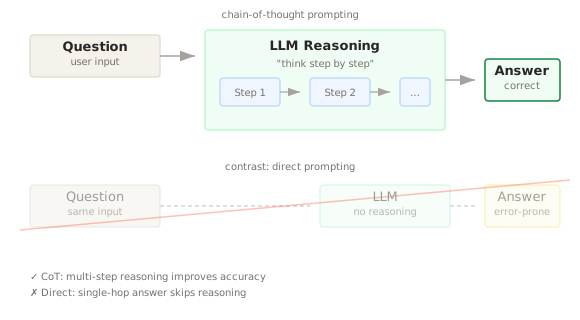
This works especially well when combined with Chain-of-Thought prompting. Each sample generates a full reasoning trace, not just a bare answer. Different samples will take different reasoning paths. Some paths will contain errors, but the errors tend to be different across samples. The correct answer, on the other hand, can be reached through many valid reasoning paths. So the correct answer shows up more often than any particular wrong answer.
Think of it as error cancellation through diversity. A single wrong answer might be very convincing on its own. But when five out of seven samples agree on a different answer, you have strong evidence that the majority is right. The stochastic nature of generation, which was the problem, becomes the solution. Randomness generates the diversity you need for the vote to be meaningful.
When should you use Self-Consistency?
Self-consistency is most valuable when the task has a clear, extractable answer. Math problems, multiple-choice questions, yes/no decisions, classifications with a fixed label set. Anything where you can unambiguously identify and compare the final answers across samples.
It is particularly effective for reasoning-heavy tasks where Chain-of-Thought is already improving accuracy. CoT gets you part of the way there by making the model show its work. Self-consistency gets you further by aggregating across multiple reasoning attempts.
Use it when correctness matters more than speed or cost. If a wrong answer has significant consequences and you can tolerate higher latency and API costs, self-consistency is a straightforward way to buy reliability.
It is less useful for open-ended generation tasks. If you ask the model to write an email, there is no single correct answer to vote on. Each sample will be different in legitimate ways, and "majority vote" does not have a clear meaning. Similarly, if the task is so easy that the model gets it right on the first try nearly every time, self-consistency adds cost without adding value.
What are the common pitfalls?
The most fundamental failure is systematic bias. If the model consistently gets a particular type of problem wrong, generating more samples will not help. You will get a confident majority vote on the wrong answer. Self-consistency corrects for random errors, not systematic ones. If there is a flaw in how the model understands the problem, all samples will share that flaw.
Answer extraction can be surprisingly tricky. Different samples may express the same answer in different ways. "42," "the answer is 42," "forty-two," and "approximately 42.0" are all the same answer, but naive string matching will treat them as four different responses. You need a robust extraction and normalization step, and getting this wrong silently undermines the entire technique.
The number of samples matters and there is no universal right answer. Too few samples and the vote is unreliable. Too many and you are burning tokens for diminishing returns. For most tasks, five to ten samples is a reasonable starting point, but the optimal number depends on the difficulty of the task and the baseline accuracy of the model.
Temperature selection is another tuning knob. Too low and all samples will be nearly identical, defeating the purpose. Too high and the samples become unreliable individually, which can reduce the quality of the aggregate. You want enough diversity for different reasoning paths without introducing so much noise that the samples are nonsensical.
What are the trade-offs?
Cost scales linearly with the number of samples. If you generate seven samples, you pay for seven API calls. For high-volume applications, this can be prohibitive. It is worth calculating whether the accuracy improvement justifies the multiplied cost, and the answer depends entirely on what a wrong answer costs your users or your business.
Latency depends on your infrastructure. If you can make all the API calls in parallel, latency is roughly the same as a single call (bounded by the slowest response). If you must make them sequentially, latency multiplies just like cost. Parallel execution is strongly preferred.
Self-consistency does not improve the model's ceiling. It cannot produce correct answers that none of the individual samples would have produced. It filters noise from a distribution that already contains the right answer somewhere. If the model is fundamentally incapable of solving the problem, more samples will not help.
There is also an implementation complexity cost. You need to handle multiple API calls, extract answers from each response, normalize them for comparison, implement the voting logic, and handle edge cases like ties. None of this is difficult, but it is infrastructure that you need to build and maintain.
Goes Well With
Chain-of-Thought is the most natural pairing. CoT generates diverse reasoning paths, and self-consistency aggregates across them. Without CoT, the model's direct answers may not vary enough across samples for the vote to be meaningful. CoT creates the reasoning diversity that self-consistency exploits.
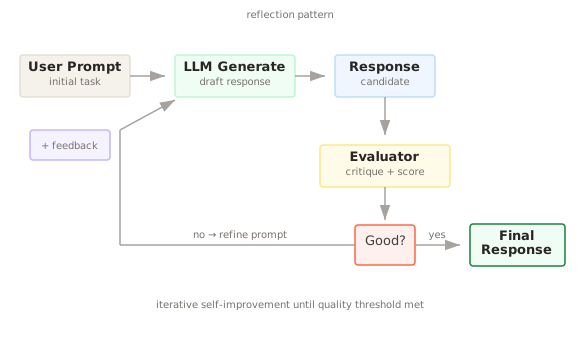
Reflection offers a different approach to the same goal. Where self-consistency uses parallel samples and voting, reflection uses sequential iteration and critique. You could combine both: generate multiple samples, vote on the best answer, and then run a reflection loop to verify and refine the winner.
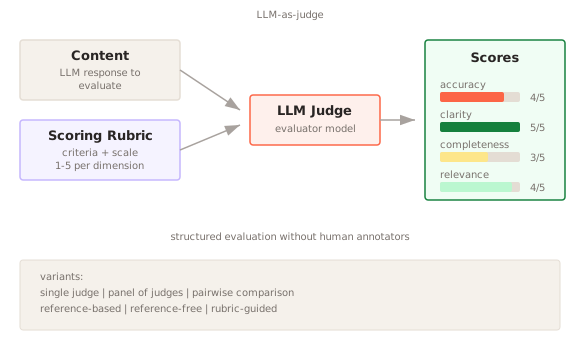
LLM-as-Judge provides a more sophisticated aggregation strategy than simple majority vote. Instead of counting which answer appears most often, you could use a judge model to evaluate each sample's reasoning quality and select the best-argued answer rather than the most common one. This is more expensive but can be more accurate when the samples are close.
References
- Wang, X., et al. (2023). Self-Consistency Improves Chain of Thought Reasoning in Language Models. ICLR 2023.
Further Reading
- Wang et al., "Self-Consistency Improves Chain of Thought Reasoning in Language Models" (2022) — Introduces the idea of sampling multiple reasoning paths and taking the majority answer, showing significant accuracy gains over single-path chain-of-thought. arXiv:2203.11171