How do they differ?
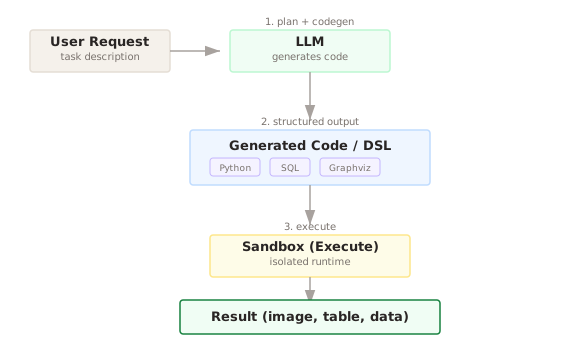
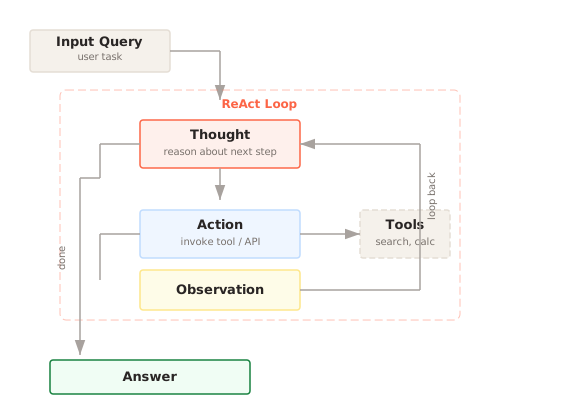
Code Execution and ReAct Loop operate at different levels of abstraction. Code Execution is a capability. It gives an LLM access to a runtime environment where it can write and execute code, then observe the results. ReAct Loop is an orchestration pattern. It structures how an LLM reasons about a task, decides what action to take, observes the result, and repeats. One is a tool. The other is the framework that decides when and how to use tools.
Code Execution solves a specific class of problems: tasks that require computational precision. When an LLM needs to calculate a compound interest schedule, parse a CSV file, generate a chart, run a statistical test, or transform data, natural language reasoning is the wrong tool. The model generates code, executes it in a sandboxed runtime, and returns the exact result. No approximation, no hallucinated arithmetic.
ReAct Loop solves a broader class of problems: tasks that require multiple steps of reasoning and action. The model thinks about what it needs to do (Thought), takes an action (Act), observes the result (Observation), and decides the next step. The actions can be anything available to the agent: web searches, API calls, database queries, file operations, and yes, code execution. ReAct is the conductor. Code Execution is one instrument in the orchestra.
This means comparing them directly is a bit like comparing a hammer to a construction project plan. They are not alternatives. They are at different levels. But understanding when each is the primary pattern driving your solution is genuinely useful.
| Dimension | Code Execution | ReAct Loop |
|---|---|---|
| Abstraction level | Tool / capability | Orchestration pattern |
| Primary problem | Computational precision | Multi-step reasoning and action |
| Scope | Single execution step | Full task lifecycle |
| Input | Code (Python, JS, SQL, etc.) | Natural language task description |
| Output | Execution result (deterministic) | Final answer after multiple steps |
| Error handling | Runtime errors, syntax errors | Reasoning errors, tool selection errors, loops |
| Sandboxing needs | Critical (untrusted code execution) | Depends on which tools are available |
| Typical latency | Milliseconds to seconds per execution | Seconds to minutes for full task |
| Autonomy | None. Executes exactly what is written. | High. Decides its own actions. |
What Code Execution actually provides
Code Execution is not just "running code." It is a pattern for giving LLMs access to a computational substrate that they otherwise lack. LLMs are language machines. They process tokens. They cannot actually perform arithmetic, manipulate data structures, or interact with file systems through their core inference mechanism. They simulate these operations, often incorrectly.
Code Execution bridges this gap. The model generates code that performs the precise operation needed, a sandbox executes that code, and the result is fed back into the model's context. The model then reasons about the result and decides the next step.
The sandbox is essential. Because the code is generated by an LLM, it is untrusted by definition. The execution environment must be isolated: no network access (or restricted network access), no access to the host filesystem, resource limits on CPU and memory, and a timeout to prevent infinite loops. Docker containers, Firecracker microVMs, and browser-based sandboxes (like Pyodide) are common choices.
The types of problems that Code Execution solves well:
- Mathematical computation. Anything beyond basic arithmetic. Financial calculations, statistical analysis, geometric computations, optimization problems.
- Data transformation. Parsing JSON, CSV, XML. Filtering, grouping, aggregating datasets. Format conversion.
- Visualization. Generating charts, graphs, and diagrams using matplotlib, D3, or similar libraries.
- String manipulation. Regex operations, text parsing, format validation.
- Verification. The model can write code to verify its own claims. "Let me check that calculation" becomes a concrete operation, not just a rephrasing.
What ReAct Loop actually provides
ReAct gives an LLM a structured way to break down complex tasks and work through them step by step. Without ReAct, an LLM receives a prompt and generates a single response. With ReAct, the LLM enters a loop: reason about the current state, select and execute an action, observe the result, and reason again.
The "Thought" step is what separates ReAct from simple tool calling. Before taking an action, the model explicitly articulates its reasoning. "I need to find the population of each country in the EU, then calculate the total. Let me start by searching for a list of EU member states." This reasoning trace serves multiple purposes. It grounds the model's next action in explicit logic, making it less likely to take irrelevant actions. It provides a debug trace for developers. And it allows the model to self-correct when it realizes its reasoning is heading in the wrong direction.
The "Act" step is where the model selects from its available tools and invokes one. This is where Code Execution often shows up as one option among many. The model might choose to search the web, query a database, read a file, call an API, or execute code, depending on what the current step requires.
The "Observation" step feeds the tool's output back into the model's context, and the loop continues.
ReAct excels at tasks where:
- The path to the answer is not obvious. Research questions, investigation tasks, debugging sessions.
- Multiple information sources need to be consulted. Cross-referencing data from different APIs, documents, or databases.
- The task requires adaptive decision-making. Each step's result influences what the next step should be.
- The agent needs to recover from dead ends. A search returns no results, so the agent reformulates the query.
When to use Code Execution as the primary pattern
Sometimes the task is fundamentally computational, and the orchestration overhead of a ReAct loop is unnecessary.
Single-step computational tasks. If the user asks "What is the monthly payment on a $350,000 mortgage at 6.5% for 30 years?" the model should generate the amortization formula in Python, execute it, and return the result. There is no multi-step reasoning needed. No tools to select between. Just code and a result.
Data analysis on provided data. The user uploads a CSV and asks "What is the average revenue by region?" The model writes a pandas script, executes it, and returns the answer. The data is already available. No retrieval or external lookups needed.
Code generation and testing. When the task is to write code, the ability to execute and test that code immediately is the primary value. The model generates a function, runs it against test cases, sees failures, fixes the code, and re-runs. This is a loop, but it is a code execution loop, not a tool-selection loop.
Reproducible computations. When you need an audit trail showing exactly how a result was computed, code execution provides that. The generated code is the audit trail. Natural language reasoning is not verifiable in the same way.
Visualization. Generating charts and images requires code execution. There is no alternative. The model cannot hallucinate a correct PNG file.
When to use ReAct Loop as the primary pattern
ReAct is the right choice when the task requires reasoning about which actions to take, not just executing a computation.
Research and information gathering. "Find the three most recent papers on transformer alternatives and summarize their key findings." This requires searching, reading, evaluating relevance, possibly following citations, and synthesizing. Each step informs the next.
Multi-tool workflows. When the agent needs to combine web search, document retrieval, API calls, and code execution in a single task, ReAct provides the framework for deciding which tool to use at each step.
Tasks with ambiguous requirements. If the user's request is vague or underspecified, the agent needs to reason about what information it needs and how to get it. ReAct's explicit thought step is where this reasoning happens.
Error recovery and retries. When a tool call fails (API returns an error, search returns no results, code throws an exception), ReAct's reasoning step lets the agent diagnose the failure and try an alternative approach. Without this reasoning loop, a failed tool call is a dead end.
Goal-directed behavior over multiple steps. "Set up a new project with a PostgreSQL database, create the schema, seed it with test data, and verify the setup." This requires orchestrating multiple tools in sequence, with each step's success verified before proceeding.
Can they work together?
This is not really a "can they" question. They almost always work together. The standard architecture for capable AI agents is a ReAct loop with Code Execution as one of the available tools.
Consider an agent asked to analyze sales data and produce a chart. The ReAct loop drives the overall process: first it reasons that it needs to fetch data from an API (Act: API call), then it reasons that it needs to compute monthly trends (Act: execute Python code with pandas), then it reasons that it needs a visualization (Act: execute matplotlib code). The Code Execution steps handle the computation and charting. The ReAct loop decides what to compute and when.
Neither pattern alone could handle this task. ReAct without Code Execution would try to compute averages through natural language reasoning and produce incorrect results. Code Execution without ReAct would have no way to decide that it needs to call an API first, then compute, then visualize.
LangChain, LlamaIndex, and most modern agent frameworks implement this combination natively. You define tools (including a code execution tool), and the agent uses a ReAct-style loop to orchestrate them.
Common mistakes
Using ReAct for pure computation. If the task is "calculate the standard deviation of these 50 numbers," do not spin up a multi-step reasoning loop. Generate the code, execute it, return the result. The ReAct overhead adds latency and token cost with no benefit.
Using Code Execution without sandboxing. This is a security issue, not just a best practice. LLM-generated code can contain anything: file deletions, network calls, infinite loops, resource exhaustion. Always sandbox. No exceptions.
Not providing Code Execution as a tool in ReAct agents. Many ReAct implementations only include search and API tools. When the agent encounters a computational step, it tries to reason through the math in natural language and gets it wrong. Always include a code execution tool for agents that might encounter quantitative tasks.
Overloading the code execution step. Generating a 200-line script in a single execution step is fragile. If it fails, the error message is hard to diagnose. Break complex computations into smaller scripts, each doing one thing. This mirrors good software engineering practice and gives the agent better error signals.
Not including execution output in the ReAct observation. If the code execution produces output but the agent only sees "execution successful," it cannot reason about the results. Feed the full output (stdout, return values, generated files) back into the observation step.
Ignoring execution failures. When code throws an exception, the agent should see the traceback and reason about the fix. Some implementations swallow errors or return generic failure messages. This prevents the agent from self-correcting.
References
- Yao, S. et al. (2022). "ReAct: Synergizing Reasoning and Acting in Language Models." arXiv:2210.03629.
- Chen, W. et al. (2022). "Program of Thoughts Prompting: Disentangling Computation from Reasoning for Numerical Reasoning Tasks." arXiv:2211.12588.
- Gao, L. et al. (2023). "PAL: Program-Aided Language Models." arXiv:2211.10435.
- OpenAI Code Interpreter documentation.
- E2B (e2b.dev) documentation on sandboxed code execution for AI agents.