How do they differ?
Every LLM application that involves multi-turn interaction eventually runs into the same problem: the model has no memory unless you give it one. These two patterns address that problem at different time horizons.
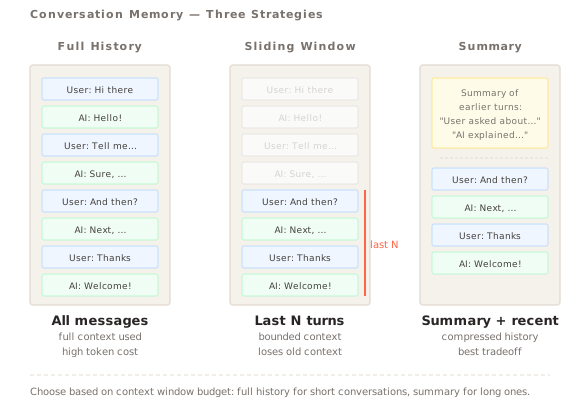
Conversation Memory is about managing context within a single session. The user starts a chat, sends several messages, and expects the model to remember what was said earlier in the same conversation. The challenge is that context windows are finite, so you need strategies for what to keep, what to summarize, and what to drop as the conversation grows.
Long-Term Memory is about persisting information across sessions. The user comes back tomorrow, next week, or next month, and expects the system to remember their name, their preferences, their project details, or the decisions they made last time. This requires external storage, retrieval mechanisms, and a strategy for what is worth remembering.
| Dimension | Conversation Memory | Long-Term Memory |
|---|---|---|
| Scope | Single session | Cross-session, indefinite |
| Lifespan | Ephemeral (dies with the session) | Durable (persists in external store) |
| Storage | In the context window | Vector database, key-value store, or graph |
| Primary challenge | Fitting relevant context into limited tokens | Deciding what to store and how to retrieve it |
| Techniques | Sliding window, summarization, token budgeting | Embedding and retrieval, entity extraction, memory consolidation |
| Latency | Minimal (just prompt construction) | Adds retrieval step (embedding search, DB query) |
| Data sensitivity | Contained to session | Requires data retention policies, privacy controls |
| Failure mode | Losing important context mid-conversation | Retrieving stale or irrelevant memories |
The fundamental difference is temporal. Conversation Memory asks "what matters right now in this conversation?" Long-Term Memory asks "what should I remember about this user forever?"
When to use Conversation Memory
Conversation Memory is essential for any multi-turn interaction, even short ones. Here are the scenarios where it is the primary concern.
Standard chatbot conversations. Any chat interface where the user sends more than one message. Without conversation memory, the model treats each message as independent and loses all context. Even a two-turn exchange ("What is the capital of France?" followed by "What about Germany?") requires the model to remember the first question to interpret the second one correctly.
Long-running work sessions. A developer using an AI coding assistant might have a conversation that spans hundreds of messages over several hours. The context window fills up fast. You need a strategy for retaining the most relevant parts of the conversation, whether that is a sliding window that keeps the most recent N messages, a running summary of earlier messages, or a hybrid approach.
Task-oriented dialogues. Booking a flight, filling out a form, configuring a system. These conversations have a clear state that evolves across turns (departure city, arrival city, date, passengers). Conversation memory needs to track this state reliably so the model does not ask the user to repeat information.
Multi-step reasoning. If the model is working through a complex problem across several messages, it needs access to earlier reasoning steps. Summarization can lose critical details here, so a sliding window with a larger budget or selective retention of key messages is often better.
Conversations with tool use. When the model calls tools (APIs, databases, code execution), the results need to stay in context for subsequent reasoning. Tool outputs can be verbose, so you often need to summarize them more aggressively than user messages while retaining the key data points.
The core techniques are well established. A sliding window keeps the last N messages (or last N tokens). Summarization compresses older messages into a shorter form. Token budgeting allocates portions of the context window to different types of content (system prompt, recent messages, summary, tool results). Most implementations combine these approaches.
When to use Long-Term Memory
Long-Term Memory becomes necessary when the system needs to behave as if it knows the user, not just the current conversation.
Personalized assistants. A personal AI assistant that knows your communication preferences, your team members' names, your project deadlines, and your dietary restrictions. This information was established in past conversations and should be available in every future conversation without the user repeating it.
Customer support systems. When a customer contacts support for the third time about the same issue, the agent should know the history. What was the original problem? What solutions were tried? What was the outcome? This cross-session continuity dramatically improves the experience and reduces resolution time.
Learning and tutoring applications. An AI tutor that tracks what the student has already learned, where they struggle, and what explanations worked well for them. This profile builds over weeks or months and informs how new material is presented.
Professional tools with user context. A legal research assistant that remembers which jurisdiction the lawyer works in, which cases they have cited before, and what their client's key arguments are. A medical assistant that remembers a patient's history and conditions. These are contexts where forgetting is not just inconvenient but potentially harmful.
Enterprise knowledge management. Teams that use AI assistants for project planning, decision tracking, and institutional knowledge. The assistant becomes a shared memory layer that captures decisions, rationale, and context that would otherwise be lost in email threads and meeting notes.
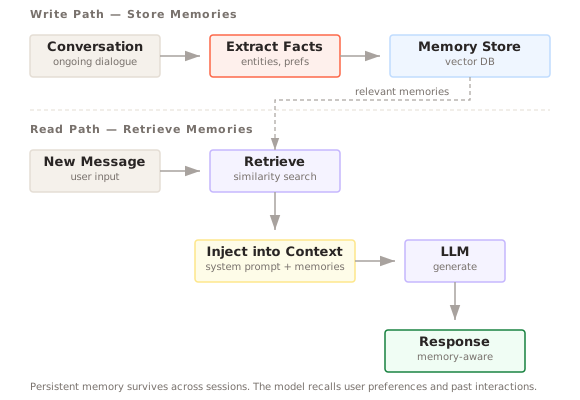
The implementation typically involves three components. First, an extraction step that identifies facts worth remembering from conversations (user preferences, stated facts, decisions, entity relationships). Second, a storage layer, usually a vector database for semantic retrieval, sometimes augmented with a structured store for entity data. Third, a retrieval step at the start of each conversation that pulls relevant memories into the context window.
Can they work together?
Not only can they work together, in most production systems they must. A well-built chatbot uses both patterns simultaneously, and they complement each other cleanly.
Here is how the typical integration works. At the start of a new conversation, the system retrieves relevant long-term memories based on the user's identity and any initial context. These memories are injected into the system prompt or an early section of the context window. As the conversation progresses, conversation memory manages the growing message history using sliding windows and summarization. If important new facts emerge during the conversation (the user mentions a new project, changes a preference, makes a decision), the system extracts these and writes them to long-term storage.
The context window budget gets divided among several competing needs: system instructions, long-term memories, conversation summary, recent messages, and tool results. Getting this allocation right is one of the trickier engineering problems. Too many long-term memories crowd out the recent conversation. Too few make the assistant seem forgetful across sessions.
A practical architecture looks like this:
- User sends a message.
- Retrieve relevant long-term memories (embedding similarity search against the user's memory store).
- Construct the prompt: system instructions + retrieved memories + conversation summary + recent messages + new user message.
- Generate a response.
- Append the user message and assistant response to the conversation history.
- If the conversation history exceeds the token budget, summarize older messages.
- Asynchronously extract any new facts from the exchange and write them to long-term storage.
The asynchronous extraction in step 7 is important. You do not want memory writes to add latency to the response. Run the extraction as a background job after the response is sent.
Some systems add a memory reflection step where periodically (every N conversations, or on a schedule) the system reviews and consolidates long-term memories. This catches contradictions (the user said they live in New York in March, but mentioned moving to London in June), merges related facts, and prunes outdated information.
Common mistakes
Treating the entire conversation history as memory. Dumping every message into the context window works for the first ten turns. Then the context fills up, the model starts losing earlier context, and response quality degrades. You need an active management strategy, not just concatenation.
Summarizing too aggressively. Summarization loses detail. If the user established specific requirements in message 3 and you summarized them into "the user discussed their requirements," you have lost the actual requirements. Summarization should be lossy compression, not information destruction. Keep specific numbers, names, decisions, and constraints in the summary.
Storing everything in long-term memory. Not every conversational exchange deserves to be remembered. "Thanks, that helps!" is not a useful long-term memory. Overeager extraction fills the memory store with noise, which degrades retrieval quality. Be selective: store facts, preferences, decisions, and entities. Skip acknowledgments, pleasantries, and transient queries.
Retrieving too many memories. If you retrieve twenty long-term memories at the start of every conversation, you consume a large portion of the context window with potentially irrelevant information. Retrieve a focused set (three to seven memories) based on the current conversation's topic. You can always retrieve more as the conversation reveals what is relevant.
No memory expiration or update mechanism. People change. Preferences shift. Projects end. If your long-term memory has no mechanism for updating or expiring old facts, the system will confidently act on outdated information. Timestamp your memories. Implement conflict resolution. Let users correct the system.
Ignoring privacy implications of long-term memory. Storing user facts across sessions creates a persistent data asset. Users should know what is being remembered, have the ability to view and delete their memories, and the system should comply with data retention regulations. Conversation memory is ephemeral and less risky. Long-term memory requires deliberate privacy engineering.
Using the same retrieval strategy for all memory types. Semantic similarity search works well for topical memories but poorly for temporal queries ("What did we discuss last Tuesday?") or relational queries ("Who is my manager?"). Consider a hybrid approach: vector search for topical retrieval, structured queries for temporal and relational data.
References
- Park, J.S., et al. "Generative Agents: Interactive Simulacra of Human Behavior." UIST 2023.
- Wang, L., et al. "A Survey on Large Language Model Based Autonomous Agents." Frontiers of Computer Science 2024.
- LangChain Documentation. "Memory Types." 2024.
- LlamaIndex Documentation. "Chat Memory." 2024.
- Packer, C., et al. "MemGPT: Towards LLMs as Operating Systems." ICLR 2024.
- Anthropic. "Long Context Window Prompting." 2024.