Long-Term Memory is a pattern that persists information across separate conversations and sessions. It stores user preferences, learned facts, and interaction history in an external database, allowing the LLM to recall context from days, weeks, or months ago.
What problem does Long-Term Memory solve?
A user talks to your AI assistant every day for a month. On day one, they mention they are allergic to shellfish. On day fifteen, they ask for dinner recommendations. The assistant suggests shrimp scampi. The user had already told the system something critical, but that information is gone. The context window only holds the current conversation, and yesterday's session is ancient history as far as the model is concerned.
This is not a hypothetical annoyance. It is a fundamental limitation that shapes what LLM applications can and cannot do. Every conversation starts from zero. The model has no memory of previous interactions. Users have to repeat themselves. Preferences get forgotten. Decisions that were discussed last week need to be re-established today. The experience feels impersonal and frustrating, especially for applications that are supposed to know the user over time.
Context windows have grown larger, but they do not solve this problem. Even a million-token context window only holds the current session. The information from previous sessions, from different channels, from weeks of accumulated interaction, simply does not exist from the model's perspective. You need a mechanism that persists information beyond the boundaries of a single conversation.
How does Long-Term Memory work?
Long-term memory gives an LLM application the ability to remember things across sessions by storing important information in an external persistent store and retrieving it when relevant.
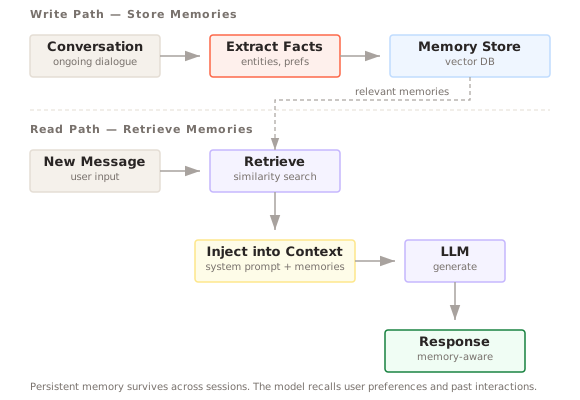
The architecture has three components. A memory writer extracts noteworthy facts, preferences, and decisions from conversations and stores them. A memory store holds this information persistently. A memory retriever finds and injects relevant memories into the model's context when generating a response.
The memory writer can work in several ways. The simplest approach is to use the LLM itself to identify what is worth remembering at the end of each conversation turn. You prompt the model with something like: "Based on this conversation, what facts about the user should be remembered for future sessions?" The model extracts structured memory entries that get written to your store. Alternatively, you can use rules-based extraction, pulling out entities, stated preferences, or explicit instructions from the conversation.
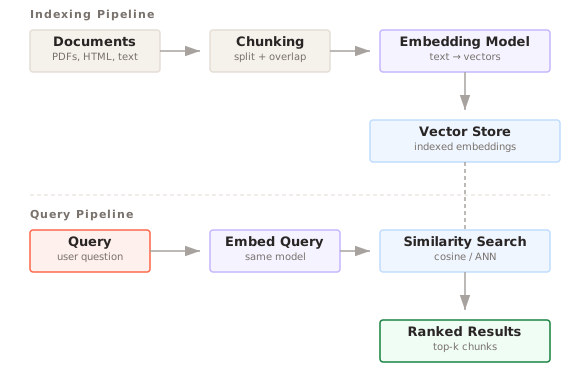
The memory store can be a vector database, a key-value store, a relational database, or a knowledge graph. Vector databases are the most common choice because they enable semantic retrieval. You embed each memory entry as a vector and retrieve the most relevant ones based on semantic similarity to the current conversation. Key-value stores work well when memories are categorical (user preferences, settings, profile information). Knowledge graphs shine when the relationships between memories matter (this person manages that team, which works on this project).
The memory retriever runs at the start of each conversation turn. It takes the current user message, searches the memory store for relevant entries, and injects them into the system prompt or the beginning of the conversation context. The model then generates its response with awareness of past interactions.
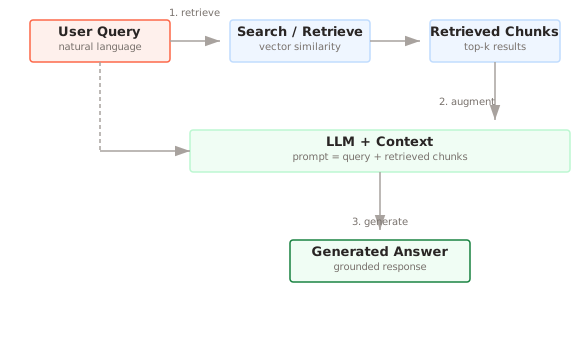
This is conceptually similar to retrieval-augmented generation, but the corpus being searched is conversation history and extracted user facts rather than external documents. The retrieval mechanics are the same. The difference is what you are retrieving and why.
When should you use Long-Term Memory?
Long-term memory is essential for any application that interacts with the same users repeatedly and where continuity improves the experience. Personal assistants, coaching applications, customer service systems, and productivity tools all benefit from remembering user context across sessions.
It is particularly valuable when users have complex, evolving needs. A project management assistant that remembers your team structure, current priorities, and past decisions can provide far more relevant suggestions than one that starts fresh every time.
Personalization is another strong signal. If your application recommends content, products, or actions, accumulated knowledge about user preferences makes those recommendations better over time. The first interaction is generic. The hundredth interaction should feel tailored.
Long-term memory also makes sense when re-establishing context is costly. If a consulting chatbot needs 10 minutes of back-and-forth to understand the user's situation before it can help, remembering that context across sessions saves time for both the user and the system.
What are the common pitfalls?
Storing everything is tempting but counterproductive. If you write every conversational detail to memory, retrieval becomes noisy. The model's context fills up with marginally relevant memories that crowd out the important ones. You need a curation strategy. Not everything is worth remembering, and some memories should be updated or deleted as circumstances change.
Stale memories cause problems. The user mentioned they were working on Project Alpha six months ago. They have since moved to Project Beta. If the old memory persists without being updated, the assistant will reference an outdated context. Memory management requires mechanisms for updating, archiving, or expiring entries.
Privacy and data retention are serious concerns. Long-term memory is, by definition, a store of personal information. Users may have shared sensitive details in conversation that they did not intend to be permanently recorded. You need clear policies about what gets stored, how long it persists, and how users can view or delete their memories. In regulated environments, memory retention may conflict with data minimization requirements.
Retrieval relevance is imperfect. Semantic search will sometimes surface memories that are topically related but not actually useful for the current query. A question about "Python" might retrieve memories about a snake identification project when the user is asking about the programming language. Including metadata (timestamps, categories, confidence scores) in your memory entries helps the retriever make better selections.
What are the trade-offs?
Long-term memory adds infrastructure. You need a persistent store, an embedding pipeline, and retrieval logic. This is manageable but not trivial. The operational burden scales with the number of users and the volume of memories.
Latency increases slightly because each turn requires a retrieval step before generation. For most applications, this adds 100-300 milliseconds, which is acceptable. For latency-critical applications, you may need to run retrieval in parallel with other preprocessing.
There is a quality ceiling imposed by your extraction and retrieval pipeline. Memories that are poorly extracted or poorly retrieved degrade the model's performance rather than improving it. Irrelevant memories waste context tokens and can confuse the model. The system is only as good as its weakest link, whether that is the writer, the store, or the retriever.
You are making a commitment to data management. Memories need to be updated, deduplicated, and sometimes deleted. Users need controls over their stored information. This is an ongoing operational responsibility, not a one-time implementation.
Goes Well With
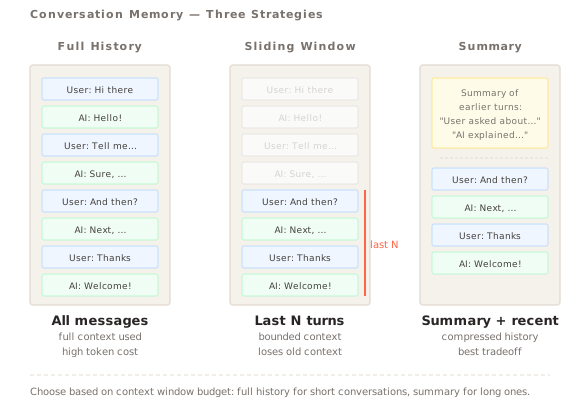
Conversation Memory handles within-session context management. Long-term memory handles across-session persistence. Together, they give the model both recent conversational context and historical knowledge about the user. Most production systems need both.
Basic RAG uses the same retrieval infrastructure but searches external documents instead of user memories. You can share the same vector store and retrieval pipeline for both, searching user memories and knowledge base documents in a single query and combining the results.
Semantic Indexing improves the quality of memory retrieval. Better embeddings and smarter indexing strategies lead to more relevant memory recall, which directly improves the model's ability to use stored information effectively.
References
- Park, J.S., et al. (2023). Generative Agents: Interactive Simulacra of Human Behavior. UIST 2023.
- Hu, C., et al. (2023). ChatDB: Augmenting LLMs with Databases as Their Symbolic Memory. arXiv preprint.