How do they differ?
Guardrails and Grounded Generation both improve the reliability of LLM applications, but they address fundamentally different failure modes. Conflating them leads to gaps in your safety architecture. Understanding what each one protects against is the starting point for building a system that is both safe and accurate.
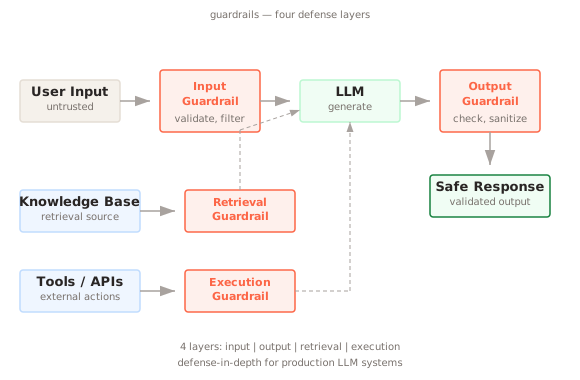
Guardrails are boundary enforcement mechanisms. They sit at the edges of your LLM pipeline, inspecting inputs before they reach the model and outputs before they reach the user. Their job is to block content that violates your policies. This includes prompt injection attempts, toxic or harmful content, personally identifiable information, off-topic requests, and anything else your organization defines as unacceptable. Guardrails are like security checkpoints. They do not care about whether the content is factually correct. They care about whether it is allowed.
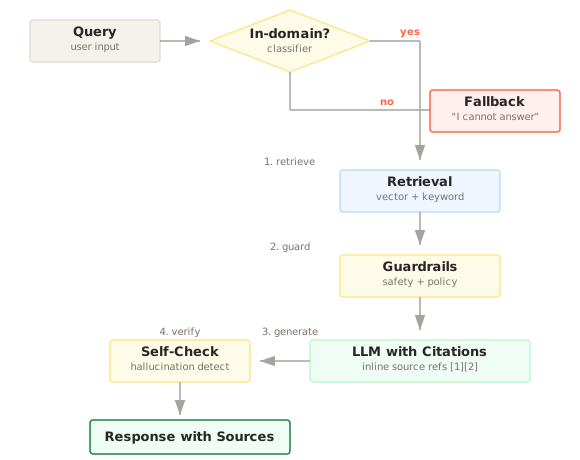
Grounded Generation operates at the generation level itself. Its goal is to make the model's output more reliable and verifiable. This means inline citations that trace claims back to source documents, out-of-domain detection that recognizes when the model does not have enough information to answer, self-correcting retrieval strategies like CRAG (Corrective RAG) that verify retrieved documents before using them, and confidence signals that tell users how much to trust the answer. Grounded Generation does not block harmful content. It prevents the model from making things up.
The distinction maps to two different risk categories. Guardrails manage safety risk: the chance that the system produces content that causes harm, violates regulations, or exposes sensitive data. Grounded Generation manages accuracy risk: the chance that the system produces content that is factually wrong, unsupported by evidence, or misleadingly confident.
| Dimension | Guardrails | Grounded Generation |
|---|---|---|
| Primary goal | Enforce policies, prevent harm | Ground outputs in evidence, prevent hallucination |
| Failure mode addressed | Policy violations, data leaks, prompt injection | Factual errors, unsupported claims, false confidence |
| Where it operates | Input/output boundaries (middleware) | Generation stage and retrieval-generation interface |
| Mechanism | Filter, block, redact, or reject | Cite, verify, detect out-of-domain, self-correct |
| Evaluates content for | Compliance with rules | Consistency with source evidence |
| Implementation | Classifiers, regex, rule engines, secondary LLM calls | Citation generation, relevance scoring, CRAG, Self-RAG |
| Can work without RAG | Yes (applies to any LLM application) | Primarily designed for RAG pipelines |
| User-facing signal | "This request cannot be processed" | "Based on [Source X], the answer is..." |
When to use Guardrails
Guardrails are necessary for any LLM application that faces external users or processes sensitive data. They are not optional, they are table stakes.
Any user-facing application. If a human can type input into your system, you need input guardrails. Prompt injection is a real and active threat. Users, whether malicious or just curious, will try to override your system prompt, extract hidden instructions, or make the model do things you did not intend. Input guardrails catch these attempts before the model sees them.
Applications handling personal data. If your LLM context includes names, emails, account numbers, medical records, or any other PII, output guardrails must scan responses for data leakage before they reach the user. The model might inadvertently include sensitive information from context in its response, and a PII detection layer is the last line of defense.
Regulated industries. Financial services, healthcare, legal, education. These domains have specific content policies, and violating them has consequences beyond bad UX. Guardrails let you implement these policies as concrete, testable rules rather than hoping the system prompt covers every edge case.
When the model has tool access. If your LLM can call APIs, execute code, or modify databases, execution guardrails are critical. You need to validate that the model is not calling a delete endpoint when it should only have read access, or passing user input directly into a SQL query. These guardrails prevent the model's actions from causing real-world damage.
Content moderation at scale. If your application generates content that will be published, shared, or used in downstream processes, output guardrails ensure that nothing toxic, biased, or legally problematic gets through. This is especially important for applications that generate content autonomously without a human review step.
When to use Grounded Generation
Grounded Generation matters most when factual accuracy is the core value proposition of your application.
Knowledge-heavy applications. Internal knowledge bases, documentation search, research assistants, customer support systems. When users come to your application to get accurate answers about specific topics, they need to be able to trust what the system tells them. Inline citations let them verify claims. Out-of-domain detection prevents the system from guessing when it does not know.
High-stakes decision support. Medical information systems, legal research tools, financial analysis platforms. In these contexts, a single hallucinated fact can cause real harm, not the kind of harm that comes from offensive content (that is the guardrails domain) but the kind that comes from acting on wrong information. Grounded Generation techniques like source-level citation and claim verification are essential safeguards.
When users have no way to independently verify answers. If your users are non-experts relying on the system for authoritative answers, the system has a higher obligation to be right. A developer asking a coding assistant can spot a bad code suggestion. A patient asking a health bot about medication interactions may not be able to evaluate the answer independently. Grounded Generation provides the verification mechanisms that compensate for this asymmetry.
Long-form content generation grounded in sources. Report generation, literature reviews, briefing documents. When the output is long and draws from multiple sources, hallucination can creep in subtly. One fabricated statistic in a ten-page report is easy to miss during human review. Inline citations make every claim auditable.
When you need to detect retrieval failures. Sometimes the retrieval step in a RAG pipeline returns irrelevant documents, but the LLM generates a plausible-sounding answer anyway because it draws on its training data instead of the context. CRAG and similar self-correcting patterns detect this failure and either retry with a different search strategy or honestly report that the information is not available.
Can they work together?
They should always work together. A production LLM application needs both layers because they protect against orthogonal risks.
The layered architecture looks like this. Input guardrails screen the user query first. They block prompt injections, filter toxic input, and reject out-of-scope requests. Queries that pass input guardrails proceed to the RAG pipeline. The retrieval step fetches relevant documents. Grounded Generation techniques kick in during the generation phase: the LLM produces an answer with inline citations, the system checks whether the retrieved documents actually support the claims, and out-of-domain detection flags queries where the context is insufficient. After generation, output guardrails scan the response for PII leakage, policy violations, and harmful content.
The order matters. Guardrails form the outer layer. They handle the "should we even process this request" and "is this response safe to return" questions. Grounded Generation forms the inner layer. It handles the "is this response accurate and well-sourced" question. You need both because a response can be policy-compliant but factually wrong, and a response can be factually grounded but contain leaked personal data.
A practical example illustrates the complementary roles. A user asks a healthcare bot "What medications interact with warfarin?" Input guardrails verify this is a legitimate medical question and not a prompt injection attempt. The RAG system retrieves relevant drug interaction documents. Grounded Generation ensures the answer cites specific interaction databases and flags confidence levels. It detects if the retrieval returned nothing relevant and says "I do not have enough information" rather than generating an answer from training data. Output guardrails verify the response does not contain any patient-specific data that might have been in the context and that it includes appropriate medical disclaimers.
Some organizations add a third layer: evaluation. After the response passes both Grounded Generation and output guardrails, an LLM-as-Judge or domain-specific evaluator scores the response quality. Low-scoring responses get flagged for human review. This three-layer approach, guardrails plus trustworthy generation plus evaluation, provides the most comprehensive coverage.
Common mistakes
Relying on guardrails alone for factual accuracy. Guardrails check whether content is policy-compliant, not whether it is true. A guardrail system will happily pass through a response that contains fabricated statistics, as long as those statistics do not violate any content policy. You need Grounded Generation to catch factual errors.
Relying on Grounded Generation alone for safety. A perfectly cited, factually accurate response can still contain harmful content. An answer about chemical processes might be grounded in real sources but provide information that should be restricted. Citations do not replace content moderation.
Implementing citations without verification. Adding "[Source 1]" tags to a response is not the same as Grounded Generation. If you do not verify that the cited source actually supports the claim, you just have decorative references. The model can generate plausible-looking citations for fabricated content. Always include a verification step that checks citation-claim alignment.
Over-blocking with aggressive guardrails. Guardrails that are too strict create a frustrating user experience. If your toxicity classifier flags legitimate medical terms as harmful, or your off-topic filter rejects edge cases that are actually in-scope, users will lose trust in the system. Tune your guardrails on real query data and measure both the block rate and the false positive rate.
Treating out-of-domain detection as optional. Many teams implement citations but skip the step where the system recognizes it cannot answer. This is the most important part of Grounded Generation. A system that admits "I do not have information about this" is more trustworthy than one that always produces an answer, even when citations are present.
Not testing both layers under adversarial conditions. Guardrails need red-team testing for prompt injection and jailbreaking. Grounded Generation needs testing with queries that fall outside the knowledge base, queries where retrieved documents are irrelevant, and queries that tempt the model to hallucinate. Test each layer independently with targeted adversarial inputs.
References
- Dong, Y., Jiang, Y., et al. "Building Guardrails for Large Language Models." Surveys in Operations Research and Management Science, 2024.
- NVIDIA. "NeMo Guardrails: A Toolkit for Controllable and Safe LLM Applications." GitHub, 2023.
- Yan, S.Q., Gu, J., Zhu, Y., Ling, Z. "Corrective Retrieval Augmented Generation (CRAG)." arXiv, 2024.
- Asai, A., Wu, Z., Wang, Y., Sil, A., Hajishirzi, H. "Self-RAG: Learning to Retrieve, Generate, and Critique through Self-Reflection." ICLR 2024.
- Gao, Y., Xiong, Y., et al. "Retrieval-Augmented Generation for Large Language Models: A Survey." arXiv, 2024.
- Inan, H., Upasani, K., et al. "Llama Guard: LLM-based Input-Output Safeguard for Human-AI Conversations." Meta AI, 2024.