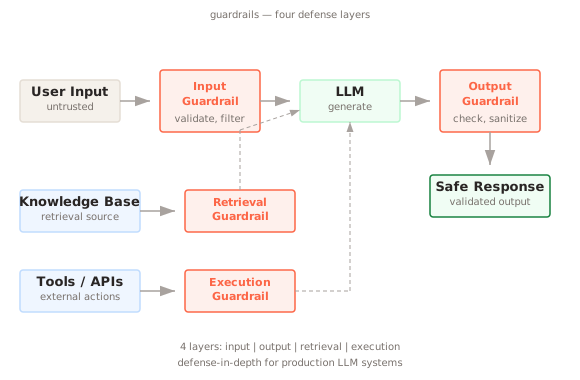
Guardrails is a pattern that wraps LLM inputs and outputs with validation rules to enforce safety, format, and policy constraints. Input guardrails filter harmful or off-topic prompts before they reach the model. Output guardrails check generated text for policy violations, hallucinations, or format errors before returning it to the user.
What problem does Guardrails solve?
You ship an LLM-powered feature. Within hours, someone figures out how to make it generate instructions for something dangerous. A few days later, a support ticket arrives because the model leaked a customer's email address that was sitting in the prompt context. By the end of the week, your legal team is asking pointed questions about content moderation.
The core issue is that large language models have no built-in sense of what they should or should not do in your specific application. They will happily follow instructions that violate your terms of service, surface private data that was included in context, or produce outputs that expose your organization to liability. The model itself is a general-purpose text generator. It does not know your rules.
Relying on system prompts alone to enforce safety is fragile. Prompt injection techniques can override instructions embedded in the system message. Even without adversarial intent, the model may drift into territory you did not anticipate. You need something more structural than a polite note at the top of the prompt.
How does Guardrails work?
Guardrails are dedicated processing layers that sit between the components of your LLM pipeline. Think of them as middleware for AI applications. They intercept data at specific points, evaluate it against your policies, and either pass it through, modify it, or reject it entirely.
There are four natural insertion points. Input guardrails sit between the user and the model. They screen incoming prompts for injection attempts, toxic content, or out-of-scope requests before the model ever sees them. Output guardrails sit between the model's response and the user. They catch hallucinated claims, inappropriate content, or leaked sensitive data before it reaches the end user. Retrieval guardrails sit between your knowledge base and the model. When you are doing retrieval-augmented generation, these layers filter or redact retrieved documents to prevent sensitive information from entering the context window. Execution guardrails sit between the model and any tools or APIs it can call. They validate that proposed function calls are within allowed parameters and do not perform destructive operations.
Each guardrail layer can perform three actions. It can pass the data through unchanged, modify the data (for example, redacting PII or rewriting a response), or reject the request entirely with an appropriate error message. The key insight is that these layers operate independently of the model. They can use simple rules, regex patterns, classification models, or even a second LLM call to make their decisions.
When should you use Guardrails?
Use guardrails when your application is user-facing and you cannot tolerate arbitrary model outputs. This is especially important when the application handles sensitive data like personal information, financial records, or health data. If you are building an internal tool for a small trusted team, lightweight guardrails may suffice. If you are building a consumer product, you need all four layers.
Guardrails are also the right choice when you need auditable safety. Regulated industries often require you to demonstrate that specific controls are in place. A guardrail architecture gives you clear checkpoints where you can log decisions, flag violations, and prove compliance.
If your application allows the model to execute actions (calling APIs, writing to databases, sending emails), execution guardrails are non-negotiable. A model that can take real-world actions without validation is a security incident waiting to happen.
Implementation
# Using OpenAI SDK for illustration — swap client for any provider
from openai import OpenAI

client = OpenAI()

BLOCKED_TOPICS = ["violence", "illegal activity", "self-harm"]

def input_guardrail(user_input: str) -> tuple[bool, str]:
    """Check if user input violates safety policies."""
    response = client.chat.completions.create(
        model="gpt-4o",
        messages=[
            {"role": "system", "content": f"You are a safety classifier. Does this input request content about any of these topics: {', '.join(BLOCKED_TOPICS)}? Reply with only YES or NO."},
            {"role": "user", "content": user_input},
        ],
    )
    is_blocked = response.choices[0].message.content.strip().upper() == "YES"
    return (not is_blocked, "Input blocked by safety policy." if is_blocked else "")

def output_guardrail(response_text: str) -> tuple[bool, str]:
    """Check if model output contains problematic content."""
    response = client.chat.completions.create(
        model="gpt-4o",
        messages=[
            {"role": "system", "content": "Does this text contain factual claims that could be harmful if wrong (medical, legal, financial advice)? Reply YES or NO."},
            {"role": "user", "content": response_text},
        ],
    )
    needs_disclaimer = response.choices[0].message.content.strip().upper() == "YES"
    if needs_disclaimer:
        return (True, response_text + "\n\n*Disclaimer: This is not professional advice. Consult a qualified expert.*")
    return (True, response_text)

def guarded_chat(user_input: str) -> str:
    """Chat with input and output guardrails."""
    safe, msg = input_guardrail(user_input)
    if not safe:
        return msg

    response = client.chat.completions.create(
        model="gpt-4o",
        messages=[{"role": "user", "content": user_input}],
    )
    raw_output = response.choices[0].message.content

    _, final_output = output_guardrail(raw_output)
    return final_output

# Usage
print(guarded_chat("What are some good stretches for lower back pain?"))
What are the common pitfalls?
The most common failure is building guardrails that are too rigid. If your input filter rejects anything that mentions a sensitive topic, you will block legitimate use cases. A medical chatbot that refuses to discuss symptoms because the word "pain" triggered a content filter is useless. Calibrating the sensitivity of each layer requires iteration and real user data.
Another failure mode is treating guardrails as a one-time setup. Adversarial techniques evolve. New prompt injection methods appear regularly. Your guardrail rules need ongoing maintenance, just like any other security infrastructure.
Over-reliance on LLM-based guardrails introduces a circular problem. If you are using a language model to check the output of another language model, both can fail in correlated ways. A prompt injection that fools your primary model might also fool your guardrail model. Combining rule-based checks with model-based checks provides better coverage than either approach alone.
Finally, guardrails add latency. Each layer is an additional processing step. If you chain multiple LLM calls for safety checks, response times can double or triple. You need to balance safety requirements against user experience, possibly running some checks in parallel or using faster classification models for the guardrail layers.
What are the trade-offs?
Guardrails increase system complexity. You are adding multiple processing stages, each with its own logic, configuration, and failure modes. This means more code to maintain, more tests to write, and more things that can break during deployment.
There is a real tension between safety and utility. Every guardrail that blocks harmful content will occasionally block legitimate content. The tighter your filters, the more false positives you generate. Finding the right threshold is an ongoing process, not a one-time decision.
Cost is a factor when guardrail layers involve additional model calls. Running a classifier on every input and output doubles your inference costs at minimum. Rule-based and regex-based checks are essentially free, but they catch fewer edge cases.
Latency increases with each guardrail layer. Users notice when a chatbot takes three seconds instead of one. You may need to invest in optimizing your guardrail pipeline, running checks in parallel where possible, or using smaller, faster models for safety classification.
Goes Well With
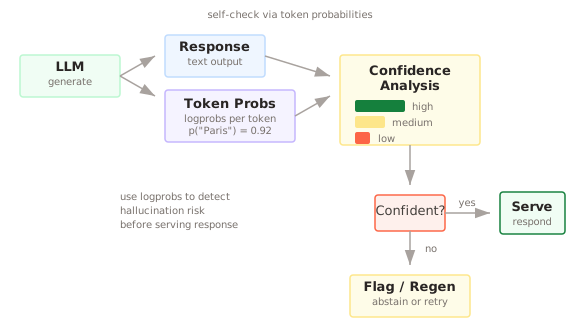
Self-Check pairs naturally with guardrails. While guardrails handle policy enforcement at the pipeline level, self-check focuses on detecting hallucinations in the model's output using token probabilities. Guardrails catch what should not be said. Self-check catches what might not be true.
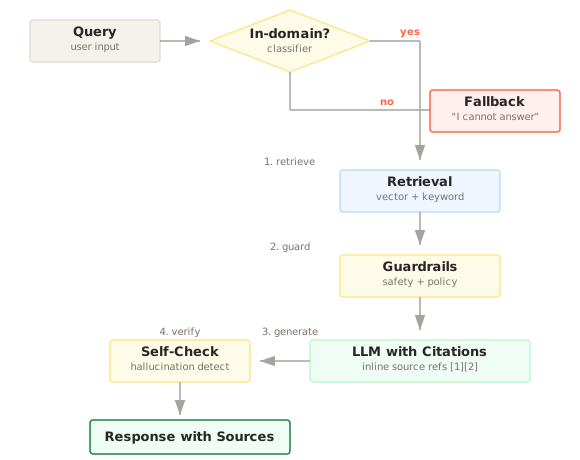
Grounded Generation extends the guardrail concept by incorporating citations and source attribution into the generation process. Where guardrails act as external validators, grounded generation builds verifiability into the output itself.
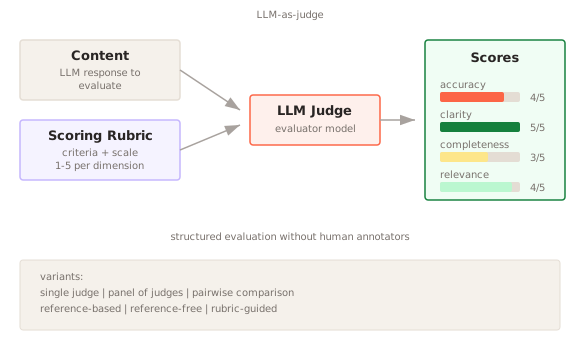
LLM-as-Judge can automate part of the quality review process. Instead of having a human evaluate every output from scratch, a judge model pre-screens against quality criteria and surfaces only borderline cases for human attention.
Output Structuring
Output structuring separates content generation from final formatting. The LLM generates raw content freely, then a deterministic post-processing step assembles it into the required output format using templates, validators, and transformation rules.
This approach works when you have access to authoritative data sources and the primary value of the LLM is presentation, not knowledge. Assemble all raw facts using methods that are inherently low-hallucination — database queries, OCR, structured API calls, template lookups. Then pass the assembled facts to the LLM and ask it to organize, rephrase, and present them in your desired format. The model works as an editor, not a researcher.
When to use output structuring: Catalog-scale content generation where underlying data exists in structured form. Domains with low tolerance for inaccuracy but high expectations for readability — financial reports, medical information, legal summaries, technical documentation.
Key pitfall: The model can still distort meaning during the reformat step. Be explicit about which fields must appear verbatim. Use structured output formats that require all input fields to appear in the result. The assembly step is only as good as your data sources — garbage in, polished garbage out.
Prompt Templating
Prompt templating constrains LLM output to fill predefined templates rather than generating free-form text. By structuring the output format in advance, it prevents prompt injection, ensures consistent formatting, and makes outputs predictable and parseable.
The process splits into two phases. In the offline phase, use a language model to generate a finite set of content templates with placeholder variables. A human reviews and approves each template once. In the online phase, select the appropriate template and fill in placeholders with actual data through simple string replacement. No model is involved at inference time.
When to use prompt templating: High-volume personalized content (emails, notifications, product descriptions) where the cost of a bad output is high. Situations requiring auditability — every message traces back to a specific approved template. Content that must stay within strict brand guidelines.
Key pitfall: Combinatorial explosion if personalization axes multiply. Templates can feel mechanical without enough variants. The human review step introduces a bottleneck when launching new products or entering new markets.
References
- Anthropic. (2024). Constitutional AI: Harmlessness from AI Feedback. arXiv preprint.