How do they differ?
Few-Shot Prompting and Prompt Optimization solve the same core problem: getting an LLM to produce the output you want. The difference is in how they approach the solution. Few-Shot Prompting is a manual, craft-based practice. You select examples, arrange them in a prompt, test the results, and iterate by hand. Prompt Optimization is an automated, engineering-based practice. You define an evaluation metric, provide a dataset, and let an optimization system (like DSPy, OPRO, or similar frameworks) search for the best prompt configuration programmatically.
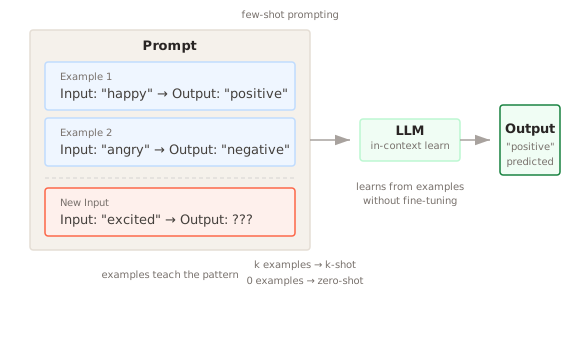
Few-Shot Prompting works by providing the model with concrete input-output examples directly in the prompt. The model uses these examples as implicit instructions, learning the desired format, style, reasoning approach, and output structure from the demonstrations. The engineer selects examples based on intuition and domain knowledge, tests them, swaps out ones that do not work, and gradually converges on a set that performs well.
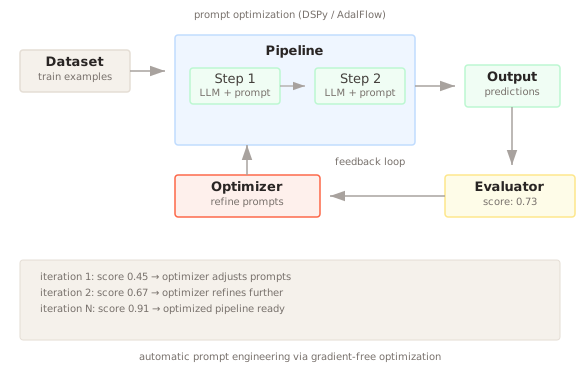
Prompt Optimization treats the prompt as a parameter in an optimization problem. The system tries different prompt structures, example selections, instruction phrasings, and orderings. It evaluates each variant against a test dataset using defined metrics (accuracy, F1, human preference scores, or custom rubrics). It then keeps the best-performing configuration. This is conceptually similar to hyperparameter tuning in machine learning, except the "parameters" are natural language strings.
The relationship between them is closer than it might appear. Prompt Optimization often produces few-shot prompts as its output. The optimization discovers which examples to include, how many, and in what order. In many cases, the optimized prompt is a few-shot prompt, just one that was selected systematically rather than manually.
| Dimension | Prompt Optimization | Few-Shot Prompting |
|---|---|---|
| Approach | Automated search over prompt space | Manual selection and iteration |
| Speed to first result | Slower (needs eval data and infrastructure) | Faster (write examples, test, iterate) |
| Consistency | Reproducible, measurable improvements | Depends on the engineer's skill and intuition |
| Infrastructure needed | Evaluation dataset, metrics, optimization framework | None beyond the model API |
| Ceiling | Higher. Explores more of the prompt space. | Lower. Limited by human intuition. |
| Transparency | Can be opaque (why did it choose these examples?) | Fully transparent (you chose the examples) |
| Maintenance | Re-run optimization when model or data changes | Manual re-evaluation and example updates |
| Cost | Significant upfront cost (many eval runs) | Low upfront cost, high ongoing cost (manual effort) |
How Few-Shot Prompting actually works
Few-Shot Prompting is deceptively simple on the surface but has surprising depth in practice. The basic pattern is: include N examples of input-output pairs in your prompt, then provide the new input and let the model complete the output. The model pattern-matches against the examples and produces an analogous output.
The subtlety is in example selection. Not all examples are equally useful. The best examples are ones that cover the edge cases your task will encounter. If you are building a classification system, you want examples from each class, including borderline cases. If you are building an extraction system, you want examples that demonstrate how to handle missing fields, ambiguous inputs, and multi-valued fields.
Order matters too. Models are sensitive to the position of examples in the prompt. Recent examples (closer to the query) tend to have more influence than earlier ones. Placing your most representative and important examples last often improves performance.
The number of examples matters. More examples give the model more signal but consume context window. There is typically a sweet spot, often between 3 and 8 examples, beyond which additional examples provide diminishing returns or even degrade performance by filling the context with less relevant demonstrations.
How Prompt Optimization actually works
Prompt Optimization frameworks automate the search for the best prompt configuration. The workflow typically follows this pattern:
- Define your task with input-output examples (a training set and a validation set).
- Define your evaluation metric (exact match, F1, LLM-as-Judge score, or custom).
- Specify what the optimizer can change: instructions, examples, example ordering, chain-of-thought structure.
- The optimizer runs many iterations, trying different configurations and measuring results.
- The best configuration is saved and deployed.
DSPy is the most established framework for this. It treats prompt components as "modules" that can be optimized independently. A DSPy program might have a retrieval step and a generation step, and the optimizer finds the best few-shot examples and instructions for each step separately while optimizing the overall pipeline metric.
OPRO (Optimization by PROmpting) takes a different approach. It uses an LLM to generate candidate prompt instructions, evaluates them, and then asks the LLM to generate better instructions based on the scores. This meta-optimization loop converges on instructions that outperform hand-written ones.
The key insight is that humans are bad at predicting which prompt variations will work best. An engineer might assume that a detailed, explicit instruction will outperform a concise one, but the optimizer might discover that a shorter instruction with better-chosen examples actually scores higher. The search is unintuitive, which is exactly why automation helps.
When to use Few-Shot Prompting
Few-Shot Prompting is the right starting point for almost every LLM application. Reach for it first.
You are prototyping. When you are still figuring out whether a task is even solvable with an LLM, writing a few examples and testing is the fastest way to get signal. Building optimization infrastructure for a task you might abandon is wasted effort.
Your task is straightforward. Classification, extraction, formatting, and translation tasks with clear input-output mappings often work well with a handful of well-chosen examples. If 5 examples get you to 95% accuracy, optimization might only get you to 97%, and the marginal improvement may not justify the investment.
You do not have evaluation data yet. Prompt Optimization requires a labeled dataset to measure against. If you are in the early stages and do not have ground truth labels, you cannot optimize. Start with Few-Shot, collect production data, label a sample, and then consider optimization.
Your team does not include ML engineers. Few-Shot Prompting is accessible to anyone who understands the task. Prompt Optimization requires familiarity with evaluation metrics, train/test splits, and optimization frameworks. If your team is product engineers or domain experts, Few-Shot is more practical.
The model changes frequently. If you switch between models regularly (testing GPT-4 vs Claude vs Gemini), hand-crafted examples are portable across models. Optimized prompts may be model-specific and need re-optimization for each model.
When to use Prompt Optimization
Graduate to Prompt Optimization when you have a production system that needs measurable, systematic improvement.
You have hit a ceiling with manual iteration. You have tried different examples, rewritten instructions multiple times, and accuracy is stuck at 87%. Prompt Optimization explores combinations you would never try manually and often breaks through plateaus.
You have a reliable evaluation dataset. At least 100 labeled examples (ideally 500+) with a clear metric. Without this, optimization has nothing to optimize against and will produce meaningless results.
The task is high-value and high-volume. If a prompt handles millions of requests and a 3% accuracy improvement saves significant manual review or prevents costly errors, the upfront investment in optimization is easily justified.
You need reproducible improvements. When your manager asks "why did you change the prompt?" and you need a better answer than "it felt right," optimization gives you data. You can show that variant A scored 0.89 and variant B scored 0.93 on a held-out test set.
Your pipeline has multiple LLM steps. For systems with retrieval, reasoning, and generation stages, optimizing each stage independently and then jointly is beyond what manual iteration can handle. DSPy was designed specifically for this case.
You are fine-tuning and want to compare. Prompt Optimization gives you the best possible performance without fine-tuning. This establishes a ceiling for prompt-based approaches and tells you whether fine-tuning is worth the additional complexity and cost.
Can they work together?
They are naturally complementary, and the best production systems use both.
Few-Shot as seed, optimization as refinement. Start with manually selected examples to establish a working baseline. Then use those examples as the seed for an optimization run. The optimizer will try different subsets and orderings of your examples, and likely find a combination that outperforms your hand-picked set.
Manual examples for new categories. When a new edge case appears that your current prompt handles poorly, write an example that demonstrates the correct handling and add it to the candidate pool. Then re-run optimization to find the best overall set that includes coverage for the new case.
Human judgment for example quality, automation for example selection. Engineers write high-quality examples that demonstrate the task clearly. The optimizer selects which subset of those examples to actually include in the prompt and in what order. Humans provide the raw material. Automation assembles the final product.
A/B testing optimized vs manual prompts. Run the optimized prompt alongside the manually crafted one in production and compare real-world performance. Sometimes the optimized prompt wins on the evaluation set but performs worse on the actual distribution of production queries. This feedback loop improves both approaches.
Common mistakes
Optimizing before you have a working prompt. If your zero-shot or few-shot prompt cannot solve the task at all, optimization will not help. The optimizer needs a gradient to follow. If every configuration scores 0, it has no signal. Get a basic working prompt first, then optimize.
Using too few evaluation examples. Optimizing against 20 examples will overfit to those specific cases. The resulting prompt will ace those 20 inputs and perform unpredictably on everything else. Use at least 100 evaluation examples, and hold out a separate test set that the optimizer never sees.
Selecting few-shot examples that are too similar. If all your examples are straightforward positive cases, the model does not learn how to handle negatives, edge cases, or ambiguous inputs. Ensure your example set covers the full distribution of inputs you expect in production.
Ignoring example order in few-shot prompts. Placing the most relevant example last (closest to the query) consistently outperforms random ordering. If you are not deliberately ordering your examples, you are leaving performance on the table.
Not re-optimizing when the model changes. A prompt optimized for GPT-4 may not be optimal for GPT-4o or Claude. Each model has different sensitivities to prompt structure. When you upgrade models, re-run the optimization.
Treating optimization as a one-time event. Your data distribution shifts over time. New edge cases appear. The evaluation dataset should be updated periodically, and optimization should be re-run. Build this into your maintenance schedule.
References
- Khattab, O. et al. (2023). "DSPy: Compiling Declarative Language Model Calls into Self-Improving Pipelines." arXiv:2310.03714.
- Yang, C. et al. (2023). "Large Language Models as Optimizers" (OPRO). arXiv:2309.03409.
- Brown, T. et al. (2020). "Language Models are Few-Shot Learners." arXiv:2005.14165.
- Lu, Y. et al. (2022). "Fantastically Ordered Prompts and Where to Find Them: Overcoming Few-Shot Prompt Order Sensitivity." arXiv:2104.08786.
- DSPy documentation and cookbook examples.