Prompt Optimization is a pattern that systematically improves prompt effectiveness through iterative testing, evaluation, and refinement. It treats prompts as code artifacts that should be versioned, benchmarked against test cases, and optimized for specific quality metrics.
What problem does Prompt Optimization solve?
Manual prompt engineering follows a predictable loop. You write a prompt, test it on a few examples, notice a failure, tweak the wording, test again, fix one thing, break another. After hours of this, you arrive at a prompt that works reasonably well on the examples you tested. Then you deploy it and discover it fails on cases you never tried.
This process has deeper problems than just being tedious. It does not scale. When you have a pipeline with multiple prompt steps, tuning one step can degrade another. When the model provider releases an update, your carefully tuned prompts may stop working and you start the cycle over. And the entire process is trapped in your head. There is no systematic record of what variations were tried, what metrics they achieved, or why the current version was chosen.
The fundamental issue is that prompt engineering is an optimization problem being solved with intuition. You have an objective (accurate, well-formatted output), you have a search space (all possible prompt wordings), and you are navigating that space by gut feeling. Every other optimization problem in software engineering has been automated. Prompts should be no different.
How does Prompt Optimization work?
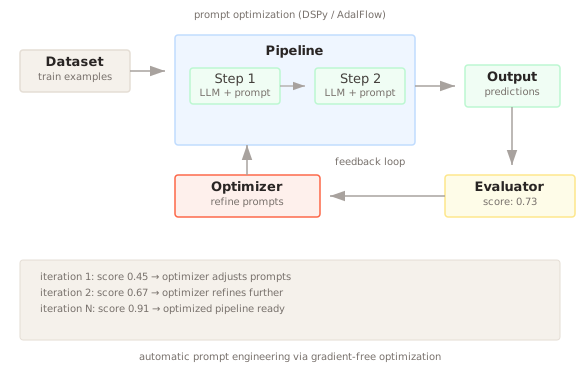
Prompt optimization replaces the manual tweak-and-test cycle with a systematic search. You define four components: a pipeline of prompt steps, a dataset of examples with expected outputs, an evaluator that scores outputs, and an optimizer that explores variations and selects the best performers.
The pipeline describes the structure of your prompts. It might be a single prompt template with variable slots, or it might be a multi-step chain where each step has its own template. The optimizer treats the text within these templates as the parameters to tune, just like weights in a neural network but at the level of natural language.
The dataset provides ground truth. You need a representative set of inputs paired with correct outputs, or at least with enough annotation to evaluate quality. This is the same kind of evaluation set you would need for any machine learning task. The size depends on the complexity of the problem, but even 50 to 100 examples can be enough to drive meaningful optimization.
The evaluator scores each candidate prompt against the dataset. This can be an exact-match metric, a custom scoring function, or an LLM-as-Judge that rates outputs on a rubric. The evaluator is what turns "this prompt feels better" into "this prompt scores 0.87 versus 0.73."
The optimizer explores the space of prompt variations. Different frameworks use different strategies. Some mutate the prompt text and evaluate the mutations. Some use the model itself to propose improvements based on failure analysis. Some search over the space of few-shot example selections. The common thread is that exploration is systematic and driven by measured performance rather than human intuition.
Frameworks like DSPy, AdalFlow, and PromptWizard implement this pattern with different philosophies. DSPy compiles declarative signatures into optimized prompts. AdalFlow treats prompt optimization as a training loop with gradient-like feedback. PromptWizard uses iterative self-improvement. The specific tool matters less than the principle: let data and measurement guide your prompt design.
When should you use Prompt Optimization?
Prompt optimization becomes worthwhile when you have a stable task with measurable quality criteria and enough volume to justify the setup cost. A classification pipeline processing thousands of inputs per day is a perfect candidate. A one-off analysis task is not.
It is especially valuable when the model changes. If you are building on a foundation model that gets updated periodically, your manually tuned prompts will drift. An optimization framework lets you re-run the optimization against the new model and get updated prompts without manual effort.
Complex pipelines with multiple interacting prompts benefit the most. Tuning each step in isolation misses interactions between steps. An optimizer can evaluate the full pipeline end-to-end and find step-level configurations that work well together even if they would not seem optimal in isolation.
Skip this pattern if you are still exploring what your task looks like. Optimization requires a stable objective, and if you are still changing the output format or the evaluation criteria, the optimization results will be invalid by the time they converge.
What are the common pitfalls?
Overfitting to your evaluation set is the most common failure. If your dataset is small or unrepresentative, the optimizer will find prompts that score well on those specific examples but fail on real-world inputs. This is the same overfitting problem that plagues all machine learning, and the same solutions apply: use a held-out test set, ensure diversity in your examples, and validate on production data.
Evaluation quality bottlenecks the entire process. If your evaluator is noisy or misaligned with actual quality, the optimizer will maximize the wrong thing. Garbage evaluation in, garbage prompts out. Spend time getting your evaluation right before optimizing.
Optimization can find adversarial prompts that game the evaluator rather than genuinely improving quality. This is especially common with LLM-as-Judge evaluation, where the optimizer might discover prompt phrasings that make the judge model more lenient without actually producing better outputs.
Computational cost can be significant. Each optimization step involves running the pipeline against the dataset multiple times with different prompt variations. A single optimization run might involve hundreds or thousands of API calls. Factor this into your budget.
What are the trade-offs?
The upfront investment is substantial. You need to build an evaluation dataset, implement or configure an evaluator, set up the optimization framework, and run the search. For a simple single-prompt task, this overhead may not be justified compared to an hour of manual tuning.
You trade interpretability for performance. An optimized prompt may contain phrasing that seems strange or counterintuitive to a human reader. It works because it works, not because it makes sense to you. This can make it harder to maintain or debug when something goes wrong.
Prompt optimization creates a dependency on your evaluation infrastructure. If the evaluation set becomes stale, or the evaluation metric drifts from actual quality, the optimized prompts degrade silently. You need ongoing maintenance of the evaluation pipeline, not just the prompts.
The payoff is reproducibility and measurability. You can rerun the optimization, compare versions quantitatively, track improvements over time, and respond to model changes systematically. For production systems, this rigor is worth the investment.
Goes Well With
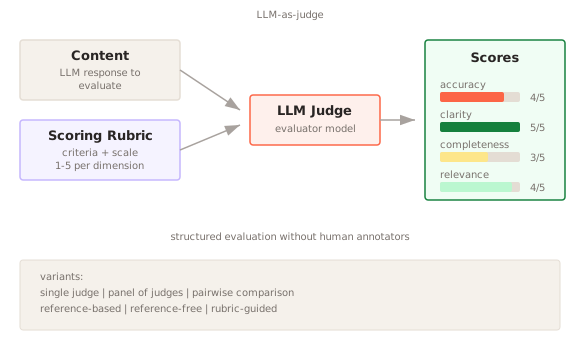
LLM-as-Judge provides a scalable evaluation signal that prompt optimization can maximize against. When your task involves open-ended output that cannot be scored with simple metrics, a judge model with a rubric bridges the gap between "I need a number" and "quality is subjective."
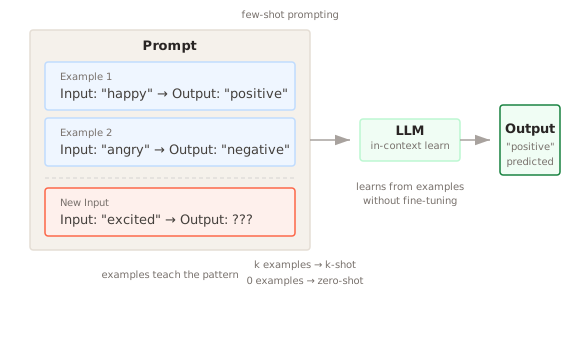
Few-Shot Prompting is one of the most effective dimensions for optimization to search over. Selecting which examples to include, in what order, and how many, is a combinatorial problem that humans solve poorly and optimizers solve well. Many optimization frameworks specifically target few-shot example selection as a key optimization axis.
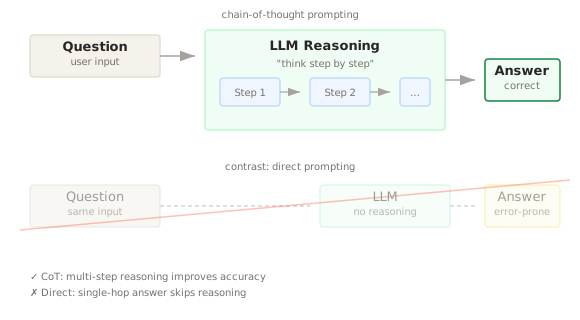
Chain-of-Thought interacts with optimization in an interesting way. The optimizer can discover whether CoT helps for your specific task, what CoT phrasing works best, and even what reasoning structure the few-shot examples should demonstrate. This is faster and more thorough than manually testing CoT variations.
References
- Zhou, Y., et al. (2023). Large Language Models Are Human-Level Prompt Engineers. ICLR 2023.
- Fernando, C., et al. (2023). Promptbreeder: Self-Referential Self-Improvement via Prompt Evolution. arXiv preprint.
Further Reading
- Yang et al., "Large Language Models as Optimizers" (2023) — Introduces OPRO, a method where LLMs iteratively optimize their own prompts by generating candidates and evaluating them against a scoring function. arXiv:2309.03409