How do they differ?
Self-Check and LLM-as-Judge are both techniques for assessing the quality of LLM outputs, but they work through completely different mechanisms. Self-Check looks inward, analyzing signals from the model that generated the response. LLM-as-Judge looks outward, using a separate model instance (or a different model entirely) to evaluate the response against explicit criteria.
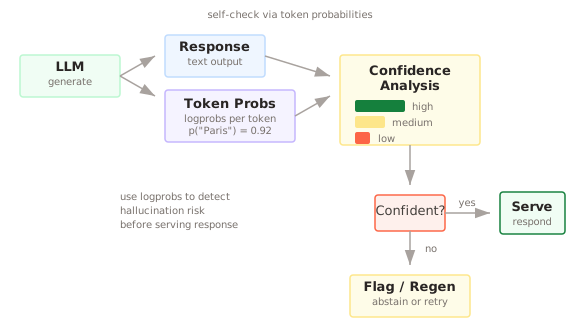
Self-Check examines the model's own confidence signals. These signals include token-level log probabilities, perplexity scores, consistency across multiple sampled responses, and self-reported uncertainty. The idea is that the model already knows, in some measurable way, when it is uncertain or likely wrong. You just need to read those signals. A response where every token has high probability is more likely to be factually grounded than one where key tokens have low probability.
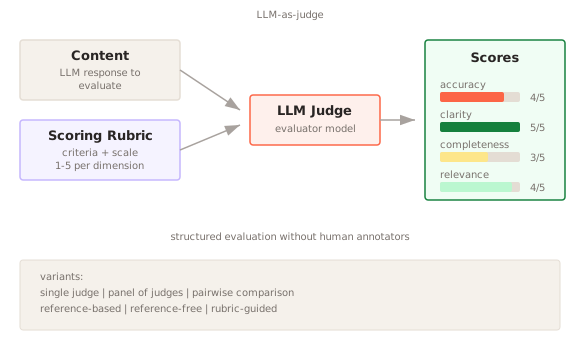
LLM-as-Judge takes the generated response, pairs it with a scoring rubric, and asks a model to evaluate it. The rubric might score for factual accuracy, relevance, helpfulness, tone, safety, or any other dimension you care about. The judge model reads both the prompt and the response, then produces a score and often a justification. This is structurally identical to having a human reviewer, except the reviewer is an LLM.
The fundamental tradeoff is speed and cost versus depth and flexibility. Self-Check runs with zero or near-zero additional latency because the signals are already available from the generation step. LLM-as-Judge requires a full additional inference call, which means more latency, more tokens, and more cost. But it can evaluate dimensions that Self-Check cannot access, like adherence to a specific style guide or alignment with a company's brand voice.
| Dimension | Self-Check | LLM-as-Judge |
|---|---|---|
| Signal source | Internal (logprobs, consistency, perplexity) | External (separate model evaluation) |
| Latency | Near-zero additional latency | Full inference call (hundreds of ms to seconds) |
| Cost | Minimal (signals already computed) | Significant (additional API call per evaluation) |
| Evaluation depth | Shallow. Detects uncertainty, not correctness. | Deep. Can evaluate any dimension with a rubric. |
| Customizability | Limited to available model signals | Highly customizable via rubric design |
| Use timing | Real-time, per-response | Often batch or async, sometimes real-time |
| Failure mode | Confident but wrong (calibration issues) | Judge model has its own biases and errors |
| Ground truth needed | No | Optional (reference answers improve accuracy) |
The mechanics of each approach
Self-Check operates on the principle that model confidence correlates with correctness. When a model generates "The capital of France is Paris," the token probabilities for "Paris" will be very high. When a model generates "The population of Liechtenstein is 38,557," the token probabilities for the specific number might be lower, signaling uncertainty. By setting thresholds on these confidence signals, you can flag responses that are likely unreliable.
There are several variants. Token-level logprob analysis examines the probability of each generated token. Consistency-based self-check generates the same response multiple times (with temperature > 0) and measures agreement across samples. If five out of five samples say the same thing, confidence is high. If they diverge, something is uncertain. Self-verbalized confidence simply asks the model "How confident are you in this response?" and parses the answer.
LLM-as-Judge is more straightforward conceptually. You write a prompt that describes the evaluation criteria, provide the original user query and the generated response, and ask the judge model to score it. The prompt might look like: "Rate the following response on a scale of 1-5 for factual accuracy, relevance, and completeness. Provide a brief justification for each score."
The judge model can be the same model that generated the response, a different model entirely, or a fine-tuned evaluation model. Using a different (often stronger) model as the judge is generally more reliable because it avoids the self-evaluation bias where models tend to rate their own outputs favorably. Using the same model is cheaper but introduces circularity.
When to use Self-Check
Self-Check is the right choice when you need quality signals in the hot path of a request, without adding latency or cost.
Real-time applications with strict latency budgets. Chatbots, autocomplete systems, and interactive assistants cannot afford an extra second of evaluation latency. Self-Check signals are available immediately after generation (or even during streaming) and can trigger fallback behavior without a round trip to another model.
High-volume, low-cost scenarios. If you are processing millions of queries per day, adding an LLM-as-Judge call to each one might double your inference budget. Self-Check gives you a quality signal at essentially zero marginal cost.
Uncertainty detection for routing. A common pattern is to use Self-Check as a triage step. If the model's confidence is above a threshold, return the response directly. If it falls below the threshold, route the query to a more capable model, a human reviewer, or a retrieval-augmented pipeline. This keeps the fast path fast while adding a safety net.
Hallucination detection in factual responses. For responses that contain specific claims (numbers, dates, names), low token probabilities on those specific tokens are a useful signal. This does not prove the claim is wrong, but it flags claims that deserve verification.
Streaming responses. Self-Check can operate token by token during streaming. If confidence drops mid-response, you can interrupt generation and retry. LLM-as-Judge cannot evaluate a response until it is fully generated.
The key limitation is that Self-Check only tells you how confident the model is, not whether it is correct. A model can be confidently wrong. Calibration varies across models, domains, and prompt styles. You need to empirically validate that the confidence thresholds you set actually correlate with accuracy in your specific use case.
When to use LLM-as-Judge
LLM-as-Judge is the right choice when you need nuanced, multi-dimensional evaluation and can tolerate the additional cost and latency.
Evaluation pipelines and benchmarks. When you are comparing prompt strategies, evaluating fine-tuned models, or running regression tests on your LLM system, LLM-as-Judge provides structured scores that you can aggregate and track over time. This is the most common use case and the one where the pattern delivers the most value.
Safety and compliance screening. Checking whether a response violates content policies, reveals sensitive information, or contains harmful advice requires semantic understanding that logprob analysis cannot provide. A judge model with a safety rubric can catch issues that confidence scores would miss entirely.
Style and tone evaluation. Does the response match your brand voice? Is it the right level of formality for the audience? Is it empathetic when it should be? These are qualitative dimensions that Self-Check has no access to. A well-designed rubric and a capable judge model can evaluate these reliably.
Pairwise comparison. When choosing between two candidate responses (from different models, prompts, or retrieval strategies), LLM-as-Judge can directly compare them and explain which is better and why. This is the basis of the LMSYS Chatbot Arena methodology and is extremely useful for iterative improvement.
When you need explainable scores. Self-Check gives you a number. LLM-as-Judge gives you a number and a justification. In contexts where you need to explain to a stakeholder why a response was flagged or why one approach was chosen over another, the judge's reasoning is valuable.
Evaluating complex, multi-part responses. A response that answers three sub-questions might be excellent on two and terrible on one. Self-Check gives you a single aggregate confidence score. LLM-as-Judge can score each part independently.
Can they work together?
Absolutely. The combination creates a two-tier quality assurance system that balances speed and thoroughness.
Tier 1: Self-Check as a fast gate. Every response gets a Self-Check score at generation time. High-confidence responses pass through immediately. Low-confidence responses are flagged.
Tier 2: LLM-as-Judge for flagged responses. Flagged responses are evaluated by a judge model against a detailed rubric. The judge determines whether the response should be returned as-is, regenerated, or escalated to a human.
This architecture keeps the common case fast (most responses are fine and pass Self-Check) while providing thorough evaluation for the edge cases where it matters. The cost is proportional to the fraction of responses that get flagged, not the total volume.
Another combination pattern is using Self-Check in production for real-time gating and LLM-as-Judge in an offline pipeline for monitoring and improvement. The offline pipeline samples production responses, scores them with the judge, and feeds the results into dashboards that track quality trends over time. When the offline pipeline detects degradation, the team investigates and adjusts the system.
You can also use LLM-as-Judge to calibrate Self-Check thresholds. Run both on a sample of responses, compare their assessments, and find the confidence threshold where Self-Check agrees with the judge. This gives you an empirically grounded threshold instead of a guess.
Common mistakes
Trusting Self-Check on knowledge-intensive tasks. Models are often confident about facts they have memorized from training data, even when those facts are outdated or wrong. Self-Check works best for detecting uncertainty, not for validating correctness. If you need factual accuracy, you need retrieval or external verification, not confidence scores.
Using the same model as both generator and judge. A model evaluating its own output tends to be lenient. It shares the same biases, knowledge gaps, and reasoning patterns. Use a different model as the judge, or at minimum, use a different prompt that encourages critical evaluation.
Writing vague rubrics for LLM-as-Judge. "Rate the quality of this response from 1-5" is a terrible rubric. The judge has no idea what "quality" means in your context. Specify dimensions (accuracy, completeness, tone), define what each score means (1 = factually incorrect, 5 = fully accurate with supporting evidence), and provide examples of responses at each score level.
Ignoring position bias in pairwise comparisons. When asking a judge to compare two responses, the order in which they are presented affects the score. Response A shown first gets a slight advantage. Mitigate this by running each comparison twice with swapped order and averaging the results.
Not validating against human judgments. Both Self-Check and LLM-as-Judge need calibration against ground truth. Run a sample of responses through human evaluation, then measure how well your automated approaches agree with humans. If agreement is low, your automated evaluation is telling you a story that does not match reality.
Using LLM-as-Judge on every request in a latency-sensitive system. If your users expect sub-second responses, adding a judge model call that takes 800ms is not acceptable. Use Self-Check for the fast path and reserve the judge for async evaluation or flagged cases only.
References
- Zheng, L. et al. (2023). "Judging LLM-as-a-Judge with MT-Bench and Chatbot Arena." arXiv:2306.05685.
- Kadavath, S. et al. (2022). "Language Models (Mostly) Know What They Know." arXiv:2207.05221.
- Manakul, P. et al. (2023). "SelfCheckGPT: Zero-Resource Black-Box Hallucination Detection for Generative Large Language Models." arXiv:2303.08896.
- OpenAI documentation on logprobs in the Chat Completions API.
- LMSYS Chatbot Arena methodology documentation.