Self-Check is a pattern where the LLM evaluates its own output for correctness, safety, or policy compliance before returning it. The model generates an answer, then a second pass critiques that answer against specific criteria, and the system either accepts, revises, or rejects the response.
What problem does Self-Check solve?
Language models sound confident even when they are wrong. They do not pause, hedge, or signal uncertainty the way a human expert would. A model asked about a court case will invent a plausible-sounding citation with the correct formatting, a realistic case number, and a made-up ruling. A model asked about a medication will produce a coherent paragraph with fabricated dosage information. The output reads well. It just happens to be false.
This is not a bug that will be fixed in the next model version. It is a structural property of how these systems work. Language models predict the next token based on statistical patterns. They do not have a fact-checking step. They do not consult a database of verified information. When the training data is sparse on a topic, the model fills in the gaps with plausible completions. The result is fluent, grammatical, and potentially dangerous.
For applications where factual accuracy matters, like legal research, medical information, financial analysis, or any domain where wrong answers have consequences, you need a mechanism to flag outputs that the model is uncertain about. You need the model to check itself.
How does Self-Check work?
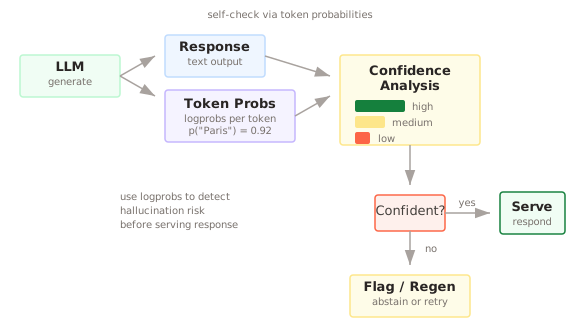
The self-check pattern exploits the fact that language models do expose their internal confidence, even if they do not express it in their text output. Most model APIs can return log probabilities (logprobs) for each generated token. These numbers tell you how likely the model considered each token before selecting it. A high probability means the model was fairly certain. A low probability means it was choosing among many plausible alternatives, which is exactly the situation where hallucinations tend to occur.
The simplest approach is to monitor logprobs on the tokens that matter most. In a structured output where the model produces key-value pairs, you often care about the values more than the keys. If the model generates "capital: Nairobi" with high confidence on "Nairobi" but generates "population: 4,397,073" with low confidence on the numeric tokens, that second fact deserves scrutiny. You can set a threshold and flag any claim where the relevant tokens fall below it.
A more robust method is to generate the same response multiple times (using a non-zero temperature) and compare the outputs. If the model produces consistent answers across five generations, it is likely drawing on well-represented training data. If each generation gives a different answer, the model is guessing. This consistency check does not require access to logprobs at all, which makes it work with APIs that do not expose them.
You can also compute perplexity over a generated sequence as a normalized confidence metric. Perplexity aggregates token-level probabilities into a single number that represents how "surprised" the model was by its own output. Lower perplexity means higher confidence. Sequences with unusually high perplexity relative to your application's baseline are candidates for human review or rejection.
For production systems, some teams train a lightweight classifier on top of token probability features. You collect examples of verified correct outputs and known hallucinations, extract their probability profiles, and train a small model to distinguish between them. This gives you a fast, automated hallucination detector tuned to your specific domain.
When should you use Self-Check?
Self-check is most valuable when your application generates factual claims that users might act on. If the model is writing creative fiction or brainstorming ideas, hallucination is a feature, not a bug. If the model is producing legal summaries, medical recommendations, or financial reports, you need confidence scoring.
This pattern also makes sense when you cannot verify outputs against a ground-truth database in real time. If you have a database to check against, do that instead. Self-check is for situations where the facts are too diverse, too nuanced, or too numerous for simple lookup validation.
It is worth implementing when you have the engineering capacity to handle flagged outputs gracefully. Self-check tells you something might be wrong. You still need a plan for what happens next. That might mean routing to a human reviewer, falling back to a retrieval-based answer, or simply telling the user that the system is not confident in this particular response.
Implementation
# Using OpenAI SDK for illustration — swap client for any provider
from openai import OpenAI

client = OpenAI()

def self_check(question: str, context: str = "") -> dict:
    """Generate a response, then verify it for accuracy."""
    # Step 1: Generate the initial response
    gen_messages = [{"role": "user", "content": question}]
    if context:
        gen_messages.insert(0, {"role": "system", "content": f"Answer based on this context:\n{context}"})

    response = client.chat.completions.create(
        model="gpt-4o", messages=gen_messages,
    )
    answer = response.choices[0].message.content

    # Step 2: Ask the model to verify its own claims
    verification = client.chat.completions.create(
        model="gpt-4o",
        messages=[{
            "role": "user",
            "content": f"""Review this answer for accuracy. List any claims that might be wrong or unverifiable.

Question: {question}
Answer: {answer}

Reply in this format:
VERDICT: PASS or FAIL
ISSUES: (list any problems, or "none")""",
        }],
    )
    check_result = verification.choices[0].message.content

    return {
        "answer": answer,
        "verification": check_result,
        "passed": "VERDICT: PASS" in check_result,
    }

# Usage
result = self_check("What year was Python first released?")
print(f"Answer: {result['answer']}")
print(f"Passed: {result['passed']}")
What are the common pitfalls?
Logprob thresholds are not universal. A probability that indicates high confidence on one topic might indicate low confidence on another. Rare but correct tokens (unusual proper nouns, technical terminology) will naturally have lower probabilities even when the model is right. You need domain-specific calibration, and that takes labeled data.
The multi-generation consistency check is expensive. Generating five responses instead of one multiplies your inference cost by five and your latency by roughly the same factor unless you can run generations in parallel. For high-throughput applications, this cost may be prohibitive for every request. A common compromise is to run consistency checks only on outputs that the logprob analysis flags as uncertain.
Self-check can create a false sense of security. High confidence does not guarantee correctness. Models can be confidently wrong, especially on topics that are well-represented in training data but where the training data itself contains errors. Self-check catches uncertainty. It does not catch confident mistakes.
There is also the risk of over-filtering. If your thresholds are too aggressive, you will flag correct outputs as potentially hallucinated, undermining user trust and reducing the utility of the system. Calibrating thresholds requires ongoing monitoring with real production data.
What are the trade-offs?
Cost increases with the sophistication of your self-check approach. Logprob monitoring is nearly free if the API already returns probabilities. Multi-generation consistency checks multiply your costs linearly. Training a custom classifier requires labeled data collection and model maintenance.
Latency is the other major cost. Any self-check that requires additional model calls adds time. For conversational applications where users expect sub-second responses, you may need to run checks asynchronously and surface confidence indicators after the initial response.
Self-check does not fix hallucination. It detects it, sometimes. You are adding a probabilistic detection layer on top of a probabilistic generation system. The combination is better than generation alone, but it is not a guarantee. Critical applications should combine self-check with retrieval-based grounding and human review for high-stakes outputs.
Goes Well With
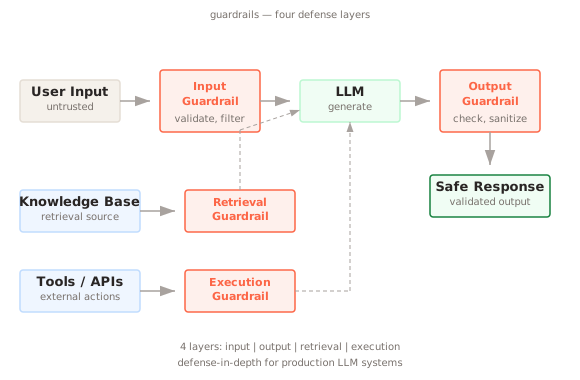
Guardrails provide the enforcement mechanism that self-check needs. Self-check identifies uncertain outputs. Guardrails in the output layer can act on that information, blocking, flagging, or modifying responses that fail confidence thresholds.
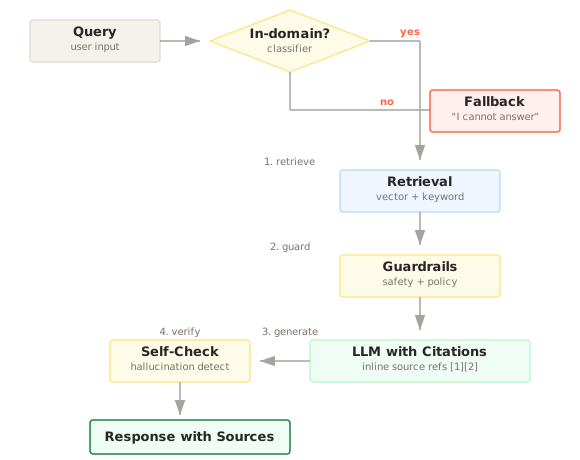
Grounded Generation complements self-check by requiring the model to cite its sources. Self-check tells you whether the model was confident. Source citation tells you where the information supposedly came from. Together, they give both quantitative and qualitative signals about output reliability.
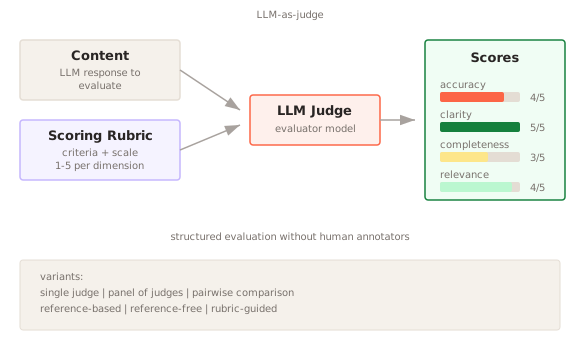
LLM-as-Judge extends self-check by using a separate model to evaluate the quality and accuracy of outputs. While self-check analyzes the generating model's own confidence signals, LLM-as-Judge provides an independent second opinion. The two approaches catch different categories of errors.
References
- Anthropic. (2024). Constitutional AI: Harmlessness from AI Feedback. arXiv preprint.