How do they differ?
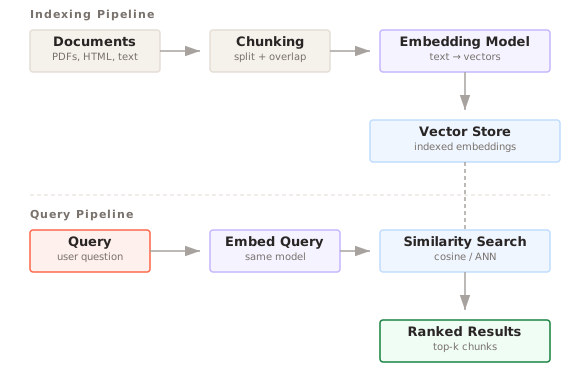
Semantic Indexing and Hybrid Retrieval operate at opposite ends of the retrieval pipeline. Semantic Indexing is about how you prepare and store your documents before any query arrives. Hybrid Retrieval is about how you formulate and execute queries against an existing index. One is a build-time concern. The other is a search-time concern.
Semantic Indexing takes your raw documents, chunks them, converts each chunk into a dense vector embedding, and stores those vectors in an index. The quality of this process determines the upper bound of your retrieval system. If a relevant passage is poorly chunked or its embedding does not capture the right semantics, no query strategy will find it. You are baking information into a fixed representation.
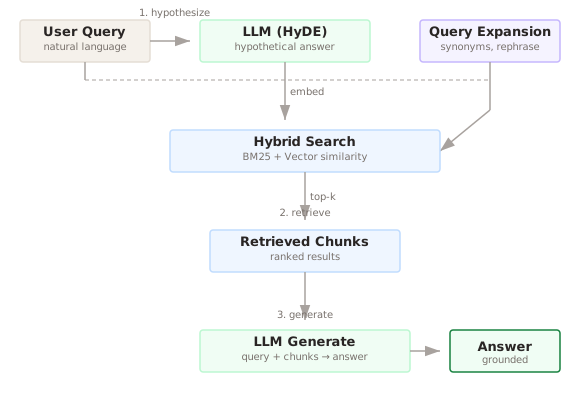
Hybrid Retrieval starts where Semantic Indexing ends. Given an index that already exists, it applies techniques to get better results from it. These techniques include HyDE (Hypothetical Document Embeddings), query expansion, query decomposition, hybrid search (combining dense vectors with sparse keyword matching), and re-ranking. The goal is to bridge the gap between what the user actually asked and what the index can surface.
The distinction matters because teams often pour effort into query optimization while their index is fundamentally broken. A bad chunking strategy or a weak embedding model cannot be fully compensated by clever query rewriting. Conversely, a perfect index queried naively still leaves precision on the table for ambiguous or complex questions.
| Dimension | Semantic Indexing | Hybrid Retrieval |
|---|---|---|
| Pipeline stage | Index time (build) | Query time (search) |
| Primary concern | Document representation quality | Query-document matching quality |
| Key techniques | Chunking strategies, embedding model selection, metadata enrichment | HyDE, query expansion, hybrid search, re-ranking |
| Latency impact | One-time cost at ingestion | Per-query cost at search time |
| Failure mode | Good queries return irrelevant results because the index is poor | Good documents are missed because the query is poorly formulated |
| Iteration speed | Slow. Re-indexing can take hours or days. | Fast. Query changes deploy instantly. |
| Dependency | Prerequisite for vector-based retrieval | Depends on an existing index to query against |
The relationship between them
These two patterns are not alternatives. They are layers. Semantic Indexing is a prerequisite for any vector-based retrieval system. You cannot do Hybrid Retrieval against a vector store that does not exist. The real question is how much effort to allocate to each layer.
Think of it like a database analogy. Semantic Indexing is your schema design and index creation. Hybrid Retrieval is your query optimizer. A well-designed schema with bad queries will underperform. But a bad schema cannot be rescued by clever queries. You need both, and you need the foundation to be solid before optimizing the queries.
In practice, teams that invest in better chunking strategies (overlapping windows, semantic boundary detection, parent-child chunk relationships) and better embedding models (domain-specific fine-tuned models, late-interaction models like ColBERT) see the biggest improvements in baseline retrieval quality. After that baseline is strong, query-time techniques like HyDE and re-ranking provide meaningful gains on the hard cases.
When to use Semantic Indexing
Focus your effort on Semantic Indexing when your retrieval system is new or when you are seeing systemic retrieval failures across many different query types.
You are building a new RAG system. Before worrying about query optimization, get the index right. Choose an embedding model that fits your domain. Experiment with chunking strategies. Add metadata that enables filtering. This foundation will determine how far you can go.
Your documents have complex structure. Technical manuals, legal contracts, codebases, and research papers need specialized chunking. A naive "split every 500 tokens" strategy will cut across section boundaries, mix unrelated content in the same chunk, and destroy context. Semantic boundary detection, hierarchical chunking, or document-aware splitting will dramatically improve results.
You are working in a specialized domain. General-purpose embedding models (OpenAI's text-embedding-3, Cohere's embed-v3) work well for common topics but struggle with domain-specific terminology. Medical, legal, financial, and scientific text benefits from fine-tuned or domain-adapted embedding models. The indexing step is where this matters.
Retrieval failures are consistent, not query-specific. If many different phrasings of a question all fail to find the right document, the problem is almost certainly in the index. The embedding for that document chunk is not close enough to any reasonable query vector.
You need to support multiple retrieval strategies. A well-designed index stores dense vectors, sparse representations (BM25), and structured metadata. This gives Hybrid Retrieval techniques the raw material they need. If your index only contains dense vectors, hybrid search is impossible.
When to use Hybrid Retrieval
Focus on query optimization when your index is solid but specific types of queries are underperforming.
Ambiguous or vague user queries. Users rarely write perfect search queries. "How does the thing work" is a real query that a real user will type. Query expansion rewrites this into multiple specific queries. HyDE generates a hypothetical answer and searches for documents similar to that answer. Both techniques help bridge the vocabulary gap between the user and the documents.
Multi-faceted questions. A question like "What are the cost and latency tradeoffs of using GPT-4 vs Claude for summarization?" touches multiple topics. Query decomposition breaks this into sub-queries (cost of GPT-4 for summarization, latency of GPT-4 for summarization, cost of Claude for summarization, latency of Claude for summarization) and retrieves documents for each. A single query would struggle to find all relevant passages.
Precision matters more than recall. Re-ranking is the workhorse technique here. Retrieve a broad set of candidates with vector search, then re-rank them with a cross-encoder model that scores each query-document pair individually. Cross-encoders are too expensive to run against every document, but they are highly accurate when run against a shortlist of 20 to 50 candidates.
Your users have diverse query styles. Some users write keyword-style queries. Others write natural language questions. Hybrid search (dense vectors plus BM25 keyword matching) handles both styles without requiring the user to adapt.
You cannot afford to re-index. Re-indexing a large corpus is expensive and slow. If your index is fixed or changes infrequently, query-time optimization is the only lever you have. This is common when the index is managed by a different team or when the corpus is massive.
Can they work together?
They should always work together. The layered architecture looks like this:
-
Semantic Indexing layer. Documents are chunked with semantic boundary detection. Each chunk gets a dense embedding from a domain-appropriate model. Metadata (source, section, date, entity tags) is stored alongside. A sparse index (BM25) is built in parallel.
-
Query understanding layer. The incoming query is analyzed. If it is ambiguous, query expansion generates alternative phrasings. If it is complex, query decomposition breaks it into sub-queries. If the domain is specialized, HyDE generates a hypothetical document to search against.
-
Retrieval layer. Hybrid search combines dense vector similarity and sparse keyword matching. Multiple sub-queries are executed in parallel. Results are merged and deduplicated.
-
Re-ranking layer. A cross-encoder or other re-ranking model scores each candidate against the original query. The top-k results are passed to the generation step.
Each layer addresses different failure modes. Semantic Indexing ensures that relevant documents are findable in principle. Query understanding ensures that the search captures the user's intent. Hybrid retrieval ensures that both semantic and lexical matches are considered. Re-ranking ensures that the final results are precisely ordered.
The teams that build the best retrieval systems iterate on both layers simultaneously. They monitor which queries fail, diagnose whether the failure is an indexing problem (the right chunk does not exist or is not close enough in vector space) or a query problem (the right chunk exists but the query did not surface it), and apply the appropriate fix.
Common mistakes
Skipping the indexing step entirely. Some teams use a default chunking strategy and a generic embedding model, then spend weeks tuning query parameters. This is working on the wrong layer. Spend a day experimenting with chunking strategies and embedding models first. The ROI is much higher.
Over-engineering queries for a broken index. If your chunking splits a table across two chunks, no amount of query rewriting will reassemble that table. Fix the chunking. This sounds obvious, but it happens constantly because query changes are easier to deploy than re-indexing.
Using HyDE without understanding the cost. HyDE adds an LLM call before every search query. For a chatbot handling thousands of queries per minute, this doubles the cost and adds latency. Use HyDE selectively, for queries that are detected as vague or short, not as a blanket strategy.
Ignoring metadata at index time. Metadata enables powerful filtering. If you know a query is about a specific product version or date range, metadata filters can eliminate irrelevant chunks before vector search even runs. But this only works if the metadata was captured during indexing.
Treating embeddings as permanent. Embedding models improve rapidly. An index built with text-embedding-ada-002 in 2023 will underperform one built with text-embedding-3-large in 2024. Budget for periodic re-indexing as better models become available.
Not measuring retrieval quality separately from generation quality. If your RAG system gives a bad answer, was it because retrieval failed (wrong chunks) or generation failed (right chunks, bad synthesis)? Evaluate retrieval and generation independently. This tells you whether to fix the index, the query, or the prompt.
References
- Gao, L. et al. (2022). "Precise Zero-Shot Dense Retrieval without Relevance Labels" (HyDE). arXiv:2212.10496.
- Khattab, O. and Zaharia, M. (2020). "ColBERT: Efficient and Effective Passage Search via Contextualized Late Interaction over BERT." arXiv:2004.12832.
- LlamaIndex documentation on node parsers and indexing strategies.
- LangChain documentation on retrievers and query transformations.
- Pinecone learning center on hybrid search architectures.