Semantic Indexing is a pattern that converts documents into dense vector embeddings so retrieval can match on meaning rather than keywords. By encoding chunks into a shared embedding space with the query, it finds conceptually relevant passages even when they use completely different terminology.
What problem does Semantic Indexing solve?
Traditional keyword search works by matching the exact terms in a query against the exact terms in your documents. This breaks down in predictable ways. A user searching for "how to cancel my subscription" will not match a document titled "Account Termination Policy" unless both happen to share the same words. Synonyms, paraphrases, and conceptual similarity are invisible to keyword indexes.
The problem gets worse with multilingual content. A keyword index treats "Kontoloeschung" and "account deletion" as completely unrelated strings, even though they mean the same thing. It also fails on jargon mismatches, where end users describe problems in casual language while documentation uses precise technical terminology. Every time the user's mental model of how to describe something diverges from the document author's word choice, keyword search returns nothing useful.
You can patch this with synonym dictionaries and query expansion, but those are brittle. They require constant maintenance, they never cover all cases, and they scale poorly across domains. The underlying issue is that keyword search operates on surface-level string matching when what you actually need is matching by meaning.
How does Semantic Indexing work?
Embedding models convert text into dense numerical vectors, typically arrays of 384 to 1536 floating-point numbers. These vectors occupy a high-dimensional space where proximity corresponds to semantic similarity. Two pieces of text that mean roughly the same thing will end up near each other in this space, regardless of whether they share any words.
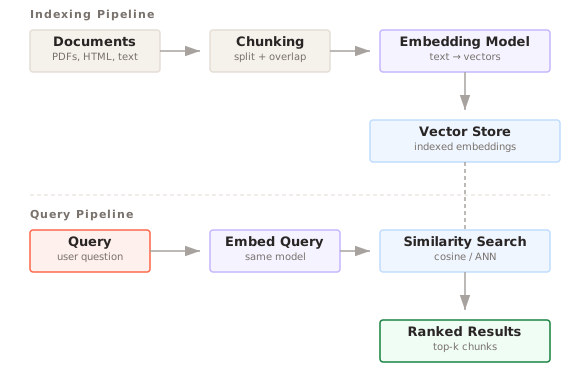
The indexing flow works like this: take each chunk from your document corpus and pass it through the embedding model. Store the resulting vector alongside the original text in a vector database. This is a one-time cost per chunk, though you need to re-embed when content changes.
The query flow mirrors this: take the user's question, pass it through the same embedding model to get a query vector, then find the nearest vectors in your index using a similarity metric like cosine distance. The chunks whose vectors are closest to the query vector are your retrieval results. This entire lookup is fast, typically single-digit milliseconds for databases with millions of vectors, because vector databases use approximate nearest neighbor algorithms optimized for this kind of search.
What makes this powerful is that the embedding model has learned, during its own training, that "cancel subscription" and "account termination" refer to similar concepts. The vectors it produces for these phrases will be close together. You get synonym handling, paraphrase handling, and even cross-lingual matching for free, without writing a single rule. The trade-off is that you are now dependent on the quality and biases of the embedding model itself.
When should you use Semantic Indexing?
Semantic indexing is the right choice when your users ask questions in natural language and your documents do not use the same vocabulary. This is nearly always the case for customer-facing search, where users describe their problems in their own words. It is also the right choice when your corpus spans multiple languages and you want a single unified search experience without maintaining separate indexes per language.
It is worth reaching for whenever keyword search is producing too many empty result sets or low-quality matches. If you find yourself constantly tweaking synonym dictionaries and boost rules, that is a signal that you have outgrown keyword matching. Semantic indexing will not solve every retrieval problem, but it removes the class of failures caused by vocabulary mismatch.
Implementation
What are the common pitfalls?
The most common mistake is using an embedding model that was not trained on text similar to your domain. General-purpose embedding models perform well on conversational text but may struggle with highly specialized content like legal contracts, medical literature, or source code. The vectors they produce for domain-specific jargon may not capture the relationships you need. Fine-tuning on domain data or choosing a domain-specific model helps, but adds complexity to the pipeline.
Dimensionality is a practical concern. Higher-dimensional embeddings (1536-d) capture more nuance but require more storage and compute for similarity search. Lower-dimensional embeddings (384-d) are cheaper but may conflate concepts that should remain distinct. Picking the right model and dimensionality involves testing on your actual queries, not trusting benchmark leaderboards.
Semantic drift is a subtler problem. Embedding models can place semantically unrelated texts near each other if they share surface-level patterns. A query about "Python exceptions" might retrieve chunks about snake species if the model is confused by the word "python." This is rare with good models but happens often enough that you should always inspect retrieval results during development. Relevance scoring thresholds and re-ranking can mitigate this.
Cold start is real. When you launch with a new embedding model and no user query logs, you have no way to validate that your vectors are actually capturing the right relationships for your use case. Building a small evaluation set of query-document pairs and measuring recall before going live is essential.
What are the trade-offs?
Semantic search is more expensive than keyword search at every layer. Embedding each chunk costs money (API calls or GPU time). Storing vectors costs more than storing inverted indexes. Query-time similarity search, while fast, still uses more compute than a BM25 lookup. For small corpora where keyword search works fine, the added cost and complexity of vector embeddings may not be justified.
Embedding model choice creates lock-in. If you index your entire corpus with model A and later want to switch to model B, you must re-embed everything. The vectors from different models are not compatible, they occupy different vector spaces with different semantics. This makes the initial model selection important and model migration expensive. Planning for re-indexing from the start (storing raw text alongside vectors, having a pipeline that can re-run) reduces the pain when you inevitably need to upgrade.
Goes Well With
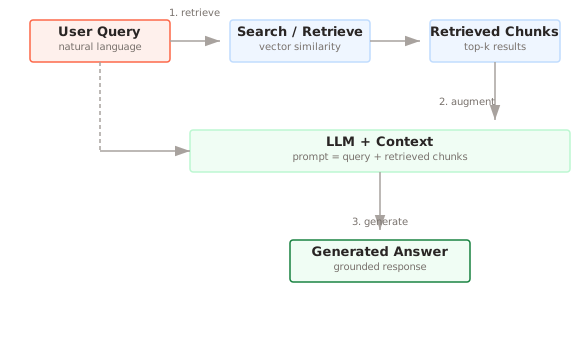
Basic RAG is the foundation that semantic indexing plugs into. The retrieval step in RAG can use any search backend, and swapping keyword search for vector search is the single highest-impact upgrade you can make to a RAG pipeline. It directly improves the quality of retrieved context without changing anything about the generation step.
Hybrid Search combines vector similarity with keyword matching (typically BM25) and merges the results. This catches cases where exact keyword matches are important (product IDs, error codes, proper nouns) while still benefiting from semantic understanding for natural language queries. Most production search systems end up here rather than using pure vector search alone.
References
- Karpukhin, V., et al. (2020). Dense Passage Retrieval for Open-Domain Question Answering. EMNLP 2020.
- Reimers, N., & Gurevych, I. (2019). Sentence-BERT: Sentence Embeddings using Siamese BERT-Networks. EMNLP 2019.