How do they differ?
When engineers need to make LLM inference cheaper or faster, they reach for one of two levers. The first lever is the model itself: use a smaller, more efficient model that requires fewer resources per inference. The second lever is the infrastructure: optimize how you run the model so that each unit of hardware processes more requests.
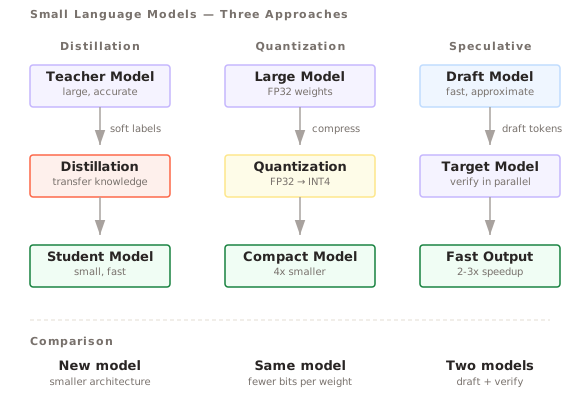
Small Language Models (SLMs) attack the numerator. You reduce the cost per request by using a model that needs fewer FLOPs, less memory, and fewer accelerator-seconds to generate each token. Techniques like distillation, quantization, and architecture-efficient training produce models that are 10x to 100x smaller than frontier models while retaining 80-95% of performance on specific tasks.
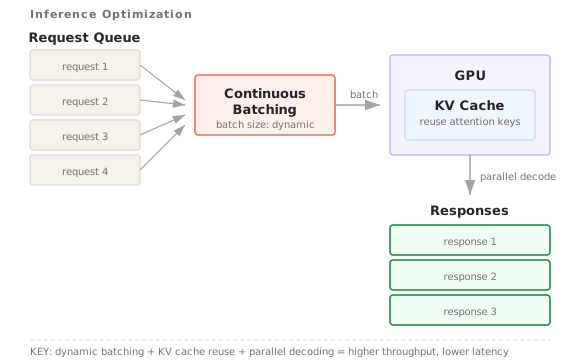
Inference Optimization attacks the denominator. You increase the throughput of your serving infrastructure so that each GPU processes more requests per second. Techniques like continuous batching, KV-cache optimization, speculative decoding, and tensor parallelism make the hardware work harder, regardless of which model you are running.
| Dimension | Small Language Models | Inference Optimization |
|---|---|---|
| What changes | The model (fewer parameters, lower precision) | The serving infrastructure (batching, caching, parallelism) |
| Cost reduction | Reduces per-request compute | Increases requests per hardware unit |
| Quality impact | Some quality loss (task-dependent) | No quality impact (same model, same outputs) |
| Effort type | Training/fine-tuning (one-time, then amortized) | Infrastructure engineering (ongoing tuning) |
| Portability | Model works on any serving stack | Optimizations are often framework-specific |
| Scaling behavior | Linear cost reduction | Sub-linear improvement at high concurrency |
| Risk | Task-specific regressions | Implementation complexity, debugging difficulty |
| Time to value | Weeks (distillation, evaluation) | Days (configuration, deployment) |
The distinction is clean: SLMs change what you run, inference optimization changes how you run it. They operate on different axes, which is why combining them is so effective.
When to use Small Language Models
Small Language Models are the right choice when you have a well-defined task, sufficient training data, and the cost of a frontier model is unsustainable at your scale.
High-volume, narrow tasks. Classification, extraction, summarization, routing, scoring. These tasks do not require the full reasoning capacity of a 400B parameter model. A distilled 1-8B model fine-tuned on your specific task can match or exceed the frontier model's performance on that task while costing a fraction per request. The narrower the task, the more effective the small model.
Edge and on-device deployment. Mobile apps, IoT devices, embedded systems, and air-gapped environments where you cannot make API calls to a cloud-hosted model. SLMs (especially quantized to 4-bit) can run on consumer hardware. A 3B parameter model quantized to Q4 fits in under 2GB of RAM and can run on a phone.
Latency-sensitive applications. Smaller models generate tokens faster because each forward pass requires less computation. If your application needs sub-100ms time-to-first-token or you are generating tokens in a real-time interactive loop (autocomplete, live translation, gaming), an SLM may be the only viable option.
Cost optimization at scale. If you are processing millions of requests per day, even a 5x cost reduction per request translates to substantial savings. A company processing 10 million summarization requests daily at $0.01 each ($100K/day) could reduce that to $20K/day with a well-distilled SLM that costs $0.002 per request.
Privacy and data sovereignty. When you cannot send data to a third-party API, you need to self-host. SLMs make self-hosting economically viable because they require fewer GPUs. A 7B model can be served on a single A100, while a 70B model needs at least two, and a 400B model needs an entire node.
Specialized domain models. Medical, legal, financial, and scientific domains where a general-purpose frontier model underperforms a fine-tuned specialist. A 7B model trained extensively on medical literature and clinical notes can outperform GPT-4 on medical question answering, at a fraction of the cost.
When to use Inference Optimization
Inference Optimization is the right choice when you want to get more out of your existing model and hardware without changing the model itself.
You need the quality of a large model. If your task requires the full reasoning capacity of a frontier model, and a smaller model does not cut it, your only option for cost reduction is to serve the large model more efficiently. Inference optimization squeezes more throughput from the same hardware.
Batch processing workloads. If you have thousands of requests that can be processed together, continuous batching and dynamic batching dramatically improve GPU utilization. A single A100 that processes 5 requests per second individually can often process 30-50 requests per second with proper batching, because the memory bandwidth bottleneck is amortized across the batch.
Multi-tenant serving. If you are serving multiple customers or multiple use cases from the same model deployment, inference optimization determines how many concurrent users you can support. Techniques like paged attention (vLLM), prefix caching, and KV-cache compression directly increase your concurrent capacity.
Long-context workloads. When inputs are 32K, 100K, or 200K tokens, the KV-cache becomes the dominant memory consumer. KV-cache quantization, paged attention, and attention pattern optimization (like sliding window attention at the serving layer) can reduce memory usage by 4-8x, allowing you to serve long-context requests that would otherwise OOM.
Speculative decoding for latency. If you need fast token generation from a large model, speculative decoding uses a small draft model to propose tokens that the large model verifies in parallel. This can increase generation speed 2-3x without any quality loss, because the large model still validates every token.
GPU fleet management. If you already have a fleet of GPUs running models, inference optimization is the fastest path to cost reduction. Upgrading from a naive serving setup to an optimized one (vLLM, TensorRT-LLM, or SGLang) often delivers a 3-5x throughput improvement with no model changes and no retraining.
Can they work together?
Absolutely, and the gains compound multiplicatively. This is not a theoretical claim. It is the standard architecture for cost-effective LLM serving at scale.
Consider a concrete example. You start with a 70B parameter model served naively. It costs $0.03 per request and handles 10 requests per second on your hardware.
Step 1: Distill to a 7B parameter model. Per-request cost drops to $0.005. Throughput on the same hardware increases to 40 requests per second. Some quality loss, but acceptable for your task.
Step 2: Quantize the 7B model to INT4. Per-request cost drops to $0.002. Throughput increases to 80 requests per second. Memory footprint drops from 14GB to 4GB.
Step 3: Apply inference optimization (continuous batching, KV-cache paging, CUDA graph compilation). Throughput increases to 200 requests per second.
The result: 15x cost reduction and 20x throughput improvement compared to the starting point. Neither approach alone would have achieved this. SLMs provided the base cost reduction. Inference optimization multiplied the throughput.
The combination is especially powerful for these scenarios:
Tiered serving architectures. Route simple requests to a highly optimized SLM (cheap, fast) and complex requests to an optimized large model (more expensive, but still efficient). Both tiers benefit from inference optimization independently.
Distillation with optimized teacher. During the distillation process, you need to run the teacher model on your training data to generate labels. Inference optimization on the teacher model makes the distillation process itself faster and cheaper, accelerating time-to-value for the SLM.
Edge plus cloud hybrid. Run a quantized SLM on device for low-latency, privacy-preserving inference. Fall back to a cloud-hosted, inference-optimized large model for tasks the SLM cannot handle. Inference optimization reduces the cloud cost. The SLM eliminates cloud calls entirely for simple tasks.
Common mistakes
Jumping to a small model before benchmarking the task. Not every task tolerates a smaller model. Before investing weeks in distillation, run a quick evaluation: test the frontier model, a mid-size model, and a small model on a representative sample of your task. If the small model already performs adequately, you can skip distillation entirely and just fine-tune. If it fails badly, you know how much distillation work you are signing up for.
Optimizing inference before profiling. Engineers sometimes apply optimizations blindly. They enable batching when their workload is entirely single-request. They quantize the KV-cache when memory is not the bottleneck. Profile first. Identify whether you are memory-bound, compute-bound, or bandwidth-bound. Then apply the optimization that addresses the actual bottleneck.
Quantizing too aggressively. INT8 quantization usually has negligible quality impact. INT4 has small but measurable impact. INT2 or sub-4-bit quantization often causes noticeable degradation, especially on reasoning-heavy tasks. Always evaluate quality at each quantization level. The savings from INT4 to INT2 are modest compared to FP16 to INT4, but the quality cost is disproportionately higher.
Ignoring evaluation after optimization. Both SLMs and quantized models can develop subtle failure modes that do not show up in aggregate benchmarks. They might handle common inputs well but fail on edge cases, rare languages, or unusual formatting. Run evaluation on your actual production distribution, not just academic benchmarks.
Not accounting for maintenance costs. A distilled SLM needs to be retrained when the underlying task changes or when new frontier models become available (you might want to re-distill from a better teacher). Inference optimization configurations need tuning when you change hardware, update frameworks, or modify model architectures. Both have ongoing costs.
Serving framework lock-in. Some inference optimizations are deeply tied to specific frameworks (TensorRT-LLM, vLLM, SGLang). This can make it painful to switch models or frameworks later. Prefer optimizations that are portable or that your framework handles automatically over hand-tuned CUDA kernels that only work with one specific setup.
References
- Kwon, W., et al. "Efficient Memory Management for Large Language Model Serving with PagedAttention." SOSP 2023.
- Leviathan, Y., et al. "Fast Inference from Transformers via Speculative Decoding." ICML 2023.
- Dettmers, T., et al. "QLoRA: Efficient Finetuning of Quantized Language Models." NeurIPS 2023.
- Hinton, G., Vinyals, O., Dean, J. "Distilling the Knowledge in a Neural Network." 2015.
- NVIDIA. "TensorRT-LLM: An Open-Source Library for Optimizing LLM Inference." 2024.
- Agrawal, A., et al. "Sarathi-Serve: Efficient LLM Inference with Pipeline Parallelism." 2024.