Retrieval Refinement is a pattern that refines retrieved chunks after the initial search but before they reach the LLM. Techniques include re-ranking by relevance, deduplicating near-identical passages, filtering by recency or metadata, and compressing context to fit token budgets.
What problem does Retrieval Refinement solve?
You run a vector search and get back your top ten chunks. The cosine similarity scores look reasonable. But when you feed them to the LLM, the generated answer is mediocre, sometimes outright wrong. You inspect the chunks manually and find that chunk number seven actually contains the answer while chunk number one, the highest-scored result, is only tangentially related.
This happens because vector similarity is a blunt instrument. It measures how close two embeddings are in a high-dimensional space. It does not measure whether a chunk actually answers the specific question being asked. A chunk about "database configuration best practices" will score highly against a query about "database connection timeout errors" because the topics overlap semantically. But that chunk might not contain anything about timeouts at all.
There are other failure modes too. Retrieved chunks might contain the right answer buried inside three paragraphs of irrelevant context. They might refer to an entity with the same name but in a completely different context. Think "Mercury" the planet versus "Mercury" the database. They might be technically correct but outdated, superseded by a newer document. Or they might be so generic that they add no value to the response. The retrieval step got you into the right neighborhood. But you are not at the right address yet.
How does Retrieval Refinement work?
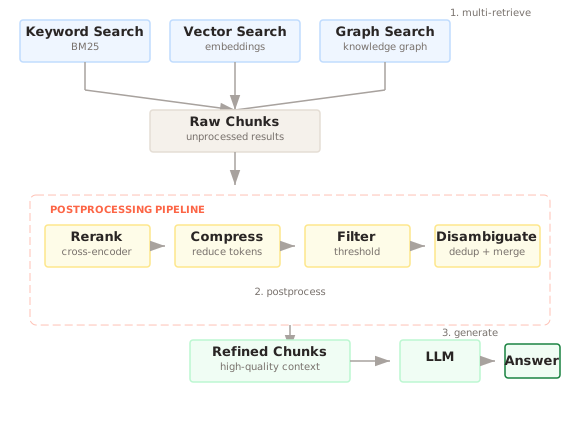
Node postprocessing is a processing stage that sits between retrieval and generation. It takes the raw retrieved chunks and transforms them into a refined set that is actually useful for the LLM. Think of it as a quality control checkpoint.
Reranking is the most impactful technique. You take your initial retrieved set, typically 20 to 50 chunks, and pass them through a cross-encoder model that scores each chunk against the original query. Unlike the embedding model used during retrieval, a cross-encoder sees the query and the chunk together and can make fine-grained relevance judgments. It can distinguish between "this chunk is about the same topic" and "this chunk directly answers this question." After reranking, you take the top-k results from the reranked list, typically 3 to 5 chunks. The improvement is often dramatic. Documents that were buried at position 15 in the original ranking jump to position 1.
Contextual compression addresses the problem of chunks that contain the answer alongside a lot of noise. Instead of passing the entire chunk to the LLM, you use a smaller model to extract only the sentences or passages that are relevant to the query. A 500-token chunk might get compressed down to 80 tokens of highly relevant content. This saves context window space and reduces the chance that the LLM latches onto irrelevant parts of the chunk.
Disambiguation handles the entity collision problem. When your knowledge base contains documents about multiple entities that share a name, retrieved chunks can mix them together. A postprocessing step can detect when chunks refer to different entities and filter out the ones that do not match the user's intent. This often requires looking at metadata like document source, category, or timestamp to resolve the ambiguity.
Metadata filtering applies hard constraints based on chunk metadata. You might filter by recency, keeping only documents updated in the last year. You might filter by source, preferring official documentation over community posts. You might filter by confidence score, dropping anything below a threshold. These filters are simple but they prevent entire categories of bad results from reaching the LLM.
These techniques compose well. A typical production pipeline retrieves a broad initial set, applies metadata filters to remove obviously irrelevant chunks, reranks the remainder, compresses the top results, and passes the compressed output to the LLM.
When should you use Retrieval Refinement?
If your retrieval accuracy is below 80% on your evaluation set and you have already tuned your embedding model and chunking strategy, postprocessing is the next lever to pull. Reranking alone often yields a 10 to 25 percentage point improvement in relevance metrics.
Use reranking when you can tolerate an additional 100 to 300 milliseconds of latency per query. Cross-encoder models are slower than bi-encoder retrieval but still fast enough for most interactive use cases.
Use contextual compression when your chunks are large, say 500 tokens or more, and you are concerned about context window usage or LLM distraction from irrelevant content.
Use metadata filtering when your knowledge base has clear freshness requirements, when documents have reliable source quality indicators, or when entity ambiguity is a known issue.
Skip postprocessing if your retrieval is already highly accurate, if latency requirements are extremely tight (under 200ms total), or if your knowledge base is small enough that retrieved chunks are almost always relevant.
What are the common pitfalls?
Reranking models have their own biases. They can prefer longer chunks over shorter ones, favor formal language over casual documentation, or struggle with domain-specific terminology they were not trained on. If you use a general-purpose reranker on a highly specialized corpus, the reranking might make things worse.
Contextual compression can accidentally remove important context. If a chunk says "unlike the previous approach, this method uses connection pooling," the compression step might extract "this method uses connection pooling" and drop the contrast with the previous approach. That lost context can change the meaning of the extracted passage.
Over-filtering is a real risk. If your metadata filters are too aggressive, you might filter out the only chunk that contains the answer. A strict recency filter will drop older documents that are still accurate. A strict source filter might exclude community-written content that happens to have the best explanation.
Stacking too many postprocessing steps creates a pipeline that is hard to debug. When the final answer is wrong, you need to trace back through compression, reranking, filtering, and retrieval to find where the relevant information was lost. Each step is a potential point of failure.
What are the trade-offs?
Reranking adds latency and requires hosting or calling an additional model. Cross-encoder models are more expensive to run than bi-encoder retrieval because they process the query-document pair together rather than using pre-computed embeddings. For high-throughput systems, this cost adds up.
Compression reduces the information available to the LLM. This is usually a good thing, but it means you are making an irreversible decision about what is relevant before the LLM sees the content. If the compression model gets it wrong, the LLM has no way to recover.
The overall engineering cost is moderate. Reranking is a well-understood pattern with good library support. Compression and disambiguation require more custom work. The testing and evaluation burden increases because you now need to measure quality at multiple pipeline stages, not just the final output.
The biggest trade-off is complexity versus quality. A simple retrieve-and-generate pipeline is easy to build, easy to debug, and easy to explain. Each postprocessing step makes the system smarter but harder to maintain. Add them incrementally and measure the impact of each one independently.
Goes Well With
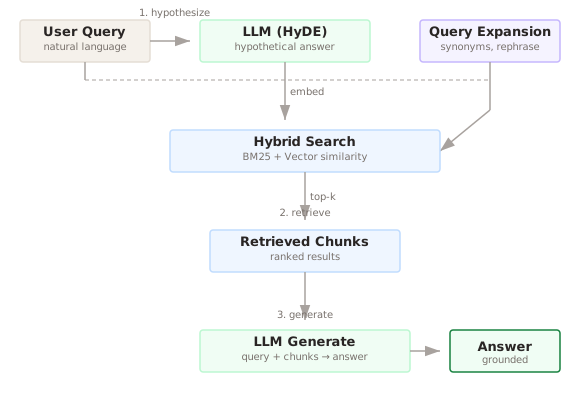
Hybrid Retrieval improves the initial retrieval step. Better input to postprocessing means better output. HyDE and query expansion feed higher-quality candidate sets into the reranking stage.
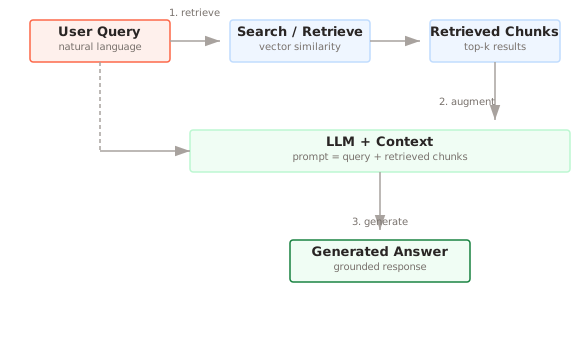
Basic RAG is the foundation pipeline that postprocessing extends. Understanding the baseline helps you identify exactly where postprocessing adds value and where it does not.
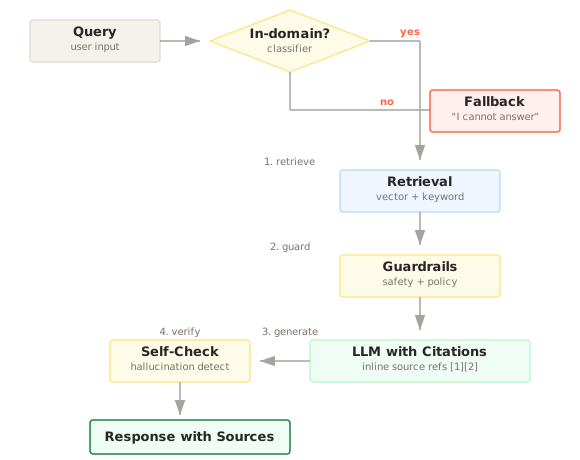
Grounded Generation builds on clean retrieval results. Accurate citations and hallucination detection work much better when the chunks reaching the LLM are actually relevant and well-compressed.
References
- Nogueira, R., & Cho, K. (2019). Passage Re-ranking with BERT. arXiv preprint.