Semantic Router is a pattern that classifies incoming queries by meaning and routes them to the appropriate handler, model, or pipeline. It uses embedding similarity to match queries against predefined route descriptions, enabling intent-based routing without keyword rules.
What problem does Semantic Router solve?
Applications that serve multiple purposes need to figure out what the user actually wants before they can respond. A customer service system might handle billing questions, technical support, account management, and sales inquiries. Each of these requires different data, different tools, and potentially different response strategies. Sending a billing question through the technical support pipeline wastes time and produces irrelevant answers.
The naive approach is keyword matching. If the message contains "invoice" or "charge," route to billing. If it contains "error" or "crash," route to technical support. This works for obvious cases but falls apart quickly. "Why was I charged for something that crashed" touches both billing and technical support. "I want to upgrade" could be a sales inquiry or a technical request depending on context. Natural language is messy, and keyword rules cannot capture the full range of how people express their intent.
You could use an LLM to classify every incoming message, and that works, but it is slow and expensive for a routing decision that needs to happen on every single request. Classification is the bottleneck of your entire system. If it takes 2 seconds, every request starts with a 2-second delay regardless of how fast the downstream handler is.
How does Semantic Router work?
Semantic routing uses embedding models to classify intent based on meaning rather than keywords. The core insight is that text with similar meaning produces similar embedding vectors, and you can measure that similarity cheaply and quickly.
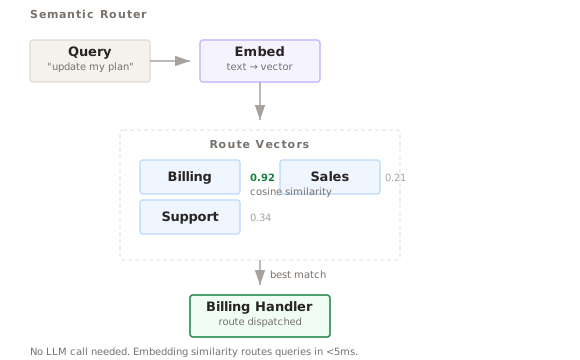
Here is how it works. You define a set of routes, where each route represents an intent category. For each route, you create a few example utterances that capture what a user might say when they have that intent. You compute the embedding vectors for all these example utterances and store them.
When a new user message arrives, you compute its embedding vector and compare it against all the stored route vectors using cosine similarity. The route with the highest similarity score wins. The message gets dispatched to the handler, tool, or agent pipeline associated with that route.
This approach is fast because embedding models are much cheaper and faster than generative models. A typical embedding computation takes single-digit milliseconds, compared to hundreds of milliseconds or seconds for an LLM classification call. At scale, this difference is substantial.
The quality of routing depends heavily on the example utterances you provide for each route. These utterances define the "semantic territory" of each route. If your billing route examples only cover invoice questions, a user asking about payment methods might not match well. Spend time crafting diverse examples that cover the range of ways users express each intent.
You can also use a hybrid approach. Define a confidence threshold for the semantic router. If the highest similarity score exceeds the threshold, route directly. If it falls below, escalate to an LLM for more careful classification. This gives you the speed of embeddings for clear-cut cases and the intelligence of an LLM for ambiguous ones.
When should you use Semantic Router?
Semantic routing works well when you have a known set of intent categories and need to classify incoming requests quickly and cheaply.
Good fit:
- Your application handles multiple distinct types of requests that require different processing paths
- You need sub-100ms routing decisions at scale
- The intent categories are relatively stable and well-defined
- You can provide 5 to 20 good example utterances per route
- Cost per request matters and you want to avoid an LLM call for every classification
Less ideal:
- Your intent categories overlap heavily and even humans would struggle to classify some messages
- You have hundreds of fine-grained intent categories (embedding similarity becomes less discriminative)
- The intent categories change frequently, requiring constant recomputation of route vectors
- The routing decision depends on conversation history, not just the current message
What are the common pitfalls?
Overlapping intent categories. If "billing support" and "account management" share a lot of semantic territory, the router will struggle to distinguish between them. Messages like "I need to update my payment information" could reasonably belong to either. When categories overlap, you get inconsistent routing that frustrates users. The fix is either to merge overlapping categories or to make the example utterances more distinctive.
Poor example utterances. If your examples are too narrow or too similar to each other, the route's semantic territory will be small and many valid user messages will not match well. If your examples are too broad or generic, different routes will overlap. Good examples are diverse in phrasing but consistent in intent.
Embedding model limitations. Not all embedding models handle all types of text equally well. Some perform poorly on short messages, others on domain-specific jargon. The embedding model you choose will have blind spots. Test with real user messages, not just the clean examples you crafted during development.
Missing intent categories. If a user's message does not match any route well, the router will still pick the closest one, which will be wrong. You need an "other" or "unknown" category with a confidence threshold below which the message gets sent to a fallback handler rather than forced into an ill-fitting route.
Static routes in a dynamic world. User behavior evolves. New product features create new intent categories. If your routes are defined once and never updated, the router gradually becomes less accurate. Build a review process that periodically checks routing accuracy against real traffic and updates routes as needed.
What are the trade-offs?
You gain very fast classification (milliseconds, not seconds), low cost per routing decision, and a system that understands meaning rather than just keywords.
You pay with the upfront effort of defining routes and crafting example utterances, the need to choose and potentially fine-tune an embedding model, and ongoing maintenance as your intent categories evolve.
Accuracy is good but not perfect. Semantic routing handles the clear-cut majority of requests well but will misclassify edge cases. If misrouting has serious consequences (sending a refund request to the sales team, for example), add a confidence threshold and human review for low-confidence classifications.
The approach does not handle multi-intent messages naturally. If a user says "I want to cancel my subscription and also need help with an error I am seeing," the message has two intents. The router will pick one. You either need to handle this at the application level or add a pre-processing step that splits multi-intent messages.
Embedding quality determines ceiling. You cannot do better than your embedding model allows. If the model does not distinguish well between your intent categories, no amount of example tuning will fix it. Test multiple embedding models early to find one that works well for your domain.
Goes Well With
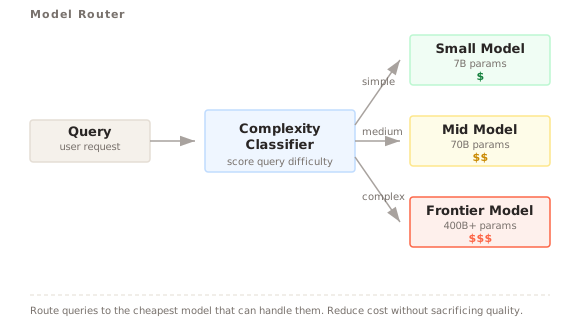
Model Router handles a complementary routing decision. Semantic routing determines what type of request this is. Model routing determines which model should handle it. In a well-architected system, you might first use a semantic router to determine intent, then use a model router to pick the appropriate model for that intent category.
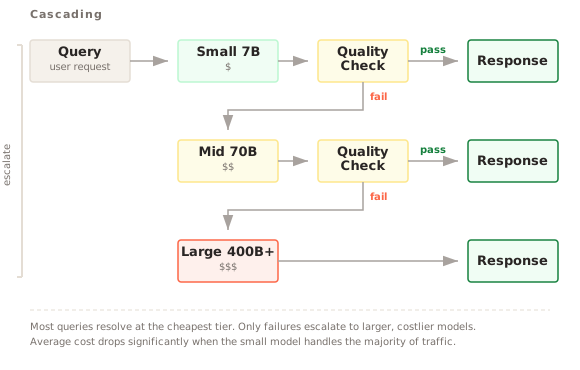
Cascading provides a fallback strategy for messages that the semantic router cannot classify confidently. Rather than forcing an uncertain classification, low-confidence messages can enter a cascade where progressively more capable (and expensive) classifiers attempt to determine intent.
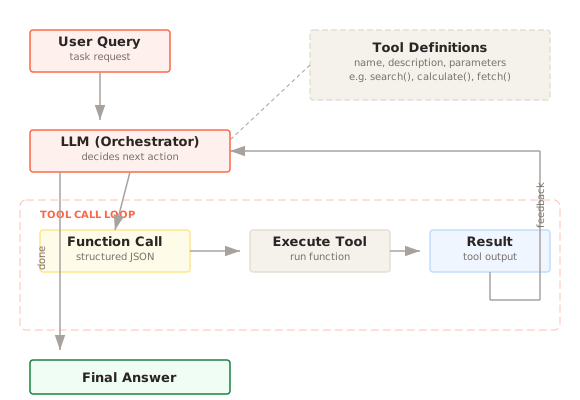
Tool Calling is often the destination of semantic routing. Each route maps to a specific tool or set of tools. The semantic router determines which tools are relevant, and the downstream agent uses tool calling to interact with them. This keeps the tool selection focused rather than presenting the agent with every tool and hoping it picks the right one.
References
- Anthropic. (2024). Constitutional AI: Harmlessness from AI Feedback. arXiv preprint.