How do they differ?
Guardrails and Self-Check address different failure modes of language model applications. Guardrails are external enforcement mechanisms that filter what goes into and comes out of the model. They check whether inputs and outputs comply with defined policies. Self-Check is an internal evaluation mechanism that analyzes the model's own output for reliability, catching hallucinations, low-confidence claims, and unsupported statements.
Think of Guardrails as a security checkpoint at the entrance and exit of a building. They check IDs, scan bags, and enforce rules. Self-Check is more like an internal audit department that reviews the work product for accuracy and flags anything that looks questionable.
The distinction matters because these patterns catch different kinds of problems. A guardrail will catch a prompt injection attempt, a request for harmful content, or an output that contains personally identifiable information. But it will not catch a confidently stated falsehood that technically complies with all policies. Self-Check will catch that hallucination, but it will not catch a cleverly crafted prompt injection that produces policy-compliant but manipulated output.
Production systems need both. Not one or the other.
| Dimension | Guardrails | Self-Check |
|---|---|---|
| Position | System boundary (input and output) | Post-generation (output analysis) |
| What it catches | Policy violations, prompt injection, PII, harmful content | Hallucinations, low-confidence claims, unsupported statements |
| Mechanism | Rule-based filters, classifier models, regex | Logprob analysis, self-consistency, fact verification |
| Latency impact | Low to moderate (runs in parallel or fast classifiers) | Moderate to high (requires additional LLM calls or analysis) |
| False positive rate | Tunable. Strict policies = more false positives. | Varies. Confidence thresholds need calibration. |
| Domain dependency | Policy definitions are domain-specific | Mostly domain-agnostic (confidence is universal) |
| Implementation | Frameworks: Guardrails AI, NeMo Guardrails, Llama Guard | Custom: logprob extraction, self-consistency checks, citation verification |
How Guardrails work
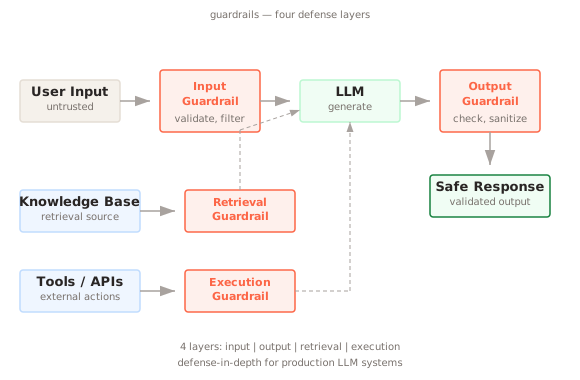
Guardrails operate as middleware in your LLM pipeline. They intercept requests and responses, evaluate them against a set of rules or classifiers, and either pass them through, modify them, or block them.
Input guardrails run before the model sees the user query. They check for:
- Prompt injection attempts (instructions disguised as user input that try to override system behavior)
- Jailbreak patterns (requests designed to bypass the model's safety training)
- Off-topic queries (requests outside the system's intended scope)
- Sensitive data in the input (credit card numbers, social security numbers, PII)
Output guardrails run after the model generates a response. They check for:
- PII leakage (the model accidentally including personal data from its training or context)
- Policy violations (content that violates your organization's guidelines)
- Format compliance (structured outputs matching expected schemas)
- Banned content categories (hate speech, illegal advice, competitor mentions)
The implementation ranges from simple regex patterns (catching credit card number formats) to specialized classifier models (Llama Guard for content safety, custom models for prompt injection detection) to full guardrail frameworks that chain multiple checks together.
The key design principle is that guardrails enforce rules that are defined externally to the model. The model does not need to know about the guardrails. They operate on the boundary between the model and the outside world, inspecting traffic in both directions.
How Self-Check works
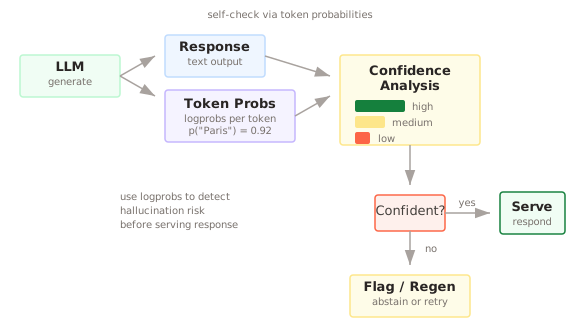
Self-Check analyzes the model's own output for signs of unreliability. The core idea is that if the model is uncertain or hallucinating, there are detectable signals in the output.
Logprob analysis. When the model generates tokens, each token has an associated probability (logprob). Low probabilities indicate uncertainty. A statement where key tokens have low logprobs is less likely to be correct than one where all tokens have high logprobs. You can flag or suppress claims where the average logprob falls below a threshold.
Self-consistency checking. Generate multiple responses to the same query (with temperature > 0). If the responses agree on a claim, it is more likely to be correct. If they disagree, the claim is uncertain. This is computationally expensive but effective for high-stakes applications.
Explicit self-evaluation. Ask the model to review its own output and rate its confidence in each claim. "For each factual statement in your response, rate your confidence from 1 to 5." This is surprisingly effective with strong models, though it should not be the only check.
Citation verification. If the model cites sources (in a RAG system, for example), verify that the cited passages actually support the claims. The model might generate a plausible citation that does not exist or misrepresent what a source says.
Claim decomposition. Break the response into individual claims and evaluate each one separately. A response might be mostly accurate with one hallucinated detail buried in the middle. Claim-level evaluation catches this.
Self-Check is fundamentally about epistemic humility. It asks "how confident should we be in this output?" rather than "does this output comply with our rules?" These are different questions with different implications for system design.
When to use Guardrails
Guardrails are non-negotiable for any LLM application that interacts with users or handles sensitive data. Here is where they matter most:
Customer-facing applications. Any chatbot, assistant, or content generation system that produces output visible to end users needs output guardrails. At minimum: PII filtering, content policy enforcement, and format validation.
Systems processing user input. Any system that accepts freeform text from users needs input guardrails. Prompt injection is a real and growing attack vector. Without input guardrails, a malicious user can manipulate your system into ignoring its instructions.
Regulated industries. Healthcare, finance, legal, and government applications have compliance requirements that translate directly into guardrail policies. "Never provide specific medical diagnoses" or "Always include required disclosures in financial advice" are policy rules that guardrails enforce.
Multi-tenant systems. When the same LLM serves multiple customers with different data, guardrails prevent cross-tenant data leakage. Output guardrails can check that the response only references data from the current tenant's context.
Content moderation. Applications that generate or process content need guardrails to prevent harmful, biased, or inappropriate outputs. This includes both explicit content policies and more nuanced tone and sensitivity guidelines.
API and integration boundaries. When your LLM system talks to external APIs or databases, guardrails on the output prevent malformed or dangerous operations. Validating that generated SQL is read-only, or that API calls are within allowed scopes, falls under guardrail territory.
When to use Self-Check
Self-Check matters most when factual accuracy is important and the cost of a wrong answer is high.
Knowledge-intensive applications. Any system that answers factual questions, whether from a knowledge base (RAG) or from the model's training data, benefits from confidence-aware output. If the model is uncertain about a fact, the system should say so rather than stating it confidently.
Medical, legal, and financial information. In high-stakes domains, a hallucinated fact can cause real harm. Self-Check provides a layer of defense that catches claims the model is not confident about, even when those claims look plausible and pass all policy guardrails.
Research and analysis tools. When users rely on the model's output for decision-making, they need to know which parts of the analysis are well-supported and which are speculative. Self-Check can annotate responses with confidence indicators.
RAG systems with imperfect retrieval. When the retrieved context might not contain the answer, the model sometimes fills in gaps with hallucinated information. Self-Check detects when the model is generating claims not supported by the retrieved documents.
Long-form content generation. In longer outputs, the model is more likely to introduce subtle inaccuracies. Self-Check at the claim level catches errors that would be invisible in a quick review of the full text.
Systems without human review. If the model's output goes directly to end users or downstream systems without a human in the loop, Self-Check acts as an automated reviewer. It does not replace human review for critical applications, but it catches the most egregious errors.
Can they work together?
They should work together. Treating Guardrails and Self-Check as complementary layers produces a much more robust system than either alone.
The architecture looks like this:
-
Input Guardrails. Filter the user query for prompt injection, off-topic requests, and sensitive data. Block or sanitize before the model sees it.
-
Model Generation. The model produces its response.
-
Self-Check. Analyze the response for hallucinations, low-confidence claims, and unsupported statements. Flag uncertain claims, add confidence annotations, or trigger a regeneration with more specific instructions.
-
Output Guardrails. Filter the final response for PII, policy violations, and format compliance. Ensure the response meets all external requirements.
This pipeline catches threats at every level. Input guardrails stop attacks before they reach the model. Self-Check catches internal reliability issues that the model itself is uncertain about. Output guardrails enforce external policies on the final output.
Some specific integration patterns:
Guardrails trigger Self-Check. If the output guardrail detects hedging language ("I think," "probably," "it might be"), it triggers a Self-Check pass to evaluate confidence more rigorously before deciding whether to include the uncertain claim.
Self-Check informs guardrail strictness. If Self-Check indicates overall low confidence in a response, the output guardrails can apply stricter filtering, adding disclaimers or requiring the response to explicitly state its limitations.
Shared infrastructure. Both patterns benefit from the same underlying classifiers. A content classifier trained for guardrails can also be used in Self-Check to evaluate whether generated claims fall within the system's domain of competence.
Common mistakes
Relying on guardrails alone for factual accuracy. Guardrails enforce policy compliance, not truth. A response can pass every guardrail check and still contain confidently stated falsehoods. If factual accuracy matters, you need Self-Check.
Relying on Self-Check alone for safety. Self-Check evaluates confidence and consistency, not policy. A harmful response that the model is very confident about will pass Self-Check with flying colors. Guardrails catch what Self-Check cannot.
Over-aggressive guardrails. Setting guardrail thresholds too tight leads to excessive blocking. If 20% of legitimate queries are blocked by input guardrails, users will find workarounds or abandon the system. Tune thresholds on real query distributions and monitor false positive rates.
Under-calibrated Self-Check thresholds. If you flag every claim with logprob below 0.9, you will flag half the output. If you only flag below 0.1, you will miss most hallucinations. Calibrate thresholds on labeled examples of correct and incorrect claims from your specific domain.
Not updating guardrail rules. Attack patterns evolve. New jailbreak techniques emerge regularly. Guardrail rules need periodic updates based on red-teaming results and observed attack patterns. Treat guardrails like security rules: they need maintenance.
Self-Check as a binary gate. Do not just accept or reject entire responses based on Self-Check. The more useful pattern is to annotate individual claims with confidence levels, suppress only the unreliable parts, or regenerate with more specific instructions targeting the uncertain areas.
Ignoring latency budgets. Both patterns add latency. Guardrails based on lightweight classifiers add tens of milliseconds. Self-Check based on multiple LLM calls can add seconds. Design your pipeline with latency budgets for each stage and choose implementation strategies that fit within those budgets.
No monitoring or alerting. Both patterns generate valuable signals. Guardrail block rates, Self-Check confidence distributions, escalation rates. If you do not monitor these signals, you are flying blind. Set up dashboards and alerts for anomalies (sudden spikes in blocked queries, drops in average confidence).
A layered safety architecture
For production systems, think of safety as layers, not a single check.
Layer 1: Input validation. Schema validation, length limits, encoding checks. Not LLM-specific, just good engineering.
Layer 2: Input guardrails. Prompt injection detection, content policy on input, off-topic filtering.
Layer 3: Model-level safety. The model's own safety training and system prompt instructions.
Layer 4: Self-Check. Confidence analysis, consistency checking, citation verification on the generated output.
Layer 5: Output guardrails. PII filtering, policy compliance, format validation on the final response.
Layer 6: Human review. For high-stakes decisions, a human reviews the flagged outputs. Self-Check confidence scores can prioritize which outputs need human attention.
No single layer catches everything. The combination provides defense in depth, the same principle that makes security architectures robust. Each layer catches what the others miss. Together, they make the system trustworthy enough for production use.
References
- Rebedea, T. et al. (2023). "NeMo Guardrails: A Toolkit for Controllable and Safe LLM Applications with Programmable Rails." arXiv:2310.10501.
- Inan, H. et al. (2023). "Llama Guard: LLM-based Input-Output Safeguard for Human-AI Conversations." arXiv:2312.06674.
- Kadavath, S. et al. (2022). "Language Models (Mostly) Know What They Know." arXiv:2207.05221.
- Manakul, P. et al. (2023). "SelfCheckGPT: Zero-Resource Black-Box Hallucination Detection for Generative Large Language Models." arXiv:2303.08896.